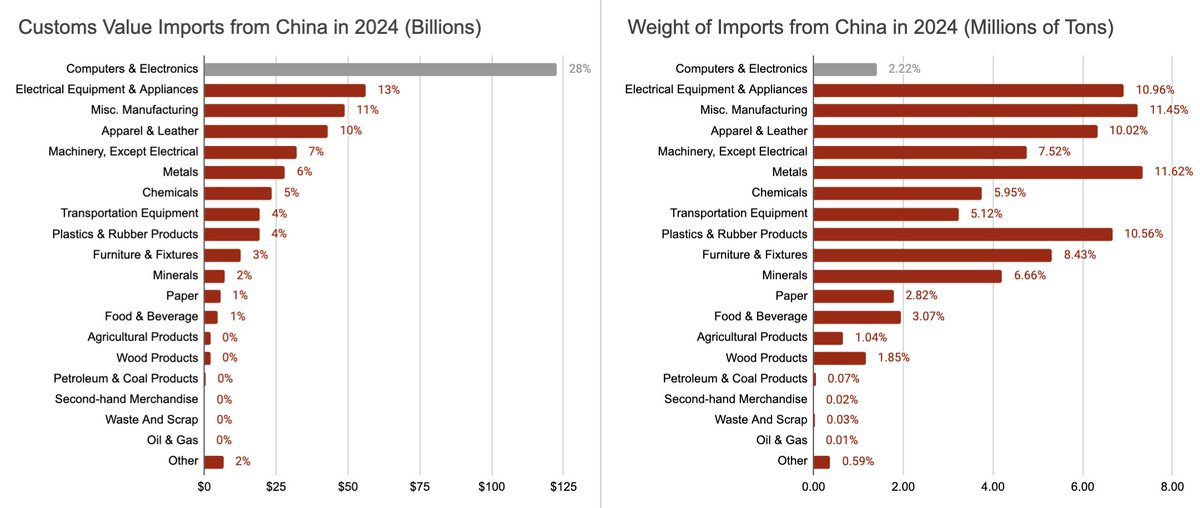
@FreightAlley The weakness in Cass is likely the result of low LTL volumes. When you consolidate several LTL shipments into TL shipment, you get a much lower overall shipment count, which is what Cass measures.
When measured in Dollars, the goods economy isn't as bad as it seems. Consumers are spending on high value/low volume goods like electronics and pharma, and less on freight generating sectors like food and bev and furtniture. For the Fed, it's not too bad because they measure output in dollars. For the freight market, it is.
Same story in manufacturing: the Fed's manufacturing index is flat y/y, but this is boosted by semiconductors/electronics. When we weigh by volume, it's about 5% lower y/y.
Bottom line: while the current low rates offer some relief for shippers, rates might not go lower, even with a recession.
For more insights on #tariffs and the #freight market, check out our latest Freight Economist Report:
https://t.co/4IGkSTTsV0
🧭 🚚 Navigating #Tariffs: How much can shippers save on #freight costs?
Over the past few weeks, I received a recurring question from shippers: "With sales softening, our finance teams are pushing hard for cost cuts. As a #recession looms, how much can we save on freight rates?"
While the desire for savings is understandable, my advice is not what everyone wants to hear: Don't bet on dramatic rate drops. Let's look at the data 🧵 1/4
Trucking Cost Per Revenue Mile:
Carriers are currently losing money on the spot market and barely breaking even on contract freight. This means contract rates have very little room to fall considering the already razor-thin margins. Spot loads can dip below operating costs in the short term, but only to cover variable costs for immediate survival. 🧵 3/4
Can a recession lower truckload rates? 🚚
Recession probability:
🚩 60% (J.P. Morgan Research)
⚠️ 45% (Goldman Sachs)
⚠️ 40% (Morgan Stanley)
However, trucking rates have already seen the worst: They dropped in 2022 and 2023 more than during the Great Financial Crisis!
Despite uncertainty, fundamentals suggest rates are unlikely to fall much further, even if we see a recession.
Q1 #GDP dipped (-0.3%) as a surge in #imports and pre-stocking took center stage. Imports, which count negatively towards GDP, dragged it down by a significant 5%, partially balanced by a 2.3% rise in private #inventories (also import-driven). Notably, Q1 saw slight dips in durable goods (-0.3%) and government spending (-0.3%).
Carriers added 9,600 #trucking jobs in March. I find this counter-seasonal and counter-cyclical. I shared my thoughts with @FreightWaves today:
“This uptick might represent a delayed hiring response following January’s temporary spot market tightening due to weather disruptions, which preceded an anticipated collapse similar to the previous year”.
Given recent negative sentiment and market softness, I expect this to reverse in the coming weeks.
@TimothyDooner Expect to see more of this unfortunately. Many unprofitable carriers have been hanging on waiting for the market to turn. This seems less likely now, so many will throw the towel.
Which commodities were hit the hardest in "Liberation Day" #tariffs?
(Note that some goods were excluded from tariffs like metals, lumber, semiconductors, and energy products).