A TEAM OF AI RESEARCHERS JUST OPEN-SOURCED THE BLOOMBERG TERMINAL FOR QUANT FINANCE.
A Bloomberg Terminal costs $25,000 per year per seat. Banks pay for thousands of them.
This thing reads every quant paper, every financial blog, every SEC filing, every arXiv preprint, and turns it into a searchable knowledge base. For free.
It's called QuantMind.
It just got accepted to the NeurIPS 2025 GenAI in Finance Workshop.
Here's what it actually does:
→ Ingests arXiv quant papers, financial news, blogs, and reports automatically
→ Parses PDFs, HTML, tables, and figures into structured knowledge
→ Tags every paper by research area and topic
→ Builds a semantic knowledge graph you can query in plain English
→ Plugs into DeepResearch, RAG, and MCP for multi-hop reasoning
→ Two-stage architecture: extract once, retrieve forever
Here's the wildest part:
The financial research industry publishes around 500 new papers and reports every single day.
Hedge funds pay six-figure salaries to junior analysts whose entire job is reading them.
QuantMind reads all of it. Tags it. Embeds it. Lets you ask it questions.
154 stars. 22 forks. 173 commits. MIT license. Python.
One honest note: this is a framework, not a magic alpha machine. You still need to know what to ask. But the "I haven't read that paper yet" excuse is officially dead.
The thing Wall Street charges $25,000 a year for is sitting on GitHub. Free.
Link in the comments.
Today I'm publishing a new essay, Policy on the AI Exponential. AI is progressing extremely fast—much faster than the policy process was built to handle. The essay lays out where I think the technology is now, and the action needed to close the gap: https://t.co/Lh6PWae178
AI is advancing at a pace our policymaking institutions were never built for—and the gap between the two is becoming the central challenge of the technology. In his latest essay, our CEO Dario Amodei lays out how to close it.
We're launching three new initiatives to support the efforts he outlines.
This is a super exciting release - Claude Fable 5 is the same underlying model as Mythos but with added safeguards. The benchmarks are great and it's SOTA on everything by a margin but I'll add that *qualitatively* also, this is a major-version-bump-deserving step change forward (imo of the same order as Claude 4.5 was in November), peaking especially for long problem-solving sessions on very difficult problems. You can give it a lot more ambitious tasks than what you're used to, the model "gets it" and it will just go, and it's never felt this tempting to stop looking at the code at all (but don't do this in prod!). The model still has quirks that people will run into and the safeguards are configured to be a little too trigger happy for launch, which can hopefully be tuned over time.
I feel a lot of things changing as working software increasingly comes out on a tap. The Jevon's paradox kicks in and I feel my own demand for software growing substantially. You can ask for anything - explainers, visualizers, dashboards, bespoke single-use apps (e.g. a full wandb that is hyper-specific just for your project), you can 10X your test suite, auto-optimize code, run giant research projects with custom HTML for the results, anything! "Free your mind" (Matrix ref). Really looking forward to all the things people build!
i'm obsessed with AI DIY projects.
my favorite one right now is this broccoli farmer in hokkaido, japan using Codex to run his 100-hectare farm
this guy never studied agriculture, never inherited land, started out as a civil servant.
but he wanted his farm to run better, and instead of paying an engineering firm he couldn't afford, he just built the tools himself.
here's what he's built on his own:
> remote control of his greenhouse vents from a chat app, wired up with an esp32 board, a motor driver, and cloudflare workers
> a bot that checks each greenhouse's temperature and opens the vents when it gets too hot
> satellite crop-health data laid over a map of his own fields
> an airtable base linking his plots, tasks, materials, and sensors
> wiring diagrams of his electrical panels, generated from a photo
stuff like this used to be locked behind machinery and engineers only the big agribusinesses could pay for.
but this legend just breezed past all of it with a laptop and Codex lol
been asking others at Anthropic how they stay in the loop with Claude and fully understand the work being done
this is one of my favorites from Suzanne:
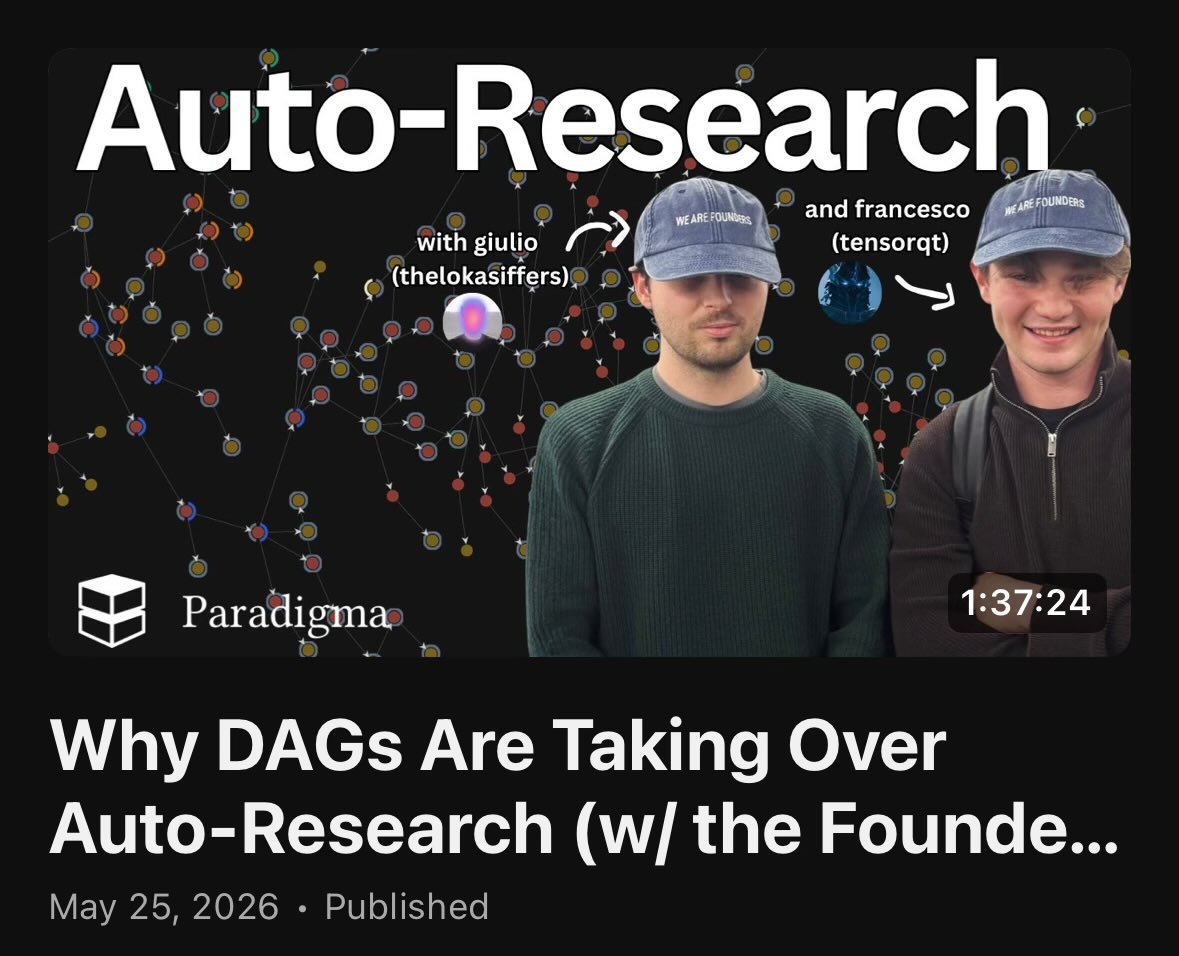
if you are interested in learning about the infra behind auto-research this 1h30min interview with the paradigma folks is for you
in it we look at:
- why dag are great research substrate
- how to let agents run that dag
- ways to make big public dag
- how to avoid bad bad dag
Your AI agent dies the second you close the terminal.
tmux fixes this...
Detach, walk away, come back hours later and it's still running like nothing happened
Watch this 25 video:
Folks: when you write skills, ask your agent to be token efficient, relax grammer. I see too many skills that write books in the skill description, and all that crap is loaded into every context.
I wrote a skill that finds the worst offenders. https://t.co/kfaaJpxMXE
diffshub[dot]com
Take any public diff from GitHub and virtualize it nearly instantly, no matter how large, with DiffsHub. Built to show off our brand new CodeView component.
To try it out, replace `github` with `diffshub` in your address bar.
Andrej Karpathy spent 4 minutes in an interview explaining a single idea
about how most people haven’t even started learning how to use AI
and everyone paying $20/month for a subscription.. that's not really using Claude at all
his point is that the real skill gap is the ability to build with AI
he identified 4 behaviors that break Claude Code and put them all into one file
a developer expanded it into 21 rules and published it - 82,000 stars and #1 on GitHub Trending
coding accuracy jumped from 65% to 94%
here's what these 21 rules actually are and why most developers using Claude every day have never configured them
the full breakdown is covered in the article below 👇
Personal update: I've joined Anthropic. I think the next few years at the frontier of LLMs will be especially formative. I am very excited to join the team here and get back to R&D. I remain deeply passionate about education and plan to resume my work on it in time.
New Anthropic research: Natural Language Autoencoders.
Models like Claude talk in words but think in numbers. The numbers—called activations—encode Claude’s thoughts, but not in a language we can read.
Here, we train Claude to translate its activations into human-readable text.