MSTR Reality Check
Emotions are running high!
People are getting manipulated by all of the engagement farming FUD and for some reason think Saylor and Strategy are on the brink of some death spiral.
As per usual, these people don't do math. They just post a red chart with a doomer sentence for clicks.
If I remember correctly, MSTR survived 2022. Actually, I don't have to remember, because I can buy the stock today.
Let us compare it to the absolute depth of the 2022 bear compared to today.
On November 21, 2022, Strategy had 130,000 BTC.
Their outstanding debt (senior claims) was equivalent to 146,735 Bitcoin.
Yes, the amount of Bitcoin that MSTR shareholders were economically exposed to was NEGATIVE. -16,735 Bitcoin.
The senior claims left zero residual for the common stock, and yet the stock never went to zero. On that same day, the stock closed at $15.72. The common equity bitcoin exposure NAV per share was -$2.33.
Today, they have 847,363 Bitcoin, with senior claims in Bitcoin at ~351,567 BTC.
Yes, in 2022 the common equity was exposed to -16,735 BTC and now it is exposed to 495,796 BTC.
2022 common equity sats/share: −14,786 sats/share
2026 common equity sats/share: 138,146 sats/share
2022 common equity NAV per share: -$2.33
2026 common equity NAV per share: +$81.69
Yes, right now the stock is trading at $87.64 vs the NAV per share of $81.69.
That means the true CEBE mNAV is 1.07x, a 7% premium to the residual left over after senior claims.
Strategy has a balance sheet built for war.
This is a cake walk compared to 2022.
Jordi Visser (@jvisserlabs) is buying AI stocks that win the next decade and most investors aren't ready.
We sat down to unpack why he's moving off the Mag 7, how to invest in AI bottlenecks, benchmark arbitrage, and how to lean into new technology to make more money.
Jordi combines decades of Wall Street experience with cutting edge AI research.
This is a must-listen conversation with one of the best in the industry.
Spotify: https://t.co/5yhRIhUC14
TIMESTAMPS:
0:00 - Your capex is my opportunity
3:06 - Entering the Physical AI Stage
5:12 - 5-Layer AI Economy
7:06 - Fading the Mag 7
8:52 - Benchmark Arbitrage
11:37 - Signal, Alpha, Agency
16:22 - The bubble argument that holds
17:43 - Selling Micron $MU
22:49 - Are bottleneck trades obvious?
24:19 - Parabolic asset prices
25:46 - Earnings risk
26:10 - Price vs. fundamentals rotation
28:32 - Risks to memory trade
30:44 - Silver bull thesis
31:43 - Marvell $MRVL
34:20 - Eli Lilly $LLY
37:39 - Government stake in AI
42:52 - Leaving Wall Street
47:39 - Career advice for the AI era
50:45 - Follow Jordi
Jensen Huang has been saying it for months.
AI's energy needs are going to break the grid, and nuclear is the answer.
3 stocks I have been watching are not getting the same attention as the usual nuclear names.
Here’s the list:
IMSR (Terrestrial Energy).
Building the Integral Molten Salt Reactor, a Generation IV SMR that produces electricity and high-temperature process heat. NRC just approved their key safety report. Also signed an MoU with Riot Platforms to co-locate plants with data centers for AI compute, up to 4 GW total. DOE agreements stacking up.
NUKX (Nicholas Nuclear Income ETF).
Actively managed, focused on nuclear industry stocks plus direct uranium exposure through US-listed uranium ETFs. Has an options overlay for income on top of the sector play. Launched in March. A clean way to get diversified exposure without picking single names.
XE (X-Energy).
Building the Xe-100, a pebble-bed high-temperature gas-cooled reactor. Each unit is around 80 MWe, with a four-pack plant putting out 320 MWe. Uses proprietary TRISO-X fuel (billiard ball-sized pebbles holding thousands of TRISO particles). Inherently safe, flexible for electricity or industrial heat. Just submitted for UK Generic Design Assessment.
Nuclear is starting to get real momentum.
At The Assembly, we track this stuff so you don’t have to.
But you need to follow us so you do not miss our alerts. This is extremely important.
A lot of people are going to wish they followed us sooner.
Capex/FCF -> Debt/Leverage
Most ROI analysis on AI has focused on Big Tech capex and FCF.
But as more companies approach zero or negative FCF, I think the focus needs to shift toward net debt and leverage.
Given the ROI we are seeing from AI investments, I suspect companies will not pause spending simply because FCF hits zero - which is already happening for some names. The real constraint is more likely to come when companies (first) move into net debt, and (then) when leverage reaches a level that is no longer sustainable.
The complication is that many Big Tech companies now have meaningful off-balance-sheet obligations - finance leases, operating leases, JVs, purchase commitments, and cloud/infrastructure commitments. These may not show up as debt today, but they will likely become a drag on FCF over time.
-------------------
$GOOGL
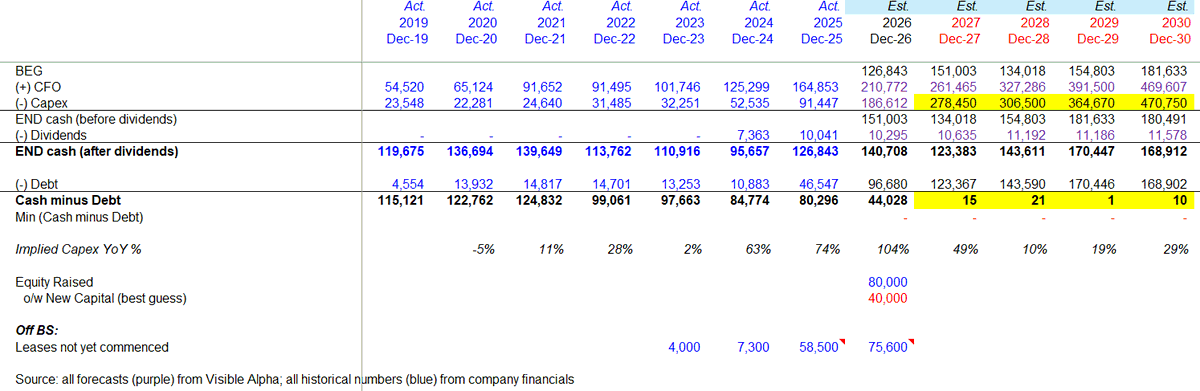
$GOOGL is relatively clean from an off-balance-sheet perspective, other than approximately $76B of leases not yet commenced.
Management has also said $Googl does not intend to move into a net debt position. Using consensus estimates from Visible Alpha and assuming $Google is willing to run down to roughly zero net cash, the implied maximum capex for FY27 would be approximately $280B, or roughly 50% YoY growth.
$GOOGL also has some buffers:
- ~$40B from the $80B equity raise (a $15B convert, $15B common equity, $10B private placement, and $40B ATM offering) (source: https://t.co/wAEEfPLeoo)
- ~$10B per year of dividends that could theoretically be adjusted.
-------------------
$META
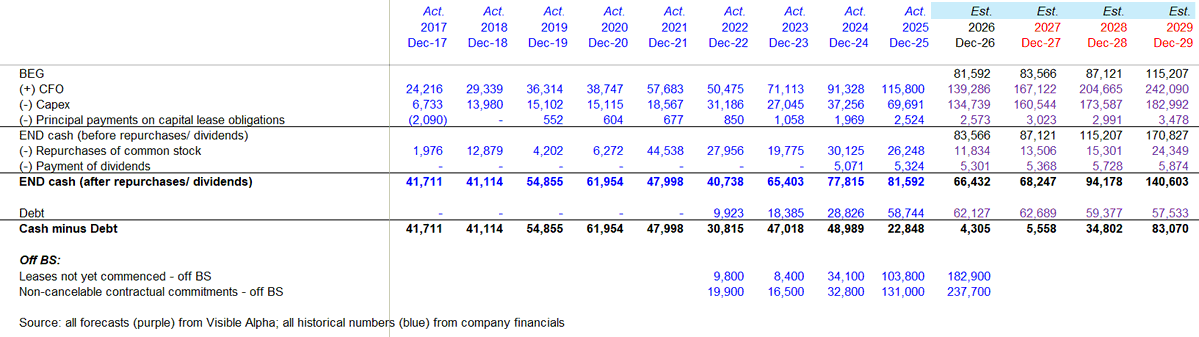
$META has much larger off-balance-sheet commitments.
The two biggest buckets are:
1. Leases not yet commenced - $183B off balance sheet as of 1Q26
2. Non-cancelable contractual commitments - $238B as of 1Q26
Importantly, $42.25B is due in 2026 and $47.65B is due in 2027.
$Meta also disclosed several additional items that are worth tracking separately:
- A contingent obligation to purchase up to $14.72B of cloud capacity over five years
- April 2026 infrastructure contracts that increased non-cancelable commitments by another ~$24B
- Unconsolidated VIE exposure of $46.0B maximum exposure to loss tied to venture economics
It is impossible to know the exact future FCF, cash, and debt impact from these off-balance-sheet items. But directionally, $Meta looks much more likely to move into a net debt position once we account for these obligations - especially given the $42.25B due in 2026 and $47.65B due in 2027.
-------------------
Bottom line
The AI capex debate should not stop at reported capex and FCF. For companies with large off-balance-sheet commitments, the better question is: what does the balance sheet look like once these obligations start flowing through cash? On that basis:
$GOOGL still looks relatively clean and has the most balance-sheet flexibility.
$META has the most meaningful off-balance-sheet risk and is likely to move into a net debt position.
$AMZN has large commitments and seems certain to move into net debt.
Net-net, I actually (weirdly) feel better after going through this exercise.
1/ These companies still have some cash buffers. Even after adjusting for off-balance-sheet commitments, most are not getting to an unsustainable leverage position in the near term.
2/ This analysis is based on consensus cash flow from operations. Actual CFO could come in higher if AI ROI starts showing up more meaningfully.
3/ Companies still have some flexibility - not a ton, but some - if they decide to slow or pause share repurchases and dividends.
So the conclusion is not that Big Tech is immediately constrained. The better question is: how far can they push AI infrastructure spending before the balance sheet, not the income statement, becomes the constraint?
+++
Full analysis: https://t.co/2ZzO8YJ9xy