Our department is hiring two positions this year. Please share widely and/or apply!
Geoeconomics (including but not limited to trade, political economy, IO, environmental, etc...): https://t.co/a4VuoaZHpL
Economics of Innovation and Technology: https://t.co/m0EhAOYs70
American science is increasingly cautious and bureaucratic.
Our institutions feel rickety.
At the same time, political and technological change is accelerating. The government is canceling research grants, AI is taking off.
Can our scientific institutions keep up? Should they be redesigned? Rebuilt?
To answer those questions and more, we’re relaunching Macroscience.
https://t.co/EbaZd1l3gu
Fortunately, we know more than ever about the structure of science.
Building from metascience evidence, scientists and policy entrepreneurs are experimenting with new models for funding and doing science. In the political and technological tumult, ideas are ready to be tested, opportunities are waiting to be seized.
Driven by writers who challenge assumptions and start friendly arguments, Macroscience will explore ideas for how to improve science and policy.
Macroscience will provide, I hope, an optimistic but plausible vision for the future of scientific progress.
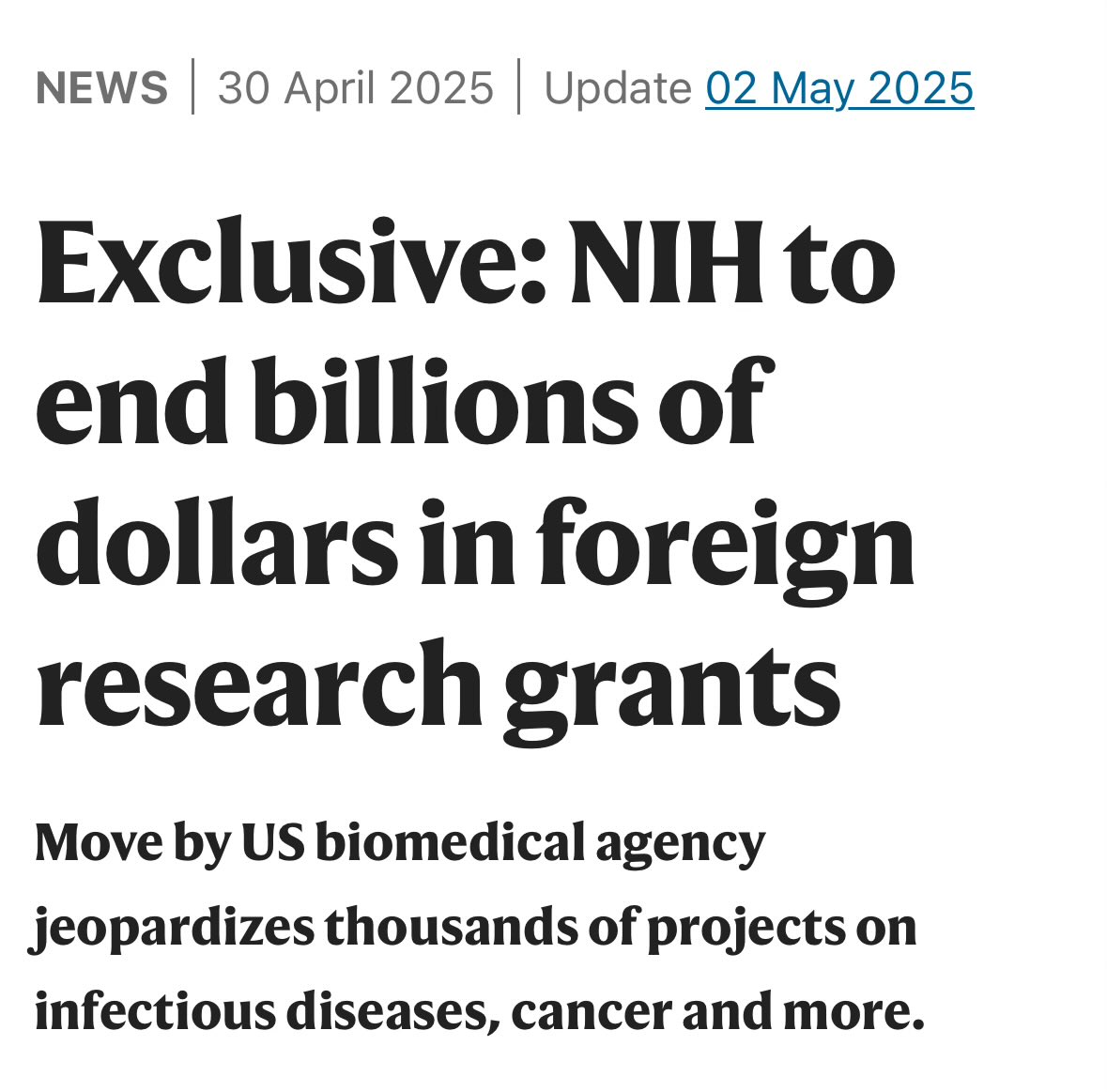
In light of the news that NIH is cutting support for lots of research abroad, posting @fry_cv and I’s recent piece arguing this kind of work has huge ROI, benefits the US, and is a small share of our R&D spend.
3/4 of R&D now happens outside the United States.
Despite the internet, advanced knowledge transfers is still a social function (person to person) to an astonishing degree.
Funding joint projects is one of the way America connects to that ¾. Foreign students are another. We are cutting vital links.
Changes to foreign aid and domestic science are making headlines — but changes to funding science in developing countries are getting far less attention. Our new post discusses why this matters for the U.S. and the world:
https://t.co/fZLx1k4SZh
Despite grim headlines, it's not time to give up on aid, writes @leecrawfurd.
Instead, he argues that we need to do a better job at showing how effective aid can be:
https://t.co/OKggTjDKL1
🪧#TIM Division Ideas Development Workshop, March 18th, 2025
📢 Open to early-career scholars in Low and Middle-income countries studying #TIM topics.
🗓️ Apply Before March 3rd, 2025
Applicaion Link: https://t.co/RP0qzT34mV
More info at: https://t.co/eJXDMBg6Mz
Please help us circulate the call for applicants to the second workshop for LMIC early career researchers - a fun interactive event with great mentoring and networking opportunities
🪧Call for Applications: #TIM Division Ideas Development Workshop.
90-min interactive session to boost your research and connect with senior scholars.
📢 Open to early-career scholars in Low and Middle-income countries studying #TIM topics.
More info: https://t.co/eJXDMBg6Mz
A thread on USAID, and why it’s a long way from over…
The wanton disruption of US assistance has been murderous. By now, kids will have died from malnutrition or one of the afflictions of camp life –perhaps dehydrating diarrhea.
USAID has been fighting disease, feeding children, and promoting goodwill around the world for six decades. As this article makes clear, dismantling this agency would be a profound foreign policy mistake - one that Congress should resist. https://t.co/MSsgZ82QbX
The freeze on foreign aid has put millions of lives at risk, & waivers for certain programs meant to protect the most vulnerable aren’t working.
@charlesjkenny explains that if @SecRubio wants to avert needless deaths, he must fix the waiver process now:
https://t.co/9eN7Kc3hte
We need USAID now more than ever, writes @MathiasenKV.
As 2025 presents a bleak outlook for countries that rely on USAID for bilateral aid, she argues that now is the time to act, not pause:
https://t.co/yaRIFxxHvj
I ran @USAID health programs for the last 3 years. Trump’s 90 day Stop Work Order on foreign assistance does serious damage to the world and the US. Examples:🧵
REMINDER: Apply for the 2025 Migration & Organizations Conference by February 14!
Submit a paper or express your interest in attending here: https://t.co/Vc6gd8hpa7
Apply for the doctoral consortium here: https://t.co/LLwFBZBawB
@abhishekn this happens, but at the same time we see that that outbound migration results in an increase in locally relevant research amongst non-migrants back at home in developing countries... implying more immigration -> more innovation *for* everyone https://t.co/ULtDpsCSDB