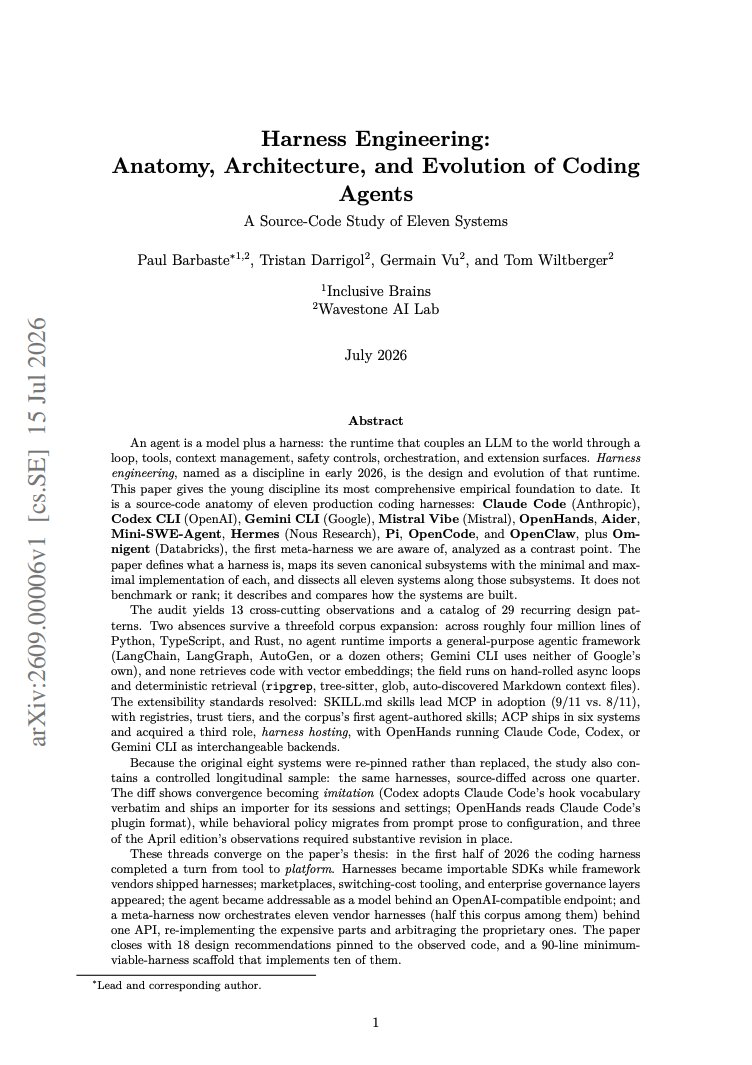
les dejo uno de los mejores papers que leí sobre Harness Engineering.
explica muy bien:
1) qué es un harness
2) cómo están construidos los coding agents actuales
3) qué patrones se repiten entre Claude Code, Codex, Gemini CLI, etc.
4) hacia dónde está evolucionando la categoría
5) qué recomiendan si querés construir uno
todo parte de una definición simple:
Agent = Model + Harness
como complemento, también pueden leer el artículo que escribí sobre el tema.
paper:
https://t.co/xTvb7MvzQG
An MIT professor writes one word on the board that turns every "impossible" derivative in first-year calculus into a two-step trick, and the class barely reacts.
The camera just watches. A dim lecture hall, chalk on a black board, a professor named David Jerison working through it with no showmanship. It's MIT 18.01, lecture four, single-variable calculus. The most standard course on the internet. Half a million people watched anyway.
Here's the wall students hit. Taking a derivative, the slope of a curve, is easy for simple things. But real functions come stacked inside each other. He writes y equals sine of t, all raised to the tenth power. A function tucked inside another function. Straight on, that's a nightmare. Nobody wants to expand sine to the tenth.
Then he does the quiet move. He gives the inside its own name. Let x equal sine of t. Now the whole thing is just y equals x to the tenth. Two clean, separate layers. He literally labels them on the board, "inside" and "outside." And the rule is almost insultingly simple: take the derivative of the outside, take the derivative of the inside, and multiply them together. The outside gives ten x to the ninth. The inside gives cosine of t. Multiply, put x back, and you're done. Ten times sine of t to the ninth, times cosine of t.
That's the chain rule. Peel a stacked function into layers, differentiate each layer on its own, multiply. It never fails, no matter how deep the nesting goes. One trick, and the whole zoo of monstrous functions becomes routine.
A problem that looked hopeless, "the slope of a function buried inside a function," quietly became "just name the inside and multiply." No music, no edit. Just chalk turning a wall into two easy steps.
The math is free and public. So is the lecture. What nobody can hand you in one video is the reflex to stop and rename the messy part before you attack it, to see the layers instead of the monster. That reflex is the real edge, and it's built over a semester of grinding problems, not one clip.
David Jerison, mathematician, from the lecture "MIT 18.01 Single Variable Calculus, Lecture 1: Derivatives":
"Everyone treats calculus as a list of formulas to memorize. It is one idea. You take the slope between two points on a curve, then slide those points together until the interval shrinks to nothing. That limit is the derivative, and the whole subject is consequences of it."
this video explains the exact mathematical move sitting underneath every rate, every optimization, and every model of change, and it's freely available.
at the board it's simple. Take a curve y equals f(x) and a point on it. Draw a line through that point and a second point a distance h away. Its slope is f(x+h) minus f(x), all over h. Now let h go to zero. The secant line becomes the tangent line, and that limit is f'(x), the derivative. Every rule you were forced to memorize, the power rule, product rule, chain rule, is just this one limit worked out carefully for a different shape. No magic, just one definition applied again and again.
Here's where it lines up with everything after. Velocity is the derivative of position. Marginal cost is the derivative of cost. The gradient that trains a neural network is this same slope in many dimensions. A subject that looks like a hundred disconnected tricks is really one operation, measure the change and shrink the interval, reused everywhere something moves.
the math is free and public, so is the lecture. what nobody can sell you is the patience to actually understand the one limit instead of memorizing the fifty formulas that fall out of it. That understanding is the foundation, and it's built in an hour, not from a formula sheet.
"Introduction to University Mathematics" is a collection of lecture notes from the University of Oxford designed to introduce the ideas, notation, and logical reasoning that students encounter when they begin studying mathematics at university.
The material covers many fundamental definitions, including natural numbers, sets, functions, relations, logic, cardinality, Cartesian products, equivalence relations, and injective and surjective functions.
I think it is a useful introductory reference for students who want to become familiar with the basic language of university mathematics before moving on to more advanced subjects. It does not replace a complete textbook, but it provides a simple overview of many concepts that appear throughout undergraduate mathematics.
https://t.co/Af35j3bEoo
@Lunaro_400 It is mathematically impossible to solve, it has 14 tiles you need to make seven pairs of tiles but the pattern only gives you five by one and three by three mazes which cannot make seven pairs