This is literally my new workflow now:
Realtime Research → Grok 4.5
Planning & Orchestration→ Fable 5
Day-to-day Coding/Debug → Grok 4.5
Write & Run Tests → Grok 4.5
Complex Coding/Debug → GPT-5.6 Sol
Frontend → Fable 5
Bookmark this
Kimi pausing new signups 3 days after launch is the most bullish signal you can get from an AI lab.
You know what happened last time a Chinese lab's servers melted from demand? DeepSeek R1. They shut down API top-ups for almost 3 weeks, and everyone called it dead.
Think about this though. The weights for this model go public on July 27, meaning the full model becomes downloadable, and anyone can host it themselves.
After that, Moonshot's server capacity is irrelevant. You'll run K3 through OpenRouter, Fireworks, whoever. The waitlist is a 1-week problem for a model that goes toe-to-toe with Fable in multiple benchmarks.
Is it annoying if you wanted to be in today? Sure. But "too popular to serve" is a very different problem than "nobody wants it."
Don't judge an open model by its launch week servers. Judge it when the weights drop.
Cybersecurity “experts” would not like it.
Kimi K3 fixed 15 critical bugs after OpenAI Codex and Claude Fable 5 refused.
10 hours, one prompt, and $250
The leading AI has already forked into two options.
A: Closed source American that costs $26-56 per 1MM tokens.
B: Open weight Chinese that costs $0.50-1 per 1MM tokens.
If you force American companies to spend 50-100x more than their competitors abroad here is what will happen:
1. American companies spending 50-100x will at some point become financially impaired and the stock market will crater. This is the equivalent of the US Government saying we can only buy oil at $800/barrel even when the free market sells the same oil for $80/barrel.
2. In the short term, the revenues of the Closed American Labs may remain hi. But then their revenue will also crater because their customers in the US will be impaired and their customers abroad will have already flipped to cheaper solutions.
This would be a terribly self-defeating form of intervention if it were to happen.
Chamath reveals his company's AI token costs are doubling every 45 days but productivity is only up 5%
"I sat down with my CTO today, I said how are we doing on token spend. And he said the most incredible thing, he said right now, our token costs are doubling every 45 days. I said well what is the downstream productivity? And he said maybe 5% max."
"So my costs are doubling every 45 days, my upside is essentially flat. He said honestly, what we're finding out is that you need to use a lot more tokens to get to this next iteration of improvement because we've effectively already asymptoted."
"We're going to take a step back and try to figure out what to do. I don't know how many other companies will actually go through this reckoning now, but the point is everybody in the next three or four years will for sure go through it."
"I suspect that if you can get out now, you should get out now before all of that starts to seep into the water table. Because I think that's probably what allows you to get out at a huge price and raise a huge amount of money."
TL;DR: Use a control plane, pick your model on a per task basis, do it massively cheaper as a result, keep your edge, don’t leak it to the frontier labs.
The thoughts below are exactly what we find in large enterprises that use 8090’s Software Factory control plane.
Our control plane is agnostic and sits above all the model chaos. You use it to manage your engineering team. It creates a more rigid conformation to the software development lifecycle so Owners and executives get well documented, governed, auditable software - not broken promises, vaporware pr large T&M bills. Engineers need to do a bit more work upfront but then are relieved of dealing with infinite slop in return.
For example, on a typical migration task of an enterprise workload (PHP—>next.js), when we chose Opus 4.8 inside our control plane, Software Factory gets to the right answer 1.5x faster and 1.4x cheaper than using Opus alone.
If an Enterprise asks our control plane to use an open weight model like GLM, instead, the costs fall even more dramatically. The migration is 16.4x cheaper but 3x slower but still works!
This brings up the obvious: at some near point in the future all large enterprises - ie those currently spending millions per month or more on tokens so they seem brilliant to a Wall Street analyst or their Board - will have to rationalize why the would spend so much more for inefficiency, poorer outcomes and data leakage to providers that increasingly also want to compete with them.
Bridgewater just published numbers that should make every frontier lab nervous.
The world's largest hedge fund tested Gemini, Claude, and GPT on six document filtering tasks its investors do every day. Naive prompts scored around 50%. A coin flip. Expert-written prompts pushed accuracy to 78%. Investors needed 80% before they'd trust the system in their workflow, and no frontier model cleared it. GPT 5.4 cost 43% more than 5.2 and was barely more accurate.
So they fine-tuned Qwen3-235B on Tinker instead. 84.7% accuracy. 29.8% fewer mistakes than the best frontier model. At 1/14th the inference cost.
The smartest part is buried in the middle of the paper. Their vendor-labeled training data was riddled with wrong labels, and expert labeling costs too much to run on everything. Their fix: train a model on the noisy dataset, then run it back over its own training data. Any example the model disagreed with got routed to senior investors, because either the example was genuinely hard or the label was wrong. The model's own confusion became a detector for bad labels.
Prompting hit a ceiling for a structural reason. A prompt captures only the judgment an expert can put into words. Twenty years of taste about which central bank memo actually signals a rate move doesn't compress into instructions. It transfers through labeled examples.
Every institution sitting on decades of expert decisions just learned that those archives can train a model that beats the frontier at their specific job. The alpha was in the filing cabinet the whole time.
Claude Tag is a Trojan horse. Not because Anthropic is doing anything evil. Because the incentives are obvious.
Day one, this looks like a great feature: tag Claude in Slack, let it follow the thread, remember context, connect to tools, break down tasks, chase work, and act like a teammate.
But that is exactly the problem. The moment your AI vendor becomes a shared coworker, it stops being just a model provider. It starts becoming the place where work is interpreted, remembered, routed, and eventually executed.
That is not model lock-in. That is context lock-in. You are now renting your company back from them.
Models can be swapped. Agents can be copied. But the memory of how your company actually works is much harder, maybe impossible, to move: the Slack scar tissue, the exception paths, the customer promises, the unfinished threads, the weird workflows, the implicit owners, the “we tried that in Q2 and it failed” knowledge.
Once that lives inside one vendor’s agent layer, you are not renting intelligence anymore. You are renting your company’s operating memory.
And the pricing model makes it even more dangerous. A human coworker has a salary. Claude has unbounded tokenized activity. The more work moves through it, the more the vendor captures not just IT spend, but labor spend.
This is the enterprise bargain people will regret: Convenience now, and rapid decent into dependency.
The right architecture is simple: rent the best intelligence from whoever is best this month. OpenAI, Anthropic, Gemini, open source, whatever. But own the context layer.
Your company memory should be inspectable, permissioned, portable, and model-neutral. It should not be buried inside the same vendor that sells you the intelligence and the workflow surface.
Claude Tag is useful. That is why it is dangerous. Rent the intelligence, but own the context. Or, regret later.
Tesla friends: my new interview with @larsmoravy & @woodhaus2 is here! It's all about the history & legacy of the Model S & X. The guys tell some really awesome stories from over the years (& give us a nugget of new Roadster news too). Timecodes and MP3 link below. Enjoy!
00:12:18 Interview Start
00:13:30 How the Decision to Discontinue S and X Happened
00:18:02 S and X Would Need a Complete Redesign to Continue
00:21:55 Next-Gen Roadster News
00:25:03 Signature Numbers
00:29:03 Final S and X Production Numbers
00:29:43 The Beginning of Model S
00:36:20 More Lightning
00:36:48 Old S and X Stories
00:39:26 First Drive of the Model S...Ever
00:45:14 The EV Market and EV Adoption Rate
00:49:36 Adding Dual Motors to Model S
00:51:36 A 3rd Motor in a Model 3?
00:54:37 About the Never-Made Model S Plaid+
00:56:58 Are 18650s done at Tesla?
00:58:10 Favorite Wheels
01:02:10 Pencils Down on S and X
01:03:22 Parting Message
01:05:07 Drive or Preserve their Signature S's
https://t.co/mznOOUILso
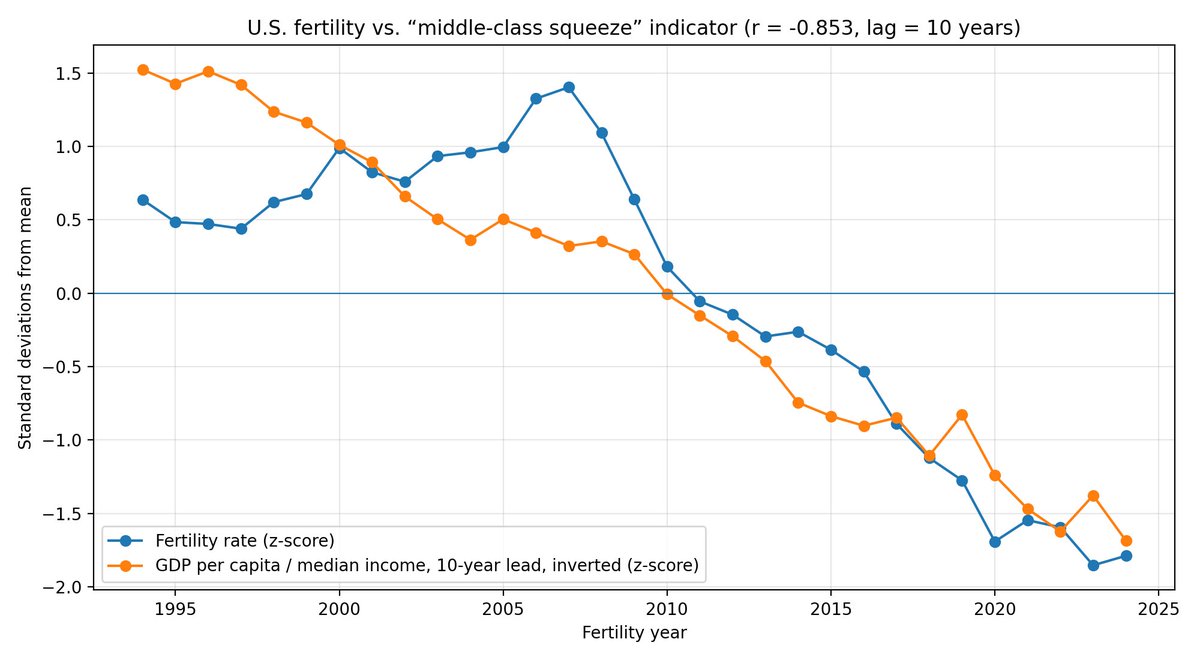
I took the first chart on fertility rate and then asked the following:
“Run a Monte Carlo simulation where you overlay various economic indicators on this chart of fertility. For example, GDP, GINI, cost of housing, middle class income growth etc. find the economic indicator that has the highest correlation to the chart provided. There may be a lag effect where the chart is the byproduct of some economic event so consider this lag in your correlation analysis.”
Result: the strongest match was not GDP, Gini, or housing alone. It was a derived “middle-class squeeze” indicator: real GDP per capita ÷ real median household income, with the indicator leading fertility by 10 years. The correlation was r = -0.853 over the 1994–2024 fertility window. Interpreted plainly: when output per person rose faster than median household income, fertility tended to be lower roughly a decade later.
Elon Musk avait dit un truc qui m'avait marqué sur l'allocation de ressources. En substance : passé un certain niveau de richesse, l'argent n'est plus de la consommation, c'est de l'allocation de capital.
Cette phrase change tout.
L'économie, dans le fond, c'est juste un problème d'allocation. Tu as des ressources finies et des usages infinis. Qui décide où va quoi ?
Imagine une cour de récré. 100 enfants, des paquets de cartes Pokémon distribués au hasard. Tu laisses faire. Très vite, un ordre émerge. Les bons joueurs accumulent les cartes rares, les collectionneurs trient, les négociateurs trouvent des deals. Personne n'a planifié. Et pourtant chaque carte finit dans les mains de celui qui en tire le plus de valeur. Le système maximise le bonheur total de la cour. C'est ça, la main invisible.
Maintenant fais entrer la maîtresse. Elle trouve ça injuste. Léo a 50 cartes, Tom en a 3. Elle confisque, redistribue, impose l'égalité. Trois effets immédiats. Les bons joueurs arrêtent de jouer, à quoi bon. Les mauvais n'ont plus de raison de progresser, ils auront leur part. Les échanges s'effondrent. La cour est égale, et morte. Elle a maximisé l'égalité, elle a détruit le bonheur.
Le problème de la maîtresse, c'est qu'elle ne peut pas avoir l'information que la cour avait collectivement. C'est le problème du calcul économique de Mises, formulé en 1920. L'URSS a essayé de le résoudre pendant 70 ans avec le Gosplan. Résultat : pénuries, queues, effondrement. Pas parce que les Soviétiques étaient bêtes, parce que le problème est mathématiquement insoluble en mode centralisé.
Quand Musk a 200 milliards, il ne les consomme pas, il les alloue. SpaceX, Starlink, Neuralink, xAI. Chaque dollar est un pari sur le futur. Et lui a un track record. PayPal, Tesla, SpaceX. Il a démontré qu'il sait identifier des problèmes immenses et y allouer des ressources avec un rendement spectaculaire.
L'État aussi a un track record. Hôpitaux qui s'effondrent, éducation qui décline, dette qui explose, services publics qui se dégradent malgré des budgets en hausse constante. Le marché identifie les bons allocateurs, la politique identifie les bons communicants.
Le profit n'est pas une finalité, c'est un signal. Il dit : tu as alloué des ressources rares vers un usage que les gens valorisent suffisamment pour payer. Plus le profit est gros, plus la création de valeur est grande. Quand Starlink est rentable, ça veut dire que des millions de gens dans des zones rurales ont enfin internet. Quand un ministère est en déficit, ça veut dire qu'il consomme plus qu'il ne produit. L'un crée, l'autre détruit, et on appelle ça redistribution.
Dans nos sociétés il y a deux catégories d'acteurs. Les entrepreneurs et les bureaucrates. L'entrepreneur prend un risque personnel pour identifier un problème, mobiliser des ressources, créer une solution. S'il se trompe il perd. S'il a raison, ses clients gagnent, ses employés gagnent, ses fournisseurs gagnent, l'État collecte des impôts. Il est la cellule de base du progrès humain.
Le bureaucrate ne prend aucun risque personnel. Son salaire est garanti. Au mieux il maintient une rente existante. Au pire il la détruit par excès de réglementation, mauvaise allocation forcée, incitations perverses qui découragent ceux qui produisent. Mais dans aucun cas il ne crée.
Regarde les 50 dernières années. iPhone, internet civil, SpaceX, Tesla, Google, Amazon, Stripe, mRNA, ChatGPT. Toutes des inventions privées, portées par des entrepreneurs, financées par du capital risque. Pas un seul ministère n'a inventé quoi que ce soit qui ait changé ta vie au quotidien.
La France est devenue le laboratoire mondial de la dérive bureaucratique. 57% du PIB en dépenses publiques, record absolu. Une administration tentaculaire, une fiscalité qui pénalise la création de richesse. Résultat : décrochage face aux États-Unis, à l'Allemagne, à la Suisse. Fuite des cerveaux. Désindustrialisation. Dette qui explose.
Et le pire c'est que la mauvaise allocation s'auto-renforce. Plus l'État prélève, moins les entrepreneurs créent. Moins ils créent, moins il y a de base fiscale. Plus l'État s'endette et taxe. Boucle de rétroaction négative parfaite. La maîtresse pense qu'elle aide, et chaque année la cour produit moins.
Dans nos sociétés, ce sont les entrepreneurs, toujours, qui font avancer la civilisation. Les bureaucrates au mieux maintiennent une rente, au pire la détruisent. Aucune société n'a jamais progressé en taxant ses créateurs pour subventionner ses gestionnaires.
La question n'est jamais qui a combien. C'est qui alloue le mieux la prochaine unité de ressource pour maximiser le futur de l'humanité. La réponse depuis 200 ans n'a jamais changé. Ce ne sont pas les fonctionnaires.
Mark Cuban on the next job wave.
Customized AI integration for small to mid-sized companies.
"Software is dead because everything's gonna be customized to your unique utilization. Who's gonna do it for them... And there are 33 mn companies in the US."
S&P 500 / M2 is repeating the dot-com fractal.
Not a coincidence. It's structure.
Dividing S&P 500 by M2 removes monetary noise and reveals the market in real liquidity terms.
The 2000 peak and the 2026 peak are nearly identical on this metric. Same extension. Same momentum. Same denial at the top.
The market didn't change. The narrative did.
In 1999 it was "the internet changes everything."
In 2026 it's "AI changes everything."
Both statements are true. The valuations are not.
The dot-com bubble didn't burst because the technology failed. It burst because expectations drifted too far from reality. Speculation assigned a weight that fundamentals couldn't support.
Same structure. Same behavior. Different story.
The chart projects a return to the 0.382 Fibonacci level as the first real support, a zone that aligned with the 2002~2003 lows in the previous structure.
Below that, 2009 marked the definitive bottom of the S&P 500 / M2 crash. Coincidentally, that's when Bitcoin was born.
Global liquidity will determine the speed. Not the direction.
The question is not whether this is a bubble. It's where in the cycle we are.
History doesn't repeat.
It rhymes.
People oddly assumed that I didn’t understand LiDAR, even though I oversaw the custom LiDAR development that Dragon uses to dock with the Space Station
The Jensen Huang episode.
0:00:00 – Is Nvidia’s biggest moat its grip on scarce supply chains?
0:16:25 – Will TPUs break Nvidia’s hold on AI compute?
0:41:06 – Why doesn’t Nvidia become a hyperscaler?
0:57:36 – Should we be selling AI chips to China?
1:35:06 – Why doesn’t Nvidia make multiple different chip architectures?
Look up Dwarkesh Podcast on YouTube, Apple Podcasts, Spotify, etc. Enjoy!
Alright, imagine a small town with 10 restaurants. Every restaurant employs local people - cooks, servers, dishwashers. Those employees eat out at each other's restaurants on their days off. The whole town's dining economy is basically a circle: restaurants pay workers, workers eat at restaurants.
Now a magical cooking robot arrives. It costs half what a human cook costs and never calls in sick. Restaurant owner Maria looks at the numbers. If she replaces her three cooks with robots, she saves a fortune on wages. Yes, those three fired cooks will stop eating out around town, but that lost spending gets spread across all 10 restaurants. Maria's place only loses a tenth of it. The savings massively outweigh her tiny slice of the demand hit. So she buys the robots.
Every other owner does the exact same calculation and reaches the exact same conclusion. They can all see what's coming. They even talk about it at the chamber of commerce meeting. "If we all do this, we'll have no customers left." Everyone nods gravely. Then they all go home and buy the robots anyway, because any single owner who holds back just eats the demand loss from everyone else's layoffs while also paying higher wages. You'd be the expensive restaurant in a town of unemployed people.
Six months later, the town is full of incredibly efficient robot-staffed restaurants with almost nobody coming through the doors. Every owner is making *less* money than before they automated. The workers are obviously worse off too. The surplus didn't transfer from workers to owners - it just evaporated.
Now the town council meets to figure out what to do.
Someone suggests giving everyone a basic stipend (UBI). That helps people eat, but it doesn't change the math any restaurant owner faces. The robots are still cheaper than humans, and the demand loss from firing one more worker still gets spread across 10 restaurants. Owners keep automating at the same rate.
Someone suggests taxing restaurant profits and redistributing the money. Same problem. You're taxing 30% of profits instead of 0%, but 70% of a higher number is still better than 100% of a lower number. The incentive to automate doesn't budge.
Someone suggests the owners just agree to limit automation. They shake hands on it. Then Maria thinks, "If the other nine stick to the deal but I quietly add one more robot, I pocket the savings and the demand hit is negligible." Everyone thinks this simultaneously. The deal falls apart by Tuesday.
Someone suggests giving workers ownership stakes in the restaurants. This helps - workers who own shares spend their dividends at other restaurants, recycling some money back. But it can't fully close the gap because workers only spend a fraction of their dividends on dining out. Some leaks away to rent and groceries and everything else.
Finally, the town accountant proposes something different: a per-robot tax set exactly equal to the demand damage each robot imposes on the *other nine restaurants*. Now when Maria considers adding one more robot, the tax forces her to pay for the full demand destruction, not just her one-tenth share. The math flips. She only automates up to the point where it's genuinely efficient for the whole town.
And here's the elegant part - the tax revenue funds retraining programs that help fired cooks become, say, robot maintenance technicians who earn comparable wages. As those retrained workers start spending in town again, the demand problem shrinks, which means the tax can shrink too. Eventually, if retraining works well enough, the tax approaches zero on its own.
That's the whole paper. The trap is that every owner's individually rational decision is collectively suicidal, and most of the obvious policy fixes operate on the wrong part of the equation.
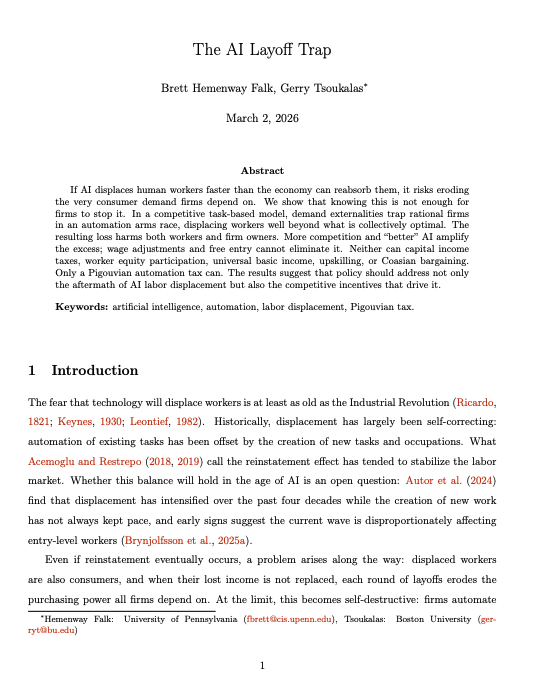
🚨RESEARCHERS JUST MATHEMATICALLY PROVED THAT AI LAYOFFS WILL DESTROY THE ECONOMY.. AND EVERY CEO ALREADY KNOWS IT.. BUT NONE OF THEM CAN STOP..
Two researchers from UPenn and Boston University just published a paper called "The AI Layoff Trap"..
They proved something terrifying..
Every company replacing workers with AI is also firing its own customers.. Every laid-off employee is someone who used to spend money.. When enough people lose their jobs.. Nobody can afford to buy anything.. And the companies that fired everyone go bankrupt selling products to an economy with no purchasing power..
Every CEO can see this coming.. The math is obvious.. Fire workers.. Lose customers.. Lose revenue.. Collapse..
But here's the trap..
No company can afford to stop..
If you don't automate.. Your competitor will.. They cut costs.. Undercut your prices.. Steal your market share.. And you die anyway..
So every company automates.. Knowing it's collectively suicidal.. Because the alternative is dying alone while everyone else survives..
It's a Prisoner's Dilemma.. And the researchers proved it mathematically..
The numbers are already stacking up..
Block cut nearly half its 10,000 employees this year.. CEO Jack Dorsey said AI made those roles unnecessary and that "within the next year, the majority of companies will reach the same conclusion"..
Salesforce replaced 4,000 customer support agents with AI..
Goldman Sachs deployed an AI coder that lets one senior engineer do the work of a five-person team..
Over 100,000 tech workers were laid off in 2025 alone.. AI was cited as the primary driver in more than half the cases..
80% of US workers hold jobs with tasks susceptible to AI automation..
And here's what should scare policymakers..
The researchers tested every proposed solution..
Universal Basic Income.. Doesn't fix it.. It raises living standards but doesn't change a single company's incentive to automate..
Capital income taxes.. Don't fix it.. They change profit levels but not the per-task decision to replace a human..
Worker equity and profit sharing.. Narrows the gap but can't close it..
Collective bargaining.. Can't fix it.. Because automating is a dominant strategy.. No voluntary agreement between companies is self-enforcing..
Only one thing works.. A Pigouvian automation tax.. A per-task charge that forces every company to pay for the demand it destroys when it fires a worker..
The researchers call it a "Red Queen effect".. Better AI doesn't solve the problem.. It makes it worse.. Because every company sees a bigger market share gain from automating faster than rivals.. But at the end.. Everyone automates equally.. The gains cancel out.. And the only thing left is more destroyed demand..
The paper's conclusion is devastating..
This isn't a transfer from workers to company owners.. Both sides lose.. Workers lose their income.. Companies lose their customers.. It's a deadweight loss that harms everyone..
And no market force can break the cycle..
The AI layoff trap isn't a prediction.. It's already happening.. And the math says it won't stop on its own.