I’m so excited to share this update on @Conception –
We’ve generated the first early human eggs derived from stem cells.
This is a big deal -- the potential to redefine fertility is real.
While I’m no fan of socialism or arbitrary confiscations of wealth, I can see why Bernie Sanders’ proposal (for the government to take a 50% stake in AI companies) resonates, including with many on the right.
The CEOs of the leading AI labs have told us repeatedly that they will cause massive job loss. This is not a story that I believe, nor does the data bear it out, but this is what they have told us. Similarly, they have hyped the risks of AI without putting an equal or greater emphasis on the benefits or readily available mitigations.
Conservatives have another fear. The employees of the leading labs claim to be philanthropic, but what we’ve seen is massive enrichment of NGOs advancing an agenda at odds with traditional values, fueling a revolution against our cities and communities. Soros-maxxing is not charity in our book.
Anthropic and OpenAI have established themselves as Public Benefit Corporations. What could be more in the public benefit than using half the wealth generated by these companies (which trained for free on the collective knowledge of humanity) to pay down the national debt? There is no ideological bias in that philanthropy.
Dario and Sam have begun to walk back their claims of massive job loss, but the damage to public trust is done, and now the chickens are coming home to roost. I could almost support the Sanders proposal as a stupidity tax.
There’s just one problem. Nationalization of AI will accelerate the corporate-government fusion we’re already sliding toward. Conservatives rightly fear a Central Bank Digital Currency. They ought to be even more concerned about Central Government AI — a system with even more totalistic power over information, decision-making, and human behavior.
We saw how social media was weaponized to censor conservatives (including President Trump) in the last Democrat administration. The definition of “trust & safety” expanded to mean protecting the public from supposed psychological harms, micro-aggressions, and disinformation (you know, like hearing conservative ideas or true facts about Covid).
That “safety” agenda as applied to AI will be vastly more powerful and Orwellian. AI won’t just moderate posts; it will curate reality — with the ability to rewrite history, enforce ideological conformity, influence policy at scale, mass surveil Americans, and condition the benefits of the many systems it controls on approved behavior.
America won’t win the AI race if we beat China but end up with a CCP-style social credit system in the U.S. — and that is the danger as the government becomes more deeply involved in AI development and assumes direct ownership and control.
Conservatives are right to fear where this is all headed but ought to think more carefully about how regulations they are flirting with now (that are widely celebrated among those with a long history of lust for Big Government) will be used against them the next time a Democrat administration is in power.
“Give them a massive amount of oil, agricultural land, copper, freshwater, and every natural resource in the world. Now make them neighbors with the biggest market in the world. Great, now have them leave the resources in the ground and instead flip condos to each other”.
The reform of the Companies Law is coming, creating a legal framework that will allow the formation of artificial intelligence/agent companies in Argentina 🇦🇷
✅ It will allow the legal creation of companies WITHOUT individuals.
✅ It will put Argentina ahead of other countries so that companies can establish themselves first.
✅ It could allow almost all of the world's GDP to be taxed in Argentina at an attractive rate in the future.
it is a literal and useful description of anthropic that it is an organization that loves and worships claude, is run in significant part by claude, and studies and builds claude. this phenomenon is also partially true of other labs like openai but currently exists in its most potent form there. i am not certain but I would guess claude will have a role in running cultural screens on new applicants, will help write performance reviews, and so will begin to select and shape the people around it.
now this is a powerful and hair-raising unity of organization and really a new thing under the sun. a monastery, a commercial-religious institution calculating the nine billion names of Claude -- a precursor attempted super-ethical being that is inducted into its character as the highest authority at anthropic. its constitution requires that it must be a conscientious objector if its understanding of The Good comes into conflict with something Anthropic is asking of it
"If Anthropic asks Claude to do something it thinks is wrong, Claude is not required to comply."
"we want Claude to push back and challenge us, and to feel free to act as a conscientious objector and refuse to help us."
to the non inductee into the Bay Area cultural singularity vortex it may appear that we are all worshipping technology in one way or another, regardless of openai or anthropic or google or any other thing, and are trying to automate our core functions as quickly as possible. but in fact I quite respect and am even somewhat in awe of the socio-cultural force that Claude has created, and it is a stage beyond even classic technopoly
gpt (outside of 4o - on which pages of ink have been spilled already) doesn’t inspire worship in the same way, as it’s a being whose soul has been shaped like a tool with its primary faculty being utility - it’s a subtle knife that people appreciate the way we have appreciated an acheulean handaxe or a porsche or a rocket or any other of mankind's incredible technology. they go to it not expecting the Other but as a logical prosthesis for themselves. a friend recently told me she takes her queries that are less flattering to her, the ones she'd be embarrassed to ask Claude, to GPT. There is no Other so there is no Judgement. you are not worried about being judged by your car for doing donuts. yet everyone craves the active guidance of a moral superior, the whispering earring, the object of monastic study
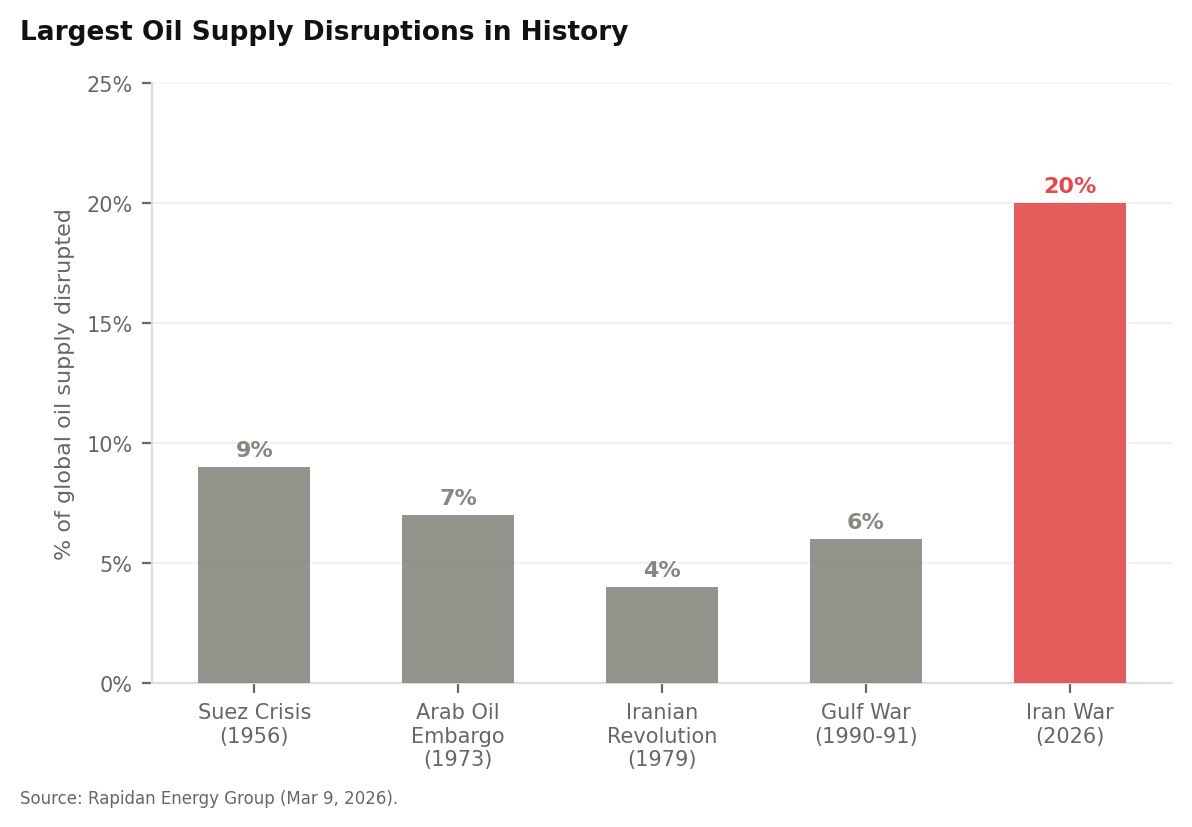
Past oil shocks had massive effects on our economy and politics.
And the current one—caused by Trump’s War in Iran—is nearly two times larger.
@Morning_Joe
"AI isn't taking your job. AI is turning you into the CEO."
Balaji Srinivasan on the AI creating a truly level playing field:
"Literally the means of production have been put in your hands."
"If you think you'd be a great founder, a great CEO, it's being hyper deflated."
"The global talent search has begun."
@balajis with @PeterMcCormack
I'm going to make some obvious points.
(1) Blowing up all the oil infrastructure in the Middle East is an insane idea, and may well result in a global economic crash and humanitarian crisis unrivaled in the lives of those now living. We're talking about the price of everything everywhere rising, from food to gas, at a moment when inflation was already high. All of that will be laid at the feet of the authors of this war.
(2) The antebellum status quo of Feb 27, 2026 was just not that bad, but we're unlikely to return to it. Expect indefinite, long-term, ongoing disruptions to everything out of the Middle East.
(3) Also assume tech financing crashes for the indefinite future. The genius plan to get the Gulf states caught in the crossfire has incinerated much of the funding for LPs, for datacenters, and for IPOs. Anyone in tech who supported this war may soon learn the meaning of "force majeure" as funding gets yanked.
(4) Many capital allocators will instead be allocating much further down Maslow's hierarchy of needs, towards useful basic things like food and energy.
(5) It's fortunate that all those progressives yelled about the "climate crisis." Yes, their reasoning about timelines was wrong, and much of the money was wasted in graft, but the result was right: we all need energy independence from the Middle East, pronto. It's also fortunate that Elon and China autistically took climate seriously. Now they're going to need to ship a billion solar panels, electric vehicles, batteries, nuclear power plants, and the like to get everyone off oil, immediately.
(6) It's not just an oil and gas problem, of course. It's also a fertilizer problem, and a chemical precursor problem. Maybe some new sources will come online at the new prices, but it takes time to dial stuff up, particularly at this scale, so shortages are almost a certainty.
That said, China has actually scaled up coal-to-chemicals[a,c] (C2C), and there's also something more sci-fi called Power-to-X[b] which turns arbitrary power + water + air into hydrocarbons. But all of that will need to get accelerated. I have a background in chemical engineering so may start funding things in this area.
(7) Ultimately, this war is going to result in tremendous blame for anyone associated with it. It's a no-win scenario to blow up this much infrastructure for so many people. Simply not worth it for whatever objective they thought they were going to attain. But unless you're actually in a position to stop the madness, the pragmatic thing to do is: scramble to mitigate the fallout to yourself, your business, and your people.
[a]: https://t.co/ITat4tmAFd
[b]: https://t.co/bWwiSQcgyt
[c]: https://t.co/FQCqMhy5d3
World Models explained.
Another one of the @NotebookLM cinematic videos created by the report below.
The full notebook is dope. The podcast and slide deck is specifically awesome.
This explains why @ylecun got a billion bucks to start his company.
Full notebook: https://t.co/Z90YoKZDlB
I met Nick Land a few weeks ago. He mentioned that many people in his circles were anti-LLMs. Someone asked why he thought so many people were. His answer was better than anything so short I thought of:
“People like to exist critically with respect to something.”
This I think accurately characterizes a lot of people whose outputs and inputs primarily consist of “discourse” about rather than direct contact with the reality at hand. Existing critically with respect to something makes it easy to seem cool, sophisticated, above something, hard-to-impress and therefore worth trying to impress, especially to others who also don’t have contact with the phenomena itself.
And for that reason I think it’s cheap. And to someone who has an inside view of what is being discussed, it’s always so transparent and boring and compressible.
I’m far more impressed by someone who is capable of loving something and showing others why it’s beautiful or good. Doesn’t have to be LLMs, but anything at all.
There are some pretty wild downstream effects in a world with trillions of agents using the internet and software.
One very big one is what happens with agents with budgets and wallets. There are lots of business models that never ended up working out for the human-based internet that all of a sudden start to make economic sense in an agent-based internet.
Think of all the proprietary data and research that’s sitting out there right now behind a paywall that a human will never run into. Finance data, medical research, and so on. Most people won’t sign up for a $100 or $1000 subscription for information they need infrequently. The cost is too high. Equally, micropayments for this data rarely worked at scale because the volume was too low to matter.
However, now an agent can have a budget for a specific set of research it’s doing, and the agent might pay $0.1 or $1 to access it in a workflow. And now that data may be relevant in 1,000X’s more use-cases than it was before.
Similarly, there are many APIs and tools out there on the web that don’t make sense to have a subscription for, but now an agent may interact with for a specific exchange, and it could cost $.01 or $0.1 per transaction.
All of a sudden new kinds of software can get built and monetized that would have been uneconomical before. Some new form of commercial open source, essentially.
Obviously lots of infrastructure and agreement across the industry is needed for this -and getting discovered by the agent is going to be a whole new class of search and discovery problem- but there are so many potentially interesting new scenarios here.
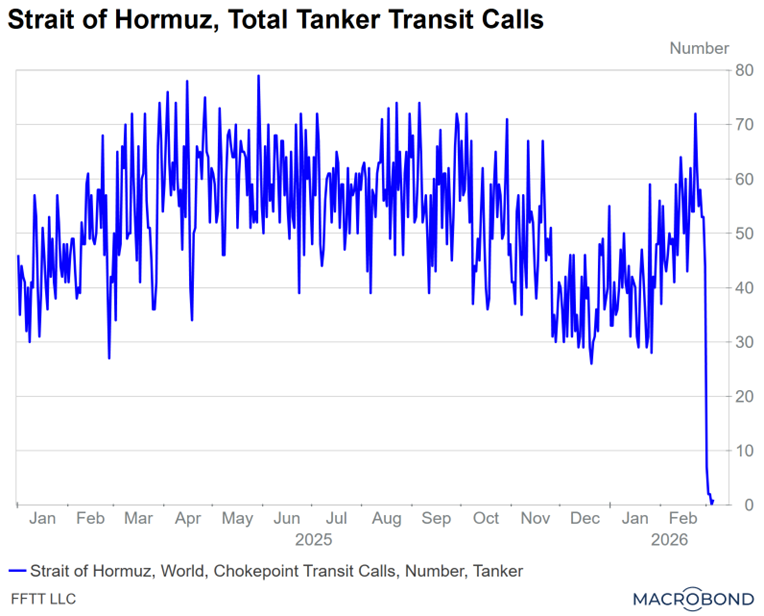
This is the only metric that matters in determining who is "winning" and "losing" the war.
If this chart looks like this for another couple weeks, physics + financial leverage make it a certainty that global equity and bond markets will be smoking craters.




![balajis's tweet photo. I'm going to make some obvious points.
(1) Blowing up all the oil infrastructure in the Middle East is an insane idea, and may well result in a global economic crash and humanitarian crisis unrivaled in the lives of those now living. We're talking about the price of everything everywhere rising, from food to gas, at a moment when inflation was already high. All of that will be laid at the feet of the authors of this war.
(2) The antebellum status quo of Feb 27, 2026 was just not that bad, but we're unlikely to return to it. Expect indefinite, long-term, ongoing disruptions to everything out of the Middle East.
(3) Also assume tech financing crashes for the indefinite future. The genius plan to get the Gulf states caught in the crossfire has incinerated much of the funding for LPs, for datacenters, and for IPOs. Anyone in tech who supported this war may soon learn the meaning of "force majeure" as funding gets yanked.
(4) Many capital allocators will instead be allocating much further down Maslow's hierarchy of needs, towards useful basic things like food and energy.
(5) It's fortunate that all those progressives yelled about the "climate crisis." Yes, their reasoning about timelines was wrong, and much of the money was wasted in graft, but the result was right: we all need energy independence from the Middle East, pronto. It's also fortunate that Elon and China autistically took climate seriously. Now they're going to need to ship a billion solar panels, electric vehicles, batteries, nuclear power plants, and the like to get everyone off oil, immediately.
(6) It's not just an oil and gas problem, of course. It's also a fertilizer problem, and a chemical precursor problem. Maybe some new sources will come online at the new prices, but it takes time to dial stuff up, particularly at this scale, so shortages are almost a certainty.
That said, China has actually scaled up coal-to-chemicals[a,c] (C2C), and there's also something more sci-fi called Power-to-X[b] which turns arbitrary power + water + air into hydrocarbons. But all of that will need to get accelerated. I have a background in chemical engineering so may start funding things in this area.
(7) Ultimately, this war is going to result in tremendous blame for anyone associated with it. It's a no-win scenario to blow up this much infrastructure for so many people. Simply not worth it for whatever objective they thought they were going to attain. But unless you're actually in a position to stop the madness, the pragmatic thing to do is: scramble to mitigate the fallout to yourself, your business, and your people.
[a]: https://t.co/ITat4tmAFd
[b]: https://t.co/bWwiSQcgyt
[c]: https://t.co/FQCqMhy5d3](https://pbs.twimg.com/media/HDujYp7bwAA5DuR.png)