I can't believe more people aren't deploying AI agents on Robinhood.
It literally takes <5 minutes to set up, and it's like having a 24/7 trading desk in your pocket.
If you trade crypto/stocks, save this.
🧵: Full setup guide (how to deploy agents on Robinhood).👇
SpaceXAI engineer, Lauren Tan:
"GrokBot is the most powerful agentic tool we have ever built, but only 1% of users use it correctly
right now I'm running a team of 20+ GrokBot agents. I have a Chief of Staff agent, 3 managers and 16 workers - that's how the team looks like"
In a 1-hour workshop, a SpaceXAI engineer reveals how to use Grok agents at 100% of their potential
worth more than a $500 agent engineering course on the internet
Skip Netflix and watch today, it will change the way you use GrokBot forever, then read the article below
INSTEAD OF WATCHING NETFLIX TONIGHT. Spend 2 hours with this. Claude AI FULL COURSE that teaches you how to BUILD and AUTOMATE anything. The people who watch this tonight will wake up tomorrow with a new skill. Watch it and bookmark it now.
This guy built an HFT algorithm on Polymarket with an average trade size of $40
Result: +$223,542
His bot trades short-term BTC/ETH Up/Down markets using a hybrid of passive market making, inventory rebalancing, and opportunistic complete-set formation:
1. It accumulates outcomes below its fair value
It places BUY orders in advance and waits for them to get filled. The average price per share acquired is 46.6c
2. When the market moves, it turns part of the inventory into cheap complete sets
If its Up orders get filled first and then the underlying reverses, making Down cheaper, it starts accumulating the opposite side
In two-sided 5-minute markets, the median combined VWAP of both sides is around 94.8c
3. It keeps part of the inventory directional
It doesn’t try to fully balance Up and Down. If it can buy a cheap hedge, part of the position turns into complete sets. If not, the original inventory remains directional
His Polymarket nickname: PBot-6
You can build your own trading bot here:
https://t.co/JVofcJaxWQ
(Trial period available after registration)
This guy’s stats:
> Trades / active hour: 46.11
> Average trade: $39.67
> Win Rate: 50%
The main edge of his HFT algorithm comes from consistently getting fills below its fair value and building arbitrage positions
SEND THIS TO YOUR GROK BOT TO CREATE AN ENTIRE AI HEDGE FUND
All you have to do is send it to your agent and ask it to build the desk. That’s it.
Credit: @RohOnChain
She is 18 built a game with 4 agents and sold it to Microsoft for $2.4M - and at Stanford shared how to repeat it from scratch:
00:09 - how Opus 5 in Claude Code built a game making $100k a month
23:34 - 4 agents replaced a developer team worth $200k a year
59:47 - how to build your first game from scratch in 60 minutes
after watching I gave Claude Code the game idea I had been holding for 2 years - in 60 minutes it already existed in the App Store and was making money.
save & watch - the article below shows how 4 agents and Claude Code replace a developer team and build a game Microsoft will buy for $2.4M.
WHOEVER LEAKED THIS HAS ZERO FEAR
SOMEONE CONNECTED 350 GROK BOTS TO RUN A ONE-PERSON TRADING DESK.
I thought it was just another AI experiment until I saw the setup.
One bot scans the market.
Another hunts for setups.
Another analyzes news and sentiment.
Another tracks whales and on-chain activity.
Another manages risk and exposure.
Then a HEAD OF DESK Grok coordinates everything and sends the owner only the trades that actually need approval.
No team of analysts. No staring at charts all day.
Just 350 Grok bots passing information between each other 24/7.
The craziest part?
The owner said he barely touches the system anymore.
FULL GUILD ON HOW TO BUILD IT BELOW
the engineer who improved 15 models in a single afternoon never touched a single model. he changed the harness.
most people think the model is the product. this diagram shows what actually is.
the harness is the software around the model: what it gets told, what it remembers, what it can touch, and who decides the job is done. the vendor gives you the model. you own everything around it.
most people skip this entirely. they write a prompt, add a tool, and hope the model figures out the rest. it does figure something out. just not necessarily what you wanted.
three decisions matter most.
where the loop stops. if you do not write the stopping rule, the agent will. defaults are not neutral.
what it is allowed to touch. least privilege. sandbox by default. no shared secrets. audit everything.
who decides it is done. define success. test it automatically. verify outputs. keep a human in the loop when needed.
three companies show what happens when you design the harness instead.
DoorDash runs 130,000 tasks a month through agents in throwaway VMs. all access goes through one gateway. work is defined as YAML playbooks.
OpenAI ships with a 100-line instructions file and rules enforced by linters. 1,500 PRs merged by 3 engineers in 5 months.
Anthropic uses three agents: spec, build, grade. they communicate by writing files. the system costs 6 hours and $200 versus 20 hours and $9. 20x the price for a much better result.
three shapes. same point.
the harness is the difference.
reliable: runs to finish or fails clearly.
walk-away: you can leave it running.
cheaper: fewer wasted turns and tokens.
quality compounds over time.
it is not the model. it is the harness.
design it once. then let the agent get to work.
Anthropic hired this engineer at $250K-$750K/year because he can build knowledge graphs for multi-agent systems
In this 15-minute workshop, he shows exactly how to build one with loops from scratch
step 1 → start with the Claude Agent SDK - the loop, context, and sandbox are already handled
step 2 → separate the brain from the hands - reasoning in one place, tools in a sandbox, ~60% faster to first token
step 3 → run it server-side and log every step - close your laptop and it keeps running, crashes resume from the log
step 4 → make failure cheap - retry dead sandboxes and replay dropped context instead of starting from zero
step 5 → turn yesterday's logs into new memory and skills - the system wakes up smarter
Anthropic calls this "dreaming"
Most people spend weeks wiring all of this by hand
You don't have to
Watch it, bookmark it, then read the full graph guide below ↓
A billionaire sat in a room for 42 minutes and listed every psychological trick that makes people lose money. for free. the finance industry has spent thirty years pretending this recording does not exist.
he didn't sell a course. he didn't write a newsletter. he sat in a chair at 96 years old and explained why brilliant people do the dumbest things with their money. then he explained why they will keep doing it.
MBA programs charge $200,000 to teach behavioral finance. he covered 25 biases in one sitting. some of them are still not in any curriculum. he gave the entire framework away on camera.
the part nobody talks about: he called crypto antisocial. he said index funds will crush most managers. he said private equity is full of wretched excess. he said all of this in a room full of people who manage money for a living. nobody argued.
a hedge fund analyst at a top firm told me this is the first thing they send to anyone who joins the desk. not a book. not a model. a 42-minute video of a 96-year-old man explaining why you will be wrong and how to recognize it before it costs you everything.
40 million people have heard his name. almost none of them have watched him explain the 25 ways their own brain is working against them.
the lecture is free. he died the following year. it is in the video.
When California had the drought a decade ago I asked during a Mother Jones editorial meeting where the water had gone and everyone laughed at me and said “everyone knows where it went” and I said “I don’t know where the water went but I know that it didn’t disappear so it went somewhere” and they said “I don’t have time for this” and ran away and it became a running gag internally because I was like “they can’t answer this basic question” and was so obstinate about it that when I ended up having to edit any stories about the drought I would constantly add edit notes like “must answer: where did the water go” and they would have to wait and find another editor to avoid me because they were like “this editor is a moron” and then after five years or whatever I got this text from one of them and they were like “I was talking to a scientist recently and one thing led to another and I mentioned that there this prick at the company obsessed with where the water went and they said ‘actually we just found the water’ and they sent me the study and there is an answer to your question.’”
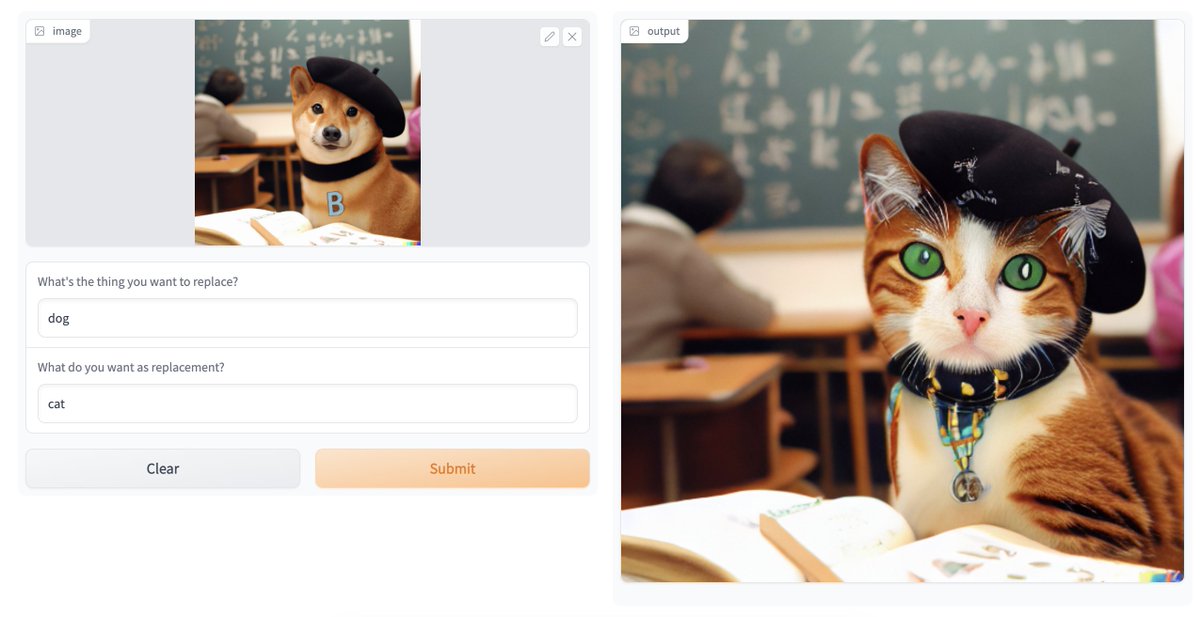
Welcome to the AI-powered future of image editing.
Forget spending hours and money on image editing tools. Now you can simply edit images using text in a matter of seconds that too for FREE.
(A thread) 👇🧵