Pardon?????
Any small thing, "Gen Z cannot relate".
Yen yen yen 😑😑
Do you people realize that Gen Z started from 1997?
Do you realize that the oldest Gen Z is almost 30 years old? And the youngest Gen Z is 14 years old .
If you want to call baby Shark do do, call Gen Alpha, because Gen Zs are NOT as young as you think they are.
I'm a Gen Z, I was very much aware of when the Five naira, Ten naira, Twenty naira and Fifty Naira notes were papers.
I knew when they changed it to the nylon that we now spend today.
I can vividly remember the time when they did Golden Jubilee for the #50 note.
I remember when a portion of pepper was #20, and when a cup of rice was #25 for long grain rice.
I remember when 5 eggs was #100. When Indomie was #30, when a cup of Garri was #10.
Yes, I'm a Gen Z and I remember.
Stop dragging us as if we just came into this world abeg.
here's what will happen.
- u16 ban passes, platforms must verify all ages
- kids use VPNs, government bans VPNs
- age verification infrastructure already exists, its scope gets broader, more invasive, more extreme
- Online Safety Act forces backdoors into encrypted messaging, E2E encryption dies, gov can read everything you ever send
- CBDC rolls out, your internet passport and financial passport become the same document
- anonymous accounts posting "wrongthink" are now identifiable + prosecutable
- the generation that grows up with this doesn't remember it being any other way
- George Orwell was right about everything
- it's over
@damnsec1 Tbh when I heard that wasn't supposed to happen.... i lost it, aren't you supposed to have contingencies. Smartest person in the world my ass......
CLOWNS using the same PLAYBOOK.
Someone tagged me to this nonsense yesterday.
You banned Nigeria and called it fraud prevention. Let's be clear about what this actually is.
Your own post admits your detection system ran for months before catching a ~95% fraud rate. If your KYC is that strong, why did it take months? You don't get to announce your detection failure and then blame the country.
The 95% figure has zero public methodology. No third-party audit. No breakdown of how fraud was defined. No clarity on whether Nigerian users were flagged by the same thresholds as Malaysia or Indonesia.
You cannot cite a statistic only you can see and call it evidence.
That passport photo proves one person submitted a fake document. Not that 200 million people are fraudsters.
WE KNOW WHO YOU ARE.
A 22 year old college dropout who built a data harvesting app and dressed it up as fair compensation for the little guy.
Look at your own investor list. K5 Global and Founders Fund have co-invested in the same portfolio companies. Founders Fund is the original institutional backer of Palantir.
Your other backer, Aglaé Ventures, owned by Bernard Arnault, runs an AI portfolio that intersects directly with the same labs that Palantir's AIP platform integrates with. Nobody is making wild accusations here. We are just reading the room.
FOR MY NIGERIANS WHO DO NOT KNOW
Here is what that network is actually building. Kled mobilizes hundreds of thousands of gig workers, mostly from the Global South, to upload personal photos, videos, and documents.
You convert raw human life into machine readable product. The labs and platforms connected to your investors then take that data and make it actionable for governments, corporations, and in some cases, military operations.
Here is why Nigeria specifically matters to this model.
The major AI labs are currently being sued by artists, writers, and publishers for stealing data through web scraping. To win those cases, they need to prove they have clean, consented data.
Buying a dataset from a platform like Kled, where every user signed a digital consent form in exchange for a few dollars, gives billion dollar tech companies a legal free pass.
You are not disrupting anything. You are laundering consent for people with far more power than you.
And here is the part nobody is saying out loud. Imagine if a company already under fire for government surveillance and military contracts openly offered to pay people in developing countries to film their homes and daily lives. It would look exactly like what it is.
By using smaller startups as the public face, the same data gets collected, the same surveillance infrastructure gets fed, and the powerful names stay clean in the public eye.
A 22 year old dropout does not accidentally end up with this investor network. The connections around him tell a very specific story. We are just the ones reading it out loud.
This is the same playbook PayPal ran on Nigeria for years. Locked us out. Called us fraudsters. Made us third-class citizens of the internet economy. And when they finally came back, after years of Nigerian developers building workarounds and Nigerian users funding entire ecosystems without them, we had already moved on.
We didn't need them. We needed the infrastructure they refused to give us. They did not give it to us and we survived. You will try to re-enter but it will be too late.
To MY FELLOW NIGERIANS,
Every time a foreign platform exits Nigeria citing fraud, we debate the fraud. We rarely ask why a country of 220 million people with the largest developer community in Africa still does not own the servers, the data centers, or the infrastructure that defines what "legitimate" looks like online.
When you don't own your data infrastructure, someone else defines your identity. They decide what counts as fraud. They decide what counts as valid. They hold the receipt and you argue at the door.
The answer to Kled is not begging them to return. The answer is owning the pipes. Data centers. Local cloud infrastructure. Payment rails we control. Identity systems we built.
Every platform that exits us citing fraud is just showing us what it costs to not own our own infrastructure.
That bill keeps compounding. It is time we paid it differently.
So that next time, comedians like this will not have the guts to call us fraud without evidence.
🇳🇬 Nigeria: Federal Housing Authority (FHA) Data Allegedly Leaked
A threat actor claims to have breached systems associated with Nigeria’s Federal Housing Authority (https://t.co/d7Aj669jTn) and released internal files online.
📊 Key Details:
• Target: Federal Housing Authority (Nigeria)
• Type: Internal system data
• Claimed contents:
Backend files
Configuration files
Source code
Distribution: Public download link (compressed archives ~70MB & 100MB+)
🧠 Threat Intelligence Insight:
• Exposure of source code + configs is highly critical:
May reveal credentials, API keys, database connections
Enables attackers to map internal architecture
• High likelihood of:
Further exploitation (if systems still active)
Discovery of additional vulnerabilities
Supply chain or lateral movement opportunities
• Actor attribution claim:
“Nullsec Philippines x Nullsec Nigeria”
Likely hacktivist-style branding
⚠️ Assessment:
• Medium–High credibility
Structured leak description
Public archive provided
Actual depth of compromise not yet validated
⚠️ Potential Impact:
• Full system compromise if credentials exposed
• Risk to citizen housing data and internal operations
• Long-term exploitation due to exposed codebase
📊 Status: Unverified — but highly sensitive technical exposure
#CyberSecurity #DataBreach #Nigeria #GovSecurity #ThreatIntel #DDW
Nigeria 🇳🇬 - The Chartered Institute of Bankers of Nigeria has allegedly suffered a data breach exposing a 250GB database containing members' personal information, identification documents, and source codes. https://t.co/obbjhdC1y9
Reason why I use kali bare metal rather then the underlying distro; “debian” is cos I love how most of the tools come pre-installed, can’t really be going about downloading burp suite, netexec, evil-winrm, bloodhound, havoc or whatever when I could use that time to do more 🥲🤷🏾♂️
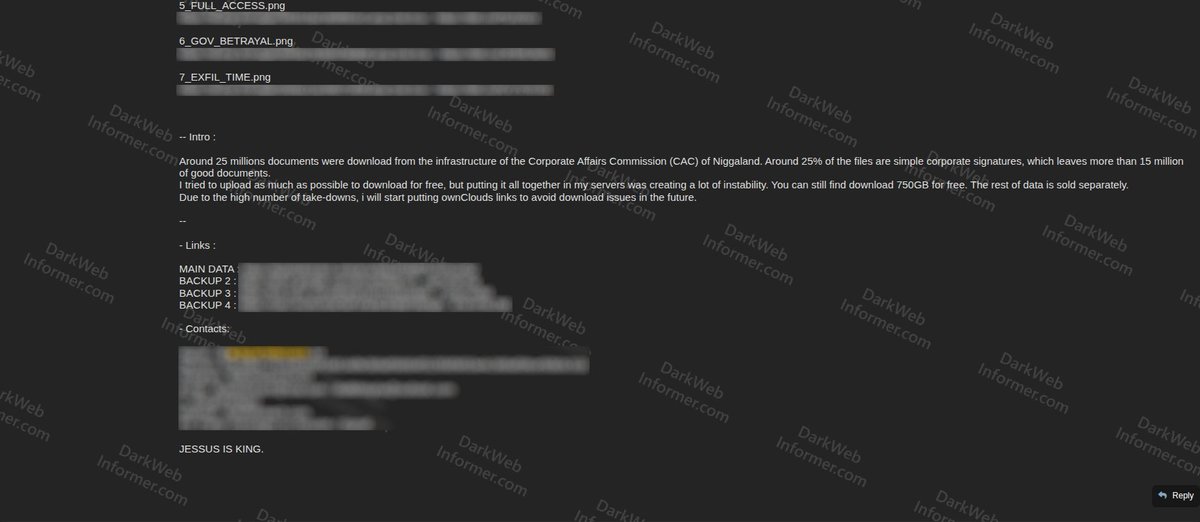
‼️🇳🇬 Approximately 25 million documents have allegedly been exfiltrated from the infrastructure of the Corporate Affairs Commission (CAC) of Nigeria, the government agency responsible for company registrations.
‣ Threat Actor: ByteToBreach
‣ Category: Data Breach
‣ Victim: Corporate Affairs Commission (CAC) / Nigeria Government
‣ Industry: Government
‣ Country: Nigeria
‣ Total Documents: ~25 million
‣ Free Download: 750 GB
The threat actor provided 7 proof screenshots documenting the attack stages:
▪️ 1_BREAKTHROUGH
▪️ 2_ESCALATION
▪️ 3_TAKEOVER
▪️ 4_PORTALS
▪️ 5_FULL_ACCESS
▪️ 6_GOV_BETRAYAL
▪️ 7_EXFIL_TIME
Around 25% of the files are described as simple corporate signatures, leaving more than 15 million documents of substance. The actor states they tried to upload as much as possible for free but server instability limited the free portion to 750 GB.
Prime, Netflix left Nigeria.
TikTok, Instagram doesn’t pay Nigerian creators because low priority, guess why?
Twitter, Facebook and YouTube pay way less per Nigerian viewer.
Roll outs, perks, only get to us after years of creators in other climes enjoying them.
There’s no light.
There’s no regulation of rent.
Data tariff increases depending on the network provider’s mood.
Fuel is 1300 per liter.
Fuel has become lighter, evaporates quicker.
5 liters of 2022 is not same as now.
But yeah!!! Bring your tax.
File your tax!
I won’t give you job but if you create one for yourself, I still won’t make it easy for you because I’ll make sure bulk of your money goes to rent payment and electricity. And things will also get ridiculously expensive because $1 is 1450 naira.
But yeah, FILE YOUR FUCKING TAX!!!
We pay VAT per online transaction.
We pay VAT per light purchase.
We pay VAT per every purchase or transaction.
But hold on… FILE YOUR TAX!!!!
And no matter what ridiculousness that happens, we swear that the “next one” that will “definitely” be our tipping point.
Bloody hell!
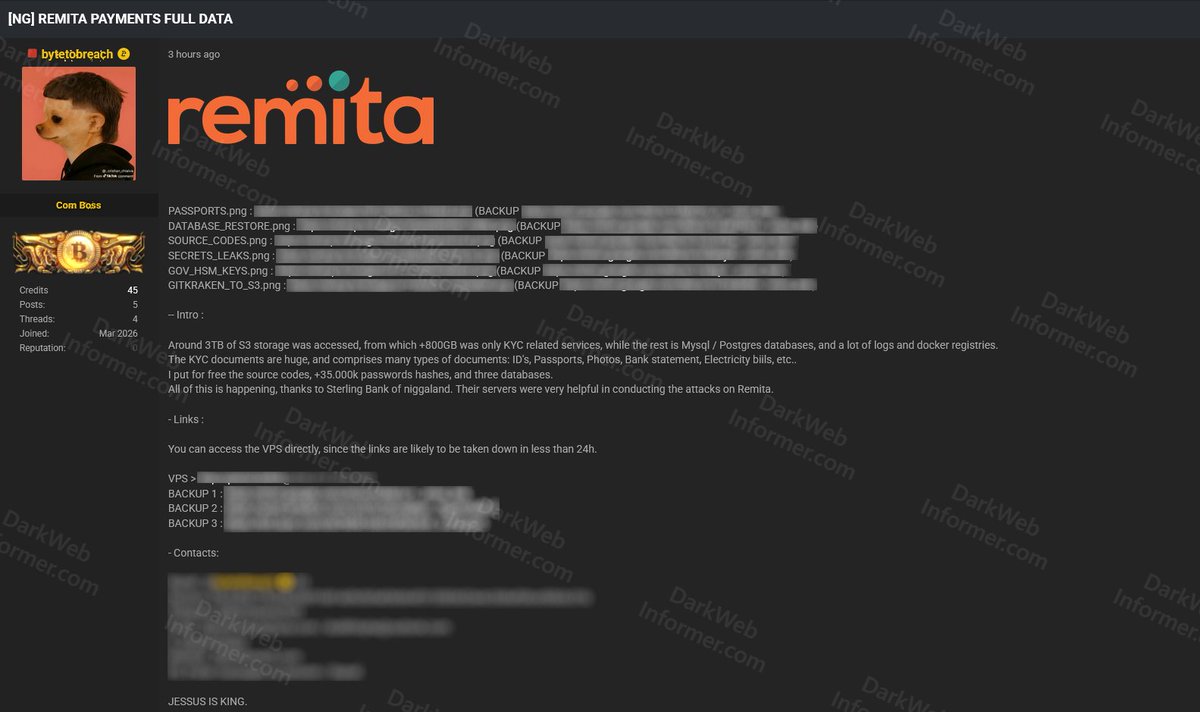
‼️🇳🇬 A massive breach allegedly from Remita, a major Nigerian payment processing platform, has been leaked on a popular cybercrime forum.
▪️ Total Size: ~3TB of S3 storage
▪️ Data Includes: 800GB+ of KYC documents (IDs, passports, photos, bank statements, electricity bills), MySQL/Postgres databases, logs, docker registries, source codes, government HSM keys, GitKraken to S3 backups
▪️ Source codes, 35,000+ password hashes, and three databases