"The future Greek family is dead and that's why we're here to talk about DEI" - Greece is experiencing the worst population decline in its history and this is what the Minister for Family has to say.
My dear front-end developers (and anyone who’s interested in the future of interfaces):
I have crawled through depths of hell to bring you, for the foreseeable years, one of the more important foundational pieces of UI engineering (if not in implementation then certainly at least in concept):
Fast, accurate and comprehensive userland text measurement algorithm in pure TypeScript, usable for laying out entire web pages without CSS, bypassing DOM measurements and reflow
Automation in manufacturing is _the_ future for Europe and @sunriserobots delivers the most promising product that I've seen in HMLV - amazing work! 🦾🇪🇺
🇪🇺🔥 Europe’s manufacturing edge is at real risk – too much capacity is moving to China, and what stays is hard to scale. The surprising solution might be a two-arm robot cell being built in a new lab in Ljubljana.
I visited Sunrise Robotics to see how they’re building a new type of automation that could reshape European industry.
Why it matters:
• Europe is the world’s #2 manufacturing hub (~17–18%)
• 50%+ of output is small-batch (high-mix/low-volume) → hard to automate
• Millions of workers will retire or be out of job due to outsourcing
• Sunrise created a standardized, simulation-trained cell
• One operator can supervise multiple of these stations to build more complex products
• This is a key to keeping factories – and competitiveness – in Europe
I truly think Sunrise can become a global automation leader – disclaimer: I was their first (small) investor and first (big) fan. 🔥
The video shows everything: the test lab, the simulation stack, the UI, the assembly line, the first production batches… and a deep dive with CEO @tomazstolfa on the vision behind it.
Full video link in the reply.
If you enjoy it, please like + subscribe on YT – this really helps boost this kind of content. 🔥
If you care about robotics, automation, European competitiveness, or the future of work – checkout this video.
PS: I was absurdly sick during the shoot… apologies for any sloppy camera work and spaced-out staring 😅
Europe Builds. Others Profit.
3D Gaussian Splatting (3DGS) is the perfect case study. It reflects both Europe’s brilliance and its chronic inability to turn that brilliance into business.
Almost everything that made 3DGS possible was born in Europe. From the early breakthroughs in point-based rasterization in Switzerland to the cumulative research from Austria, Greece, and Germany executed in France, Europe built the foundation. No other continent can match that level of scientific collaboration and intellectual strength.
The LichtFeld Studio bounty later confirmed it: the biggest performance leaps came straight out of European labs. The science was here. The innovation was here. The talent was here.
But the business was not.
When 3DGS exploded, my inbox filled with messages from US-based companies, not from Europe. In the United States, Luma AI and Polycam turned the paper into products within weeks. They did not wait for funding programs or EU consortia. They simply built.
Then came China, which not only caught up in research but quickly outpaced everyone in commercialization. XGRID, DJI, and many others built thriving businesses around what Europe invented. Today, most 3DGS papers come from Chinese institutions rather than European ones.
Meanwhile, the usual giants such as Meta, NVIDIA, Google, Netflix, and Tesla continue to iterate, integrate, and push forward. A thriving ecosystem of startups like World Labs leverages this technology to create new products and markets. The innovation cycle in the United States and China is fast, relentless, and market-driven.
Europe, in contrast, remains bureaucratic and slow. We fund excellence and celebrate publications, but we rarely ship, even though some small startups are trying to change the status quo. Our researchers create the breakthroughs; others create the successful products.
Until Europe finds a way to bridge the gap between laboratories and markets, it will remain the world’s research and development department: brilliant, underpaid, and underleveraged.
Research is Europe’s comfort zone. Execution must become its strength.
Video: One of my dynamic 3D Gaussian implementations based on the paper "Representing Long Volumetric Video with Temporal Gaussian Hierarchy."
@mike_pavlukhin Had this exact intuition the other day. Changed the order of fields to have the "reasoning" field before everything else and our evals showed a non-negligible improvement!
🇺🇸 🇮🇱 🇦🇷
Enjoyed my discussion with PM Netanyahu on how AI education and literacy will keep our free societies ahead.
We spoke about AI empowering everyone to build software and the importance of ensuring it serves quality and progress.
Optimistic for peace, safety, and greatness for Israel and its neighbors.
Vibe code is legacy code
@karpathy coined vibe coding as a kind of AI-assisted coding where you "forget that the code even exists"
We already have a phrase for code that nobody understands: legacy code
Legacy code is universally despised, and for good reason. But why? You have the code, right? Can't you figure it out from there?
Wrong. Code that nobody understands is tech debt. It takes a lot of time to understand code enough to debug it, let alone introduce new features without also introducing bugs
Programming is fundamentally theory building, not producing lines of code. This is why we make fun of business people who try to measure developer productivity in lines of code
When you vibe code, you are incurring tech debt as fast as the LLM can spit it out. Which is why vibe coding is perfect for prototypes and throwaway projects: It's only legacy code if you have to maintain it!
I vibe code happily all the time. Most often for small apps that I don't need to maintain. I'm a big fan, have at it!
Vibe coding is on a spectrum of how much you understand the code. The more you understand, the less you are vibing
Simply by being an engineer and asking for a web app with a persistent database, you are already vibing less than than a non-programmer who asks for an "app" without understanding the distinction between a web app and a native app, or how persistent data storage works
The worst possible situation is to have a non-programmer vibe code a large project that they intend to maintain. This would be the equivalent of giving a credit card to a child without first explaining the concept of debt
You'll end up spending a lot of money and getting a large, buggy, legacy code base. If you don't understand the code, your only recourse is to ask AI to fix it for you, which is like paying off credit card debt with another credit card
At Val Town, we built Townie, an AI assistant that agnatically reads & writes code, runs it, views the logs, and keeps iterating until it's done. It's is an awesome tool for vibe coding. I heartily recommend it to folks who understand these tradeoffs. I use it to vibe code sometimes. Other times I keep in on a tight leash as it makes surgical edits to a project I care about
If you know any non-programmers spending thousands of dollars vibe coding their billion dollar app idea today, warn them that vibe coding is not going to get them where they want to go. They're going to have to learn to use their human eyes to read the code 😱, and that sometimes it's easier to start over with building a well-written code base from scratch than to fix a legacy one that nobody understands
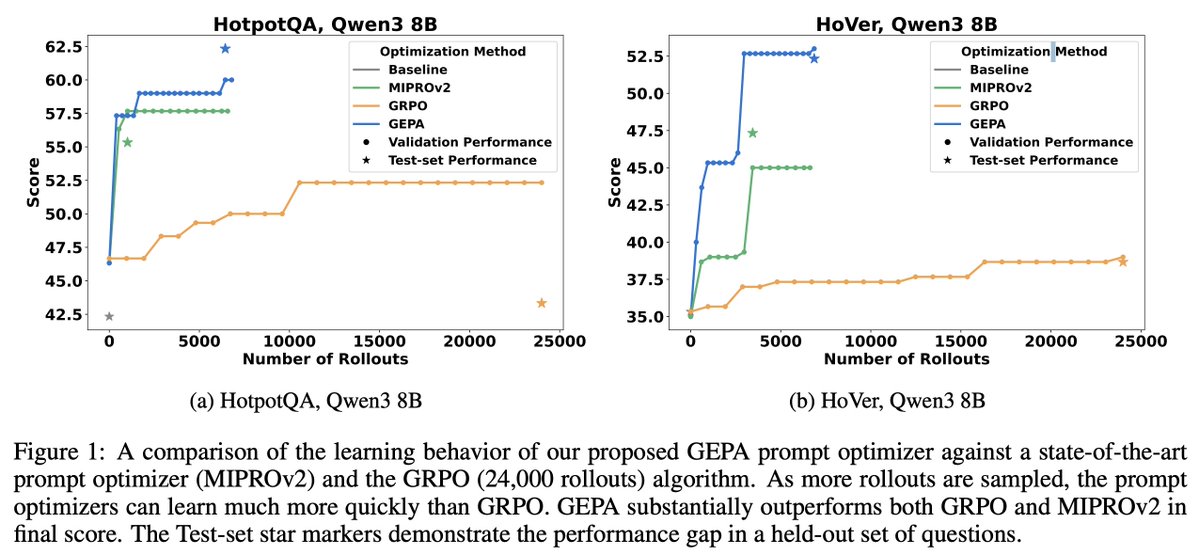
How does prompt optimization compare to RL algos like GRPO?
GRPO needs 1000s of rollouts, but humans can learn from a few trials—by reflecting on what worked & what didn't.
Meet GEPA: a reflective prompt optimizer that can outperform GRPO by up to 20% with 35x fewer rollouts!🧵