@sama@OpenAI how about create another sub level at around $35-$40/month with 2x Astra usage? Opus is trash, and Fable needs credits; that leaves Astra as the only usable model with a defined ceiling on cost - smart value for small-budget experimenters!
Been long Copper since 2023. Not naive enough to expect up-only in a straight line, but the macro thesis is still screaming bull.
S&P Global dropped some great charts, so let’s strip away the noise and run through the structural supply:
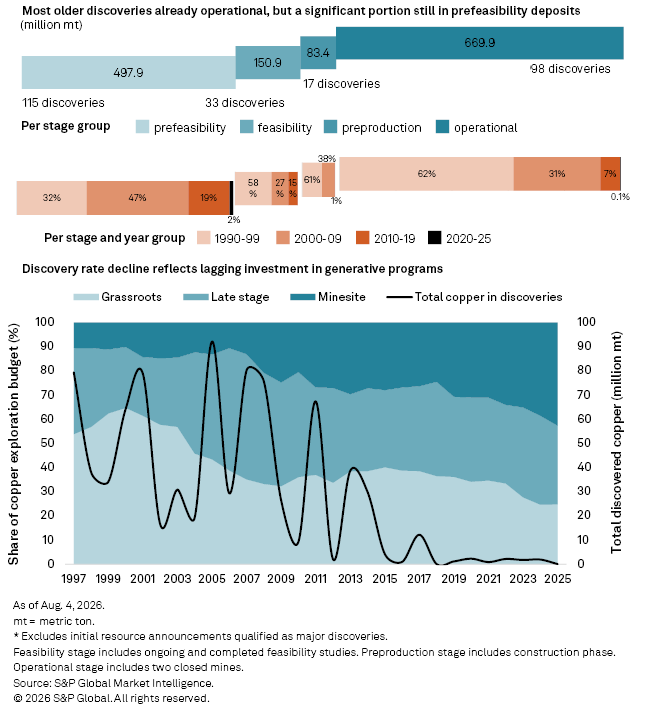
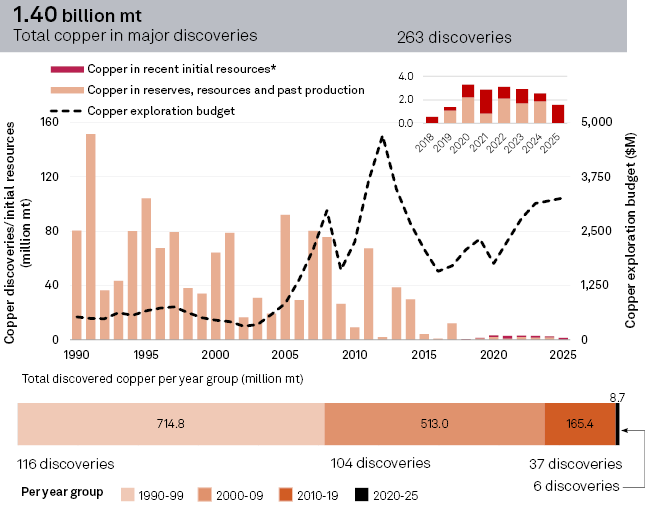
1) The tier-1 discovery pipeline is in a total desert. Down from 714.8Mt in the ‘90s to a pathetic 8.7Mt over 2020–2025. Mega discoveries are basically extinct.
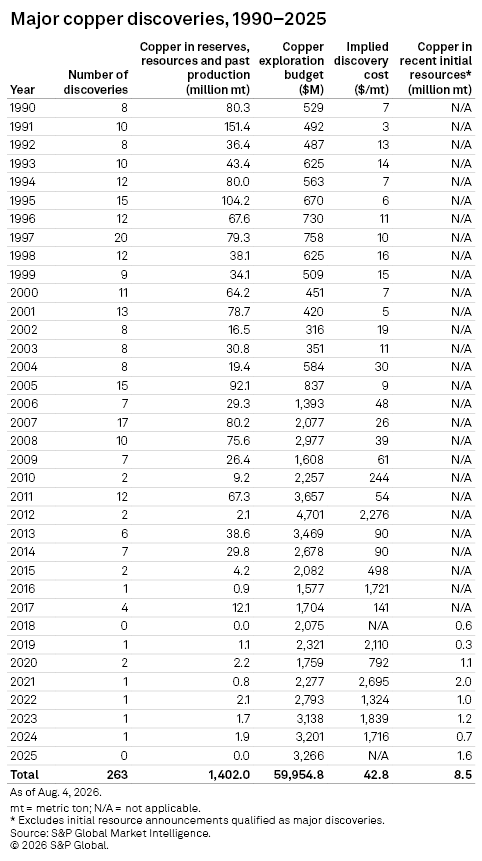
2) Capex burns are back up past $3B annually on exploration, yet the hit rate is completely cooked—netting a measly 0-2 discoveries a year. Trash ROIC...
3) Discovery cost per tonne went from ~$10 in the ‘90s to an eye watering $1,000–$2,600+ print today. Not a temporary blip; it’s a secular blowout in finding costs.
4) Gone are the days of unlocking multi tens of million monsters like Collahuasi or Pebble. Today’s wins are 1–2Mt crumbs that don't move the global balance needle.
5) More than half (55%) of cumulative reserves are concentrated in South America, while Africa—such as the DRC—is gradually taking up a larger share. South America has recently slipped into operational and production slumps, and Africa continues to suffer from political instability.
6) Roughly 500Mt of identified reserves have been rotting in prefeasibility purgatory for decades. Permitting hell, eco-lawfare, and zero IRR. Bless the regulators and green grifters for choking.
7) C-suites are terrified of greenfield risk. They’ve completely castrated wildcat budgets to hide inside safe brownfield pit extensions. Structural consequence. Zero chance of hitting a generational tier-1 asset.
8) Copper mining typically takes over 15-20 years from discovery to actual commercial production (operational), the current exploration slump translates directly into a future production cliff. This is an undeniable fact.
9) Megawatt power grids, EV buildouts, and AI data centers are devouring physical units, while the project pipeline is running bone dry. Sure, the demand ceiling floats on the macro tape, but this structural supply paralysis puts a bulletproof concrete floor under the market.
10) Marginal incentive pricing and long term cost floors have nowhere to go but violently up and to the right.
So what's priced into the equities? Large caps are still riding a fat liquidity premium over the mid/small cap complex. Ivanhoe’s lagging for obvious DRC baggage, but look at the implied copper price deck.
Freeport is pricing in $6.25/lb. First Quamtum is at $5.92/lb. Lundin sits at $5.44/lb, Capstone at $5.37/lb, my horse Hudbay at $4.73/lb, and Ivanhoe down at $3.95/lb.
Of course each name has a different setup. In the case of Hudbay, which I hold, precious account for nearly 45% of annual revenue, whereas First Quantum and Freeport sit around the 10% mark.
Naturally i'm completely fine with this since I'm structurally bullish on precious as well. What I want to say is that while we must closely monitor that the copper thesis doesn't derail, if you have conviction in the trajectory, equities still offer massive upside.
Demand downside risk? Sure conceded. If Xi pulls the trigger on Taiwan or Jensen and Sam Altman get perp walked by the feds for running an AI Ponzi(lol), things will hit the fan.
Outside of those black swans, the supply side reality is downright apocalyptic—and the operational bleed coming out of Chile just hammers the nail in the coffin. In commodity risk, when the supply side guarantees a rock solid floor, you’ve already eliminated half your downside distribution.
Still max constructive on copper. Until the tape changes my thesis, I’m letting my winners run and fading the short term chop.
Along with $HBM, I hold two junior miners. Certified worst PM on the planet and talking exclusively to pump my own book like the conflicted scumbag I am, so don't take this as financial advice.
#copper
A common political line is that America doesn't have a revenue problem; it has a spending problem. Maybe. But is there any viable pathway to materially cutting spending? I'll show there isn't. That leaves us with either a revenue problem or a debt/deficit problem. You choose.
1/n
Given the SPR’s actual design specs and subsurface setup, the whole idea of refilling it with Venezuelan extra-heavy crude is a complete non-starter. The quality mismatch alone kills it on day one.
The SPR acceptance limits are spelled out black and white in DOE regs and CRS filings: "For the purposes of the SPR, sweet crude oils are defined as containing a maximum of 0.50 mass percent total sulfur, while sour crude oils can contain up to a maximum of 1.99 mass percent total sulfur. For the most part, these are of light gravity (30 to 40° API)..."
https://t.co/KOHj48wzqG
https://t.co/q2yfKZGnLy
So SPR sour intake is capped at 1.99% sulfur, requiring a 30–36° API window(medium Sour).
Meanwhile core Venezuelan grades like Merey(16° API, 3.4% S) and Boscan(10.5° API, 4.8% S) are extra-heavy sours that completely blow past those thresholds.
Beyond basic assay specs, the real structural bottleneck is subsurface storage. The SPR isn’t parked in above-ground steel tanks; it sits in Gulf Coast salt caverns across TX and LA.
The SPR has to dump 1mb/d+ on command via high-pressure brine displacement—injecting water/brine to float crude to the surface on density differentials.
Venezuelan heavy sour at ambient temperature flows like cold molasses or peanut butter. Cavern geothermal gradients aren't nearly hot enough to drop the viscosity. Pump that stuff downhole, and you risk seizing the entire cavern during a critical drawdown.
Worse, the heavy asphaltene dropout over long-term storage would drop a massive layer of bottom sludge. Mix that with displacement brine, and you get nasty downhole emulsion, risking cavern integrity and permanently wrecking the wellbores.
Look, everyone knows Venezuelan barrels are prime, high margin feedstock for complex USGC cokers, and it makes for great political rhetoric for Trump.
But refinery complexity is not drawdown logistics. Without dropping billions on cavern heating infrastructure or totally redesigning the manifold systems, dumping Venezuelan extra-heavy into SPR caverns is physically impossible.
#oott #venezuela
@ShaleTier7 Meanwhile:
“We always talk internally that the Permian “hasn’t even tried to produce gas yet,” and we think that still holds true today. Should there ever be a price signal calling for Permian gas growth, we are confident the Permian Basin will be able to answer that call”
@Fullcarry@Alea_@BondsbondRate See your point. Trying to figure out market-based proxies for TP. And I agree with your earlier comments that SFR swap TP is the clean read on TP.
@Fullcarry@Alea_@BondsbondRate Would you say that the swap spread curve (2-year USTs 15bp cheap vs swap but 30s 75bp) is a good market-based measure of term premium?