Imagine spending your whole life becoming an academic expert. Then a random guy online tells you that you are wrong about your own field. And he's right. But you can never admit that. Because it would mean admitting that your life was a lie. That is the dilemma of many academics.
"What is cancer, exactly?"
"It's an attack by a parasite... which attempts to reproduce its intermediate stages in you."
"There is a cure and it isn't expensive."
Most people hear the word “peptides” and immediately think they are some unknown chemicals or dangerous.
Over the next 30 days, we’re going deep into the peptide world from a beginner-to-advanced perspective.
This is not going to be random hype posts or recycled TikTok information.
The goal is to create one of the most beginner-friendly peptide enlightenment series on this platform by combining research, real-world experience with some of the peptides I’ve personally tried, different users’ feedback, biology, and practical understanding.
More importantly, the goal is to build a space where people can genuinely learn, ask questions, think critically, and better understand why peptides are becoming one of the biggest conversations in health, recovery, performance, fat loss, longevity, and biohacking.
Feel free to also share your personal experiences, insights, and observations along the way so we can all learn from each other too.
IVERMECTIN: FULL DOSAGE SCHEDULE FOR CANCER & PREVENTION
1000s of people use Dr. William Makis MD’s IVERMECTIN dosing chart. Here’s a clear, categorized breakdown based on body weight (mg/kg per day).
LOW DOSE: ≤ 0.5 mg/kg/day
**Best for:**
- Cancers in remission
- Strong family history or genetic predisposition
- Prophylaxis (preventive)
**Side effects:** No long-term side effects reported.
**Example:** Dr. Tess Lawrie reported a Stage 3 ovarian cancer case treated with chemo + 12 mg ivermectin daily. Tumor marker CA125 dropped from 288 to 22 after 2 months and the tumor vanished.
MEDIUM DOSE: 1.0 mg/kg/day
**Best for:** Starting dose for **most cancers** (lung, pancreatic, renal cell, gastric, etc.).
**Side effects:** No long-term side effects reported.
**Example:** Dr. Shankara Chetty’s 70-year-old prostate cancer patient (PSA 89) took 45 mg/day (plus lactoferrin). After two months PSA fell to 10.9.
HIGH DOSE: 2.0 mg/kg/day
**Best for:** Very aggressive cancers (leukemia, pancreatic, brain cancers).
**Side effects:** No long-term side effects reported.
**Example:** Dr. Allan Landrito’s Stage 4 gallbladder cancer patient took 2 mg/kg daily for 14 months — cancer disappeared.
VERY HIGH DOSE: ≥ 2.5 mg/kg/day
**Best for:** Extensive metastatic disease, extremely poor prognosis, or certain brain cancers.
**Side effects:** Possible short-term & transient visual effects (usually resolve in a few days).
**Example:** Dr. Shankara Chetty treated a patient with 2.5 mg/kg/day — no side effects reported.
**Quick conversion example (for a 60 kg / 132 lb person):**
- Low: ≤30 mg/day
- Medium: 60 mg/day (≈5×12 mg tablets or 1 teaspoon liquid)
- High: 120 mg/day
- Very High: ≥150 mg/day
Many anecdotal reports exist of long-term daily use (months to over a year) with no serious toxicity, but individual responses vary.
Always work with a knowledgeable clinician, especially if you have pre-existing conditions (e.g., vision issues or glaucoma). This is for educational purposes only.
Share to spread awareness — information is power. 💊
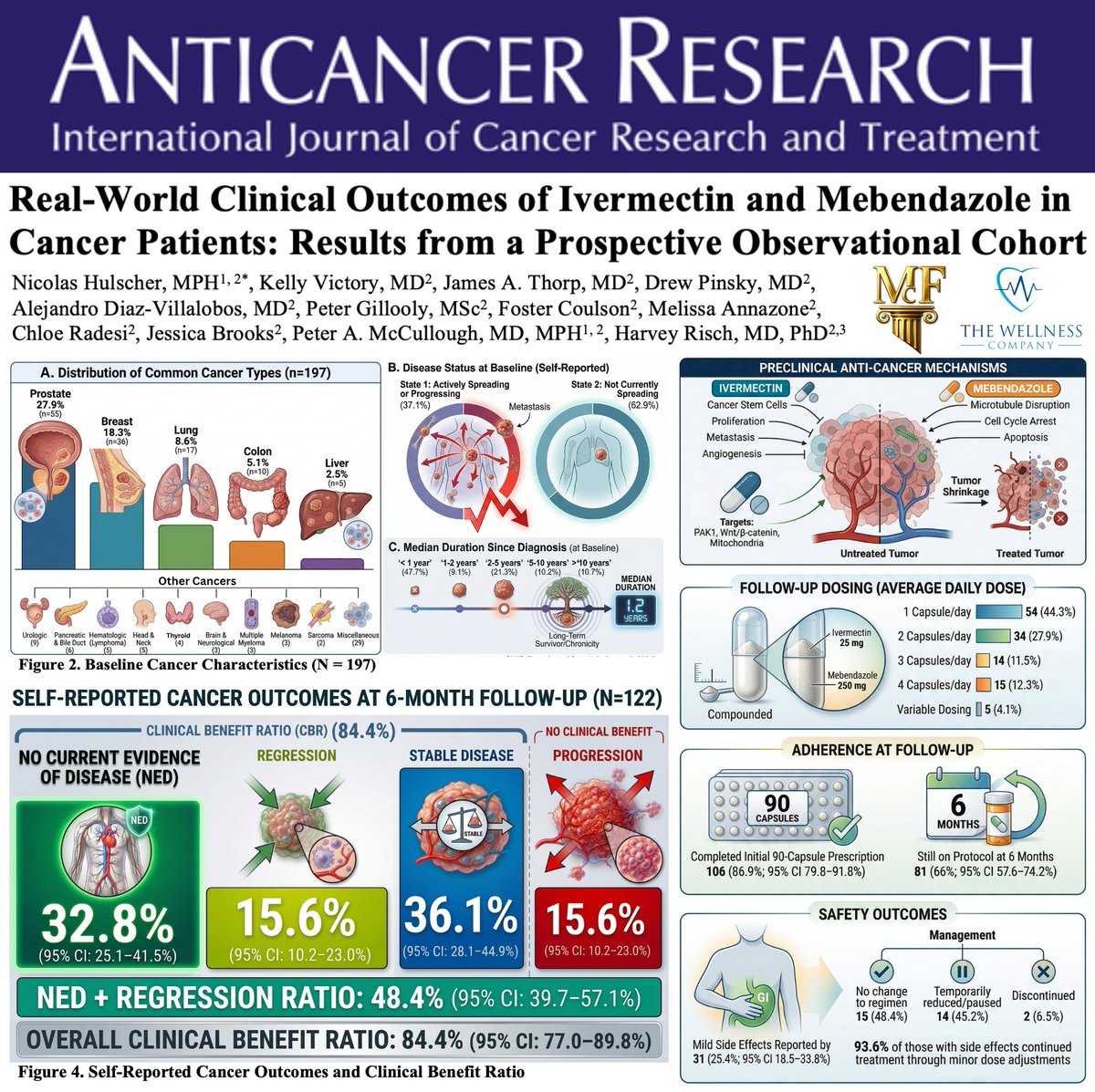
BREAKING: Largest Human Cancer Study of Ivermectin + Mebendazole Is Now PEER-REVIEWED and PUBLISHED in a MAJOR Cancer Journal
84.4% of cancer patients taking ivermectin + mebendazole for 6 months declared either CANCER DISAPPEARANCE, TUMOR REGRESSION, or CANCER STABILIZATION.
Our study, “Real-world Clinical Outcomes of Ivermectin and Mebendazole in Cancer Patients: Results from a Prospective Observational Cohort,” is now peer-reviewed and published in Anticancer Research—a major international oncology journal of the International Institute of Anticancer Research (IIAR), established in 1995.
The results represent one of the most compelling clinical signals ever documented for repurposed anti-parasitic therapies in oncology.
A diverse population of cancer patients (n=197) was prescribed compounded ivermectin–mebendazole through a U.S. telemedicine platform, with each capsule containing 25 mg ivermectin and 250 mg mebendazole.
Participants were followed for approximately six months using standardized digital surveys assessing cancer outcomes, medication adherence, and tolerability.
At approximately six months post-treatment initiation, we observed an 84.4% Clinical Benefit Ratio (CBR)—meaning more than four out of five patients reported either:
No evidence of disease (32.8%)
Tumor regression (15.6%)
or Cancer stabilization (36.1%)
Importantly, adherence was remarkably high, with 86.9% completing the initial prescription and 66.4% remaining on therapy at six months.
Side effects were predominantly mild and manageable, reported in 25.4% of patients (primarily gastrointestinal), with 93.6% of those experiencing side effects continuing treatment after minor dosing adjustments.
This groundbreaking peer-reviewed publication was made possible through a unique collaboration between The Wellness Company, the McCullough Foundation, and the Chairman of the President’s Cancer Panel—uniting real-world clinical data, frontline medical experience, and epidemiologic expertise to evaluate inexpensive, repurposed therapies with major translational potential.
With these extraordinarily promising results, double-blind, placebo-controlled clinical trials are now required.
In the meantime, many cancer patients are exercising their right to try.
@twc_health@McCulloughFund@IIAR_Journals@P_McCulloughMD@DrHarveyRisch@DrKellyVictory@jathorpmfm@drdrew@PeterGillooly@FosterCoulson