@damianborth Exactly! I just didn't imagine that zero shot would work well.
I expect massive work soon to chart when and where zero-shot model editing works well.
We asked GPT-6 Astra to edit Qwen3.5-0.8B weights to improve math.
It directly changed only 0.016% of weights, fixing 0.8B's reasoning loops & improving math up to 6x and even instruction following 3x, without gradients or training.
We call this Weight-Space Programming: frontier LLMs can now natively read/write neural network weights! 🧵
Blog: https://t.co/bOWCcFhCVq
We asked GPT-6 Astra to edit Qwen3.5-0.8B weights to improve math.
It directly changed only 0.016% of weights, fixing 0.8B's reasoning loops & improving math up to 6x and even instruction following 3x, without gradients or training.
We call this Weight-Space Programming: frontier LLMs can now natively read/write neural network weights! 🧵
Blog: https://t.co/bOWCcFhCVq
Metatron from @NVIDIAAI is one frozen whole-body policy for the Unitree G1 that takes partial goals instead of a full reference motion: hand or foot targets with arrival times, a velocity, a heading.
Policy
• Built on MaskedMimic: RL trains dense motion trackers, then on-policy distillation turns them into one generative policy that accepts masked, approximate goals
• On the G1 it distills four trackers: BONES and AMASS+LAFAN motion capture, synthetic recovery, and scene interaction (SAMP)
Skills
• A task is ordinary code that sets goals at each control step; the policy fills in the rest of the body
• Coding agents write and refine that code in simulation; the policy is never retrained
Results
• Whole-body reaching, 54 targets in MuJoCo: 83% reached vs 39% for a diffusion generator (ARDY) feeding the SONIC tracker
• Pushes while walking at 1 m/s: 75% stay upright at 800 and 1000 N, both SONIC pipelines 0%
• One checkpoint on the real G1 for walking, recovery, teleoperated pickup and sitting on furniture
The surprising bit
• A better gait came from better goals, not retraining: Claude Code fitted a foot-trajectory rule from motion-capture clips, and its timed foot targets gave more decisive steps on the real G1 (judged qualitatively)
By @ChenTessler, Yifeng Jiang, @AlecSaysThings, @YiShi_333, @UmarIqb, @GalChechik and @xbpeng4. Project: https://t.co/BqUI0NPqps
Coding agents can build an app. What if they could give it a body?
Meet Metatron: a versatile System 1 controller for humanoids. A goal-based interface connects System 2 planners, including coding agents, to whole-body movement.
A few examples below. 1/5
Excited to share our NeurIPS 2026 paper (+code): Learnable Spectral Activations 📢
Prior INR work tunes which frequencies are available. LSA learns how to compose them. Gains on audio, images, NeRFs & more.
📄 https://t.co/aGb4YBwzMk
Kudos to Tamir Shor who led it like a champ
Which fix should a coding agent try next? Most methods go by test pass rate, but passing more tests doesn't mean you're closer to a fix.
We train a 0.6B model to read the test failure and each proposed fix, then pick the most promising: 21% fewer attempts, 12% fewer tokens 🧵
🎬 Excited to share our paper: Joints, Camera, Action! (JCA)
JCA generates video & 3D motion together for any rig!
Video models generate motion you can watch. But what if you could use that motion to animate a 3D asset, with motion that responds to its surroundings?
https://t.co/Y7smggHv4w
🧵
🎬 Excited to share our paper: Joints, Camera, Action! (JCA)
JCA generates video & 3D motion together for any rig!
Video models generate motion you can watch. But what if you could use that motion to animate a 3D asset, with motion that responds to its surroundings?
https://t.co/Y7smggHv4w
🧵
Do vision-language models look at the image regions they describe? In our new paper, we present Self-Saliency, a method for aligning visual attention with reasoning text.
https://t.co/WyqXrvGYPc w/ @GalChechik@DalalGal
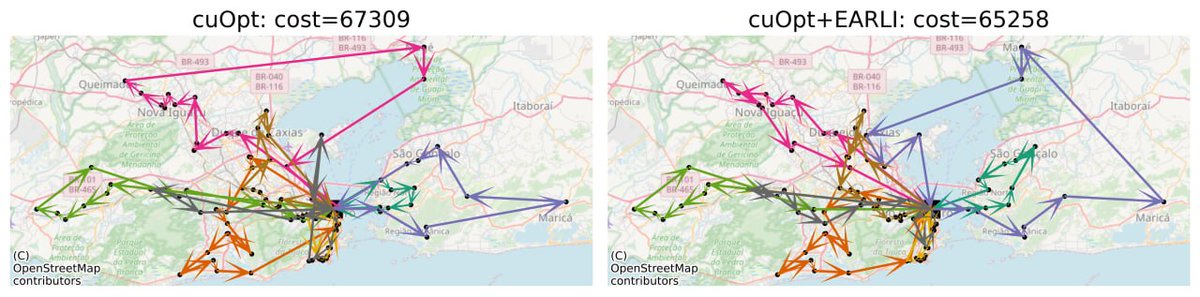
[1/4] EARLI is out in Nature's Communications AI & Computing!
EARLI combines learning and genetic algorithms to accelerate routing solvers like cuOpt and HGS, producing high-quality routes in seconds for hundreds of delivery locations.
[4/4] Paper: https://t.co/pzGJQjbaJd
Code: https://t.co/7gPrSYpluM
Data: https://t.co/Edi3tCVn7L
And a big shoutout to the team: Piotr Sielski, @hugolinsen, Rajesh Gandham, @shiemannor, Alex Fender, @GalChechik and @eli_meirom!
We’re looking for our next cohort of graduate fellows.
Our 2027–2028 Graduate Fellowship Program is open to Ph.D. students worldwide with awards up to $60,000, plus mentorship and technical support.
Apply by October 30: https://t.co/j7Zg9P42DW
@MHorovicz@urieli17 זאת שאלת מחקר מאוד קשה ומעניינת. אנחנו שמים סוכנים על הרכיבים של הרשת עצמה, switch and NIC, שלומדים לחזות את תבניות הפעילות המקומיות של הרשת.
קצב השינוי של הרשת כל כך גבוה, שעדיף לקבל החלטות מקומיות יחסית מאשר לחכות ולאסוף מידע על כל הרשת
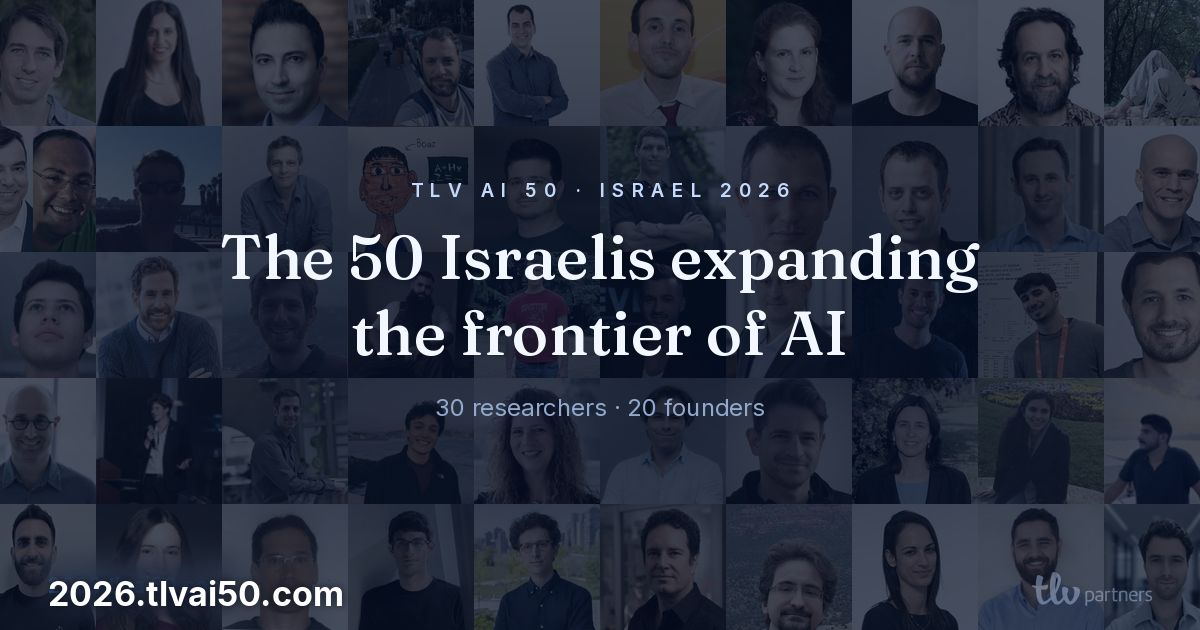
Ahead of Rosh Hashanah, we're publishing the TLV AI 50: a list of the 50 most influential Israeli AI researchers and founders. Their ideas shape how modern models think, see, and reason, and their companies turn those ideas into the chips, companies, and products the world runs on.
Full list: https://t.co/JlM80k2d0H
30 researchers, 20 founders, 7 papers. This is not a ranking, but rather a representation of the most impactful Israelis in the AI research realm.
Here’s a few trends that stood out:
• Israeli neolabs are finally emerging at the model layer
• AI security: a new cohort of AI natives is defining how systems get hardened and verified - Israel is firmly at the frontier
• Vision: some of the most cited labs anywhere, with startups now harnessing that talent for physical AI
Also featured are 7 noteworthy papers from up-and-coming Israeli researchers, below the list.
🥳 Excited to share UniProbe: A learnable, token-level hallucination detection for large VLMs 🔎
UniProbe looks inside a VLM’s internals to identify hallucinated response tokens and mitigate them before they reach the user.
📉 55% fewer hallucinations
⚡ Just 1.06× latency