In 2015 a writer named Tim Urban sat down and counted the days he had left with his parents. He was 34, healthy, both parents alive and well. The number came back around 300. Less time than he spent with them in any single year of his childhood.
The post is called The Tail End, on a blog called Wait But Why. The idea is to stop counting your life in years and start counting it in events. Reach 90 and you get about 4,680 weeks, and every one of them fits on a single sheet of paper. Maybe 60 more winters after that. If you read five books a year, that is 300 books, picked from every book ever written.
Those things at least spread out evenly. A third of the way through life means a third of the way through your pizzas. Time with the people you love does not work like that. Almost all of it sits at the very start. Then it is gone.
For your first 18 years you are around your parents nearly every day. Then you leave for college or a job in another city, and a normal adult sees their parents maybe 10 days a year. So the day you move out, you are already at 93 percent. Urban was living in the last 5 percent and had no idea until he drew the chart. He called it the tail end.
It does not stop at parents. His two sisters, after a whole childhood in the same house, had around 15 percent of their time together left. The four friends he played cards with most days in high school were down to their last 7 percent. Nobody had a fight. Nobody moved away angry. Life quietly spends the time for you while you assume there is plenty left.
You do not have to be old to be near the end with someone. If your parents are alive and you live in a different city, you have probably already used more than 90 percent of the days you will ever spend in the same room as them.
His one instruction is about that last stretch. When you are down to the final days with someone you love, treat that time like what it is, which is almost gone. The rest is the tail end, and it is much shorter than it feels.
Lee Kuan Yew:
“Air conditioning was a most important invention for us, perhaps one of the signal inventions of history. It changed the nature of civilization by making development possible in the tropics. Without air conditioning you can work only in the cool early-morning hours or at dusk. The first thing I did upon becoming prime minister was to install air conditioners in buildings where the civil service worked. This was key to public efficiency."
"Books are the closest thing you'll ever come to finding cheat codes for real life. You can access the entire learnings of someone else's career in a few hours."
"The one weird trick seems to be just read books. Make a habit of reading books and ideally change genre every three books or so, at least for one book, and then that alone will give you a range that you can draw on for basically everything you'll ever do."
— @tobi
I will never ever forget, when I was a British gov official, visiting a research institute in Singapore and a professor complained to me that the career path into civil service/politics was so desirable that they had a brain drain problem of top scientists INTO government
"AI isn't replacing radiologists" good article
Expectation: rapid progress in image recognition AI will delete radiology jobs (e.g. as famously predicted by Geoff Hinton now almost a decade ago). Reality: radiology is doing great and is growing.
There are a lot of imo naive predictions out there on the imminent impact of AI on the job market. E.g. a ~year ago, I was asked by someone who should know better if I think there will be any software engineers still today. (Spoiler: I think we're going to make it). This is happening too broadly.
The post goes into detail on why it's not that simple, using the example of radiology:
- the benchmarks are nowhere near broad enough to reflect actual, real scenarios.
- the job is a lot more multifaceted than just image recognition.
- deployment realities: regulatory, insurance and liability, diffusion and institutional inertia.
- Jevons paradox: if radiologists are sped up via AI as a tool, a lot more demand shows up.
I will say that radiology was imo not among the best examples to pick on in 2016 - it's too multi-faceted, too high risk, too regulated. When looking for jobs that will change a lot due to AI on shorter time scales, I'd look in other places - jobs that look like repetition of one rote task, each task being relatively independent, closed (not requiring too much context), short (in time), forgiving (the cost of mistake is low), and of course automatable giving current (and digital) capability. Even then, I'd expect to see AI adopted as a tool at first, where jobs change and refactor (e.g. more monitoring or supervising than manual doing, etc). Maybe coming up, we'll find better and broader set of examples of how this is all playing out across the industry.
About 6 months ago, I was also asked to vote if we will have less or more software engineers in 5 years. Exercise left for the reader.
Full post (the whole The Works in Progress Newsletter is quite good):
https://t.co/ON3GwlI3mi
stop bookmarking and start studying
until you actually sit down, read, digest and explain the underlying content you’ve bookmarked with the same level of rigor you did in school with fellow peers, you will stagnate
“You’re not talking to someone who woke up a LOSER…”
- Jensen Huang
“…and that LOSER attitude, that loser premise, makes no sense to me.”
“Your premise is WRONG.”
Jensen and Dwarkesh had a MUST LISTEN thoughtful and spicy back-and-forth.
To @dwarkesh_sp’s credit, he repeatedly holds his ground against Jensen’s aggressive pushback.
Andrej Karpathy told his OpenClaw: “I think I have Sonos at home.”
It scanned the network, found devices, reverse engineered APIs, and started playing music.
Soon “Dobby” was running the house. Lights. HVAC. Security cameras.
Agents are getting good at figuring systems out.
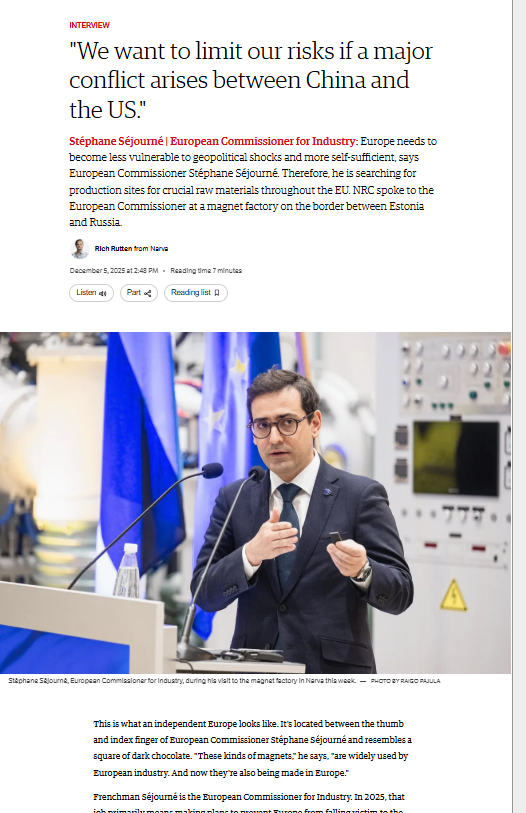
Revealing interview with EU industry chief Séjourné by @rik_rutten on rare earths
"Last month, I was supposed to go to Brazil to discuss a rare earth mine. 3 days beforehand we were told that the Americans had come, put money on the table, and bought all production until 2030"
My AI investment thesis is that every AI application startup is likely to be crushed by rapid expansion of the foundational model providers.
App functionality will be added to the foundational models' offerings, because the big players aren't slow incumbents (it is wrong to apply the analogy of "fast startup, slow incumbent" here), they are just big. Far more so than with any other prior new technology, there is a massive and fast-moving wave that obsoletes every new app almost as fast as it can be invented. There is almost no time to build a company and scale it.
There are two ways AI application startup founders can make money:
- Make a flash-in-the-pan app that generates a ton of cash and bank the cash (my estimate is that you have about 12-18 months cashflow generation)
- Make a good enough app that you get acquired by one of the big players for sufficient equity
The situation is highly unstable - we don't know if it's going to crash or go to the moon but both scenarios make it very unlikely that any AI application startup will independently become a generational supercompany (baseline odds are low to begin with).
The best odds are finding an application niche in a highly specialized field with extremely unique and specific data barriers, ideally ones relating to real atoms (hardware or world-related) data and not software/finance.
🔴 Débats budgétaires ▶ "J’étais atterré par le niveau intellectuel et économique de certains députés. Certains ne comprennent absolument rien à l’économie et ne font pas leur travail sérieusement. D’autres oui", assure Philippe Aghion, prix Nobel d’économie
Le directeur de la stratégie d'Airbus a été récemment auditionné au Sénat. Ce qu'il dit rejoint ceux qui sont précédemment passé à sa place concernant la désindustrialisation :
- la France tabasse les entreprises d'impôts et de charges
- la France sur-réglemente tout.
Vidéo complète ici :
https://t.co/lvJ269ZRrl
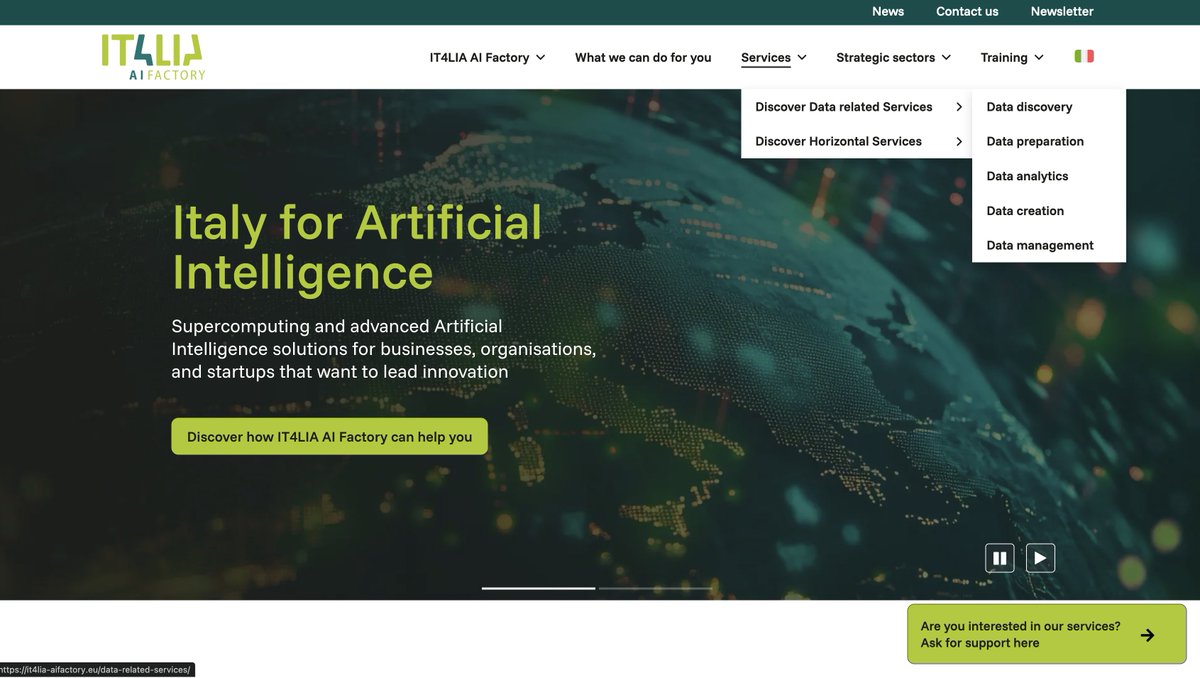
What in the F is an AI factory?
I had to investigate what the unelected @EU_Commission is talking about today
So according to them, it's some data centers (which they call supercomputers) in 6 different EU countries
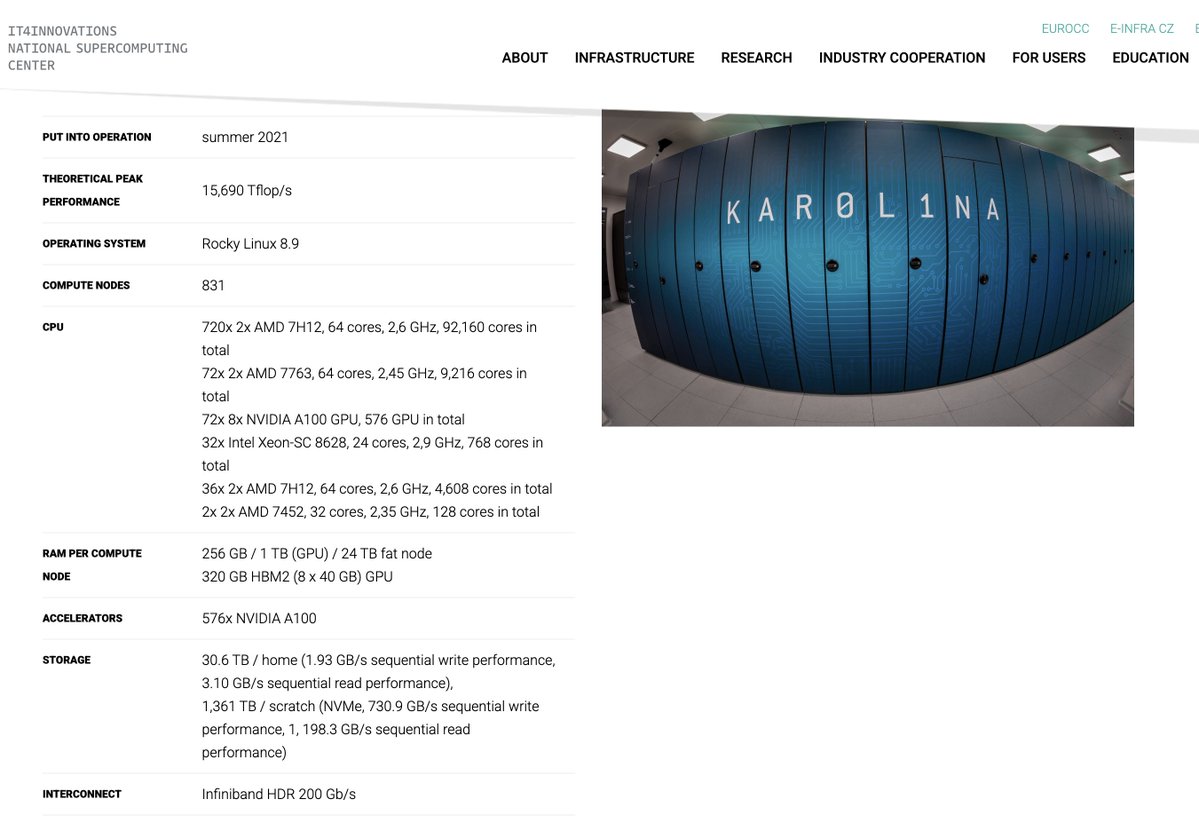
I checked out the most powerful one: Karolina, a Czech data center, it mostly has CPUs though (see pic) not GPUs, so mostly useless for AI
The GPUs it does have are 72x 8x NVIDIA A100 GPU, so 576x A100, or equivalent of 240x H100s
(H100 is about 2.4x the compute power of A100)
So let's compare that:
@xAI has 200,000x H100 GPUs
So the xAI data center has 800x more compute than the Czech one
If we combine xAI, Meta, AWS, etc. it's about 750,000 H100s
If we assume the other 5 data centers in the EU are equivalent to the Czech one (which is massive stretch because most of the others seem AI consultacny services, they don't even HAVE chips!), the EU's new "AI factories" have a total of 1,440x H100 GPUs, let's round up to 1,500 to be nice
So the EU is trying to compete with 750,000 GPUs with their own 1,500 GPUs, so 500x less??
Correct me if I'm wrong but it's just seems very low impact and another ridiculous idea and burning of EU tax payers money that will end up in local cronies and bureaucrats and will do NOTHING to improve the AI business climate for Europe
The best way to improve it is to deregulate, make it super easy and low tax (especially when starting out) to start AI companies in Europe
🚨 Novak Djokovic about Jelena (his wife) :
“She’s the only relationship I’ve had in my life and She’s my rock. We’ve grown together. I always want her feedback, I still play tennis because she takes care of home. She’s the best partner in every way”