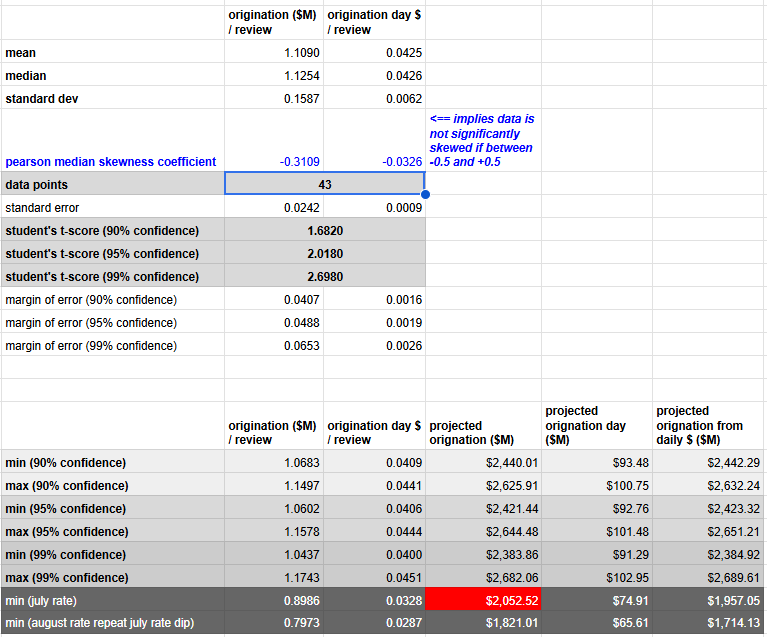
@ManufortiCanada@parthpat87 the implication here is review rate for August was likely a little over 1%... which all time is within range but not for modern era (>July 2024)...
@ManufortiCanada@parthpat87 it's a good point.
btw, I wouldn't say 3rd party doesn't generate reviews but rather generates at a much lower rate. I say this because I have observed review samplings which reference the CU or bank through which the loan was received.
@parthpat87 One thing to note which implies a return to norm for August review efficiency... Observe the review efficiency of May-August 2025... May through July, the exact same pattern occurred as 2026, but August returned to above June level representing a return to norm. $upst
@KaySchnd@StockZombie222@HenryInvests fwiw, your method applied to my prediction is -$231.48... not too far off your -300 estimate... both put August OV right around $2B ballpark...
@parthpat87 I have no reason to believe review efficiency will take a historically odd dip again in August. Likewise, a return to norm for review efficiency seems too optimistic and equally unlikely with what we know. Safest bet, to me, is repeating July's review efficiency.
@KaySchnd@StockZombie222@HenryInvests I haven't double checked your numbers but seems somewhat misleading expressed as absolute values vs relative percentage change. Either way, July is the oddball in which more reviews led to less origination $. This is why I have used it as the baseline.
August efficiency could repeat July, return to modern era (> 7/1/2024) historical norms after one-time outlier, or dip big again. IMHO, most likely scenario July efficiency is new baseline for a variety of known/unknown factors. Dipping again like July seems unlikely. $UPST
Obviously a huge jump in UOV on par with the jump in reviews for August.
Calculation is based on origination review efficiency dip in July repeating in August. July was lowest such efficiency in modern $UPST era.