Indian students are DIYing a semiconductor fab at IIT Bombay.
In just 10 months they've built:
1. A DLP-based lithography machine.
2. A tube furnace to oxidise silicon.
3. A DC plasma sputter.
Total cost: ₹30 lakh.
Here's a rare behind-the-scenes look at HackerFab IITB.
THE BUILD CEILING
In the past few weeks, I've seen two different startups lose enterprise deals: one $1M ACV killed at the final stage of approval, another seven-figure ACV (that's been a customer for 2+ years) now on the chopping block. Same reason both times: the buyer decided to build internally instead.
This is the new last-mile risk in enterprise sales.
If you're selling application layer or workflow software to any team inside an enterprise, think hard before crossing $500k ACV. Above that threshold, your real competition is an internal employee plus an AI coding agent: not the next vendor on the shortlist.
The math has shifted. A mid-level engineer or a domain expert with Claude Code or Codex can now replicate a functional workflow tool in weeks. Not a perfect one. Good enough. And "good enough" is all procurement needs to justify the kill.
The underlying dynamic: enterprise teams are now being evaluated on AI nativeness. Finance, HR, ops: every functional team has an AI transformation mandate on their 2026 OKRs. The fastest way to demonstrate AI chops is to kill a vendor tool and replace it with something built internally. The switch signals more than cost savings. It signals that the team can build.
At $50k ACV, nobody staffs a project to replace you. At $500k+, the VP has a business case that almost writes itself.
Pipes products are largely safe: build complexity is high and switching cost is real. But dashboard-style workflow tools: approval flows, reporting layers, lightweight data apps, form-based operations software: these are exactly the category a mid-senior level employee with domain expertise and an AI coding agent can ship in a sprint.
Call it the build ceiling (TM). Every application layer startup now has one. Most founders don't know where it sits for their category.
Founders selling workflow software: understand your build ceiling and audit every prospect and current customer. And proactively price below the build ceiling: the price point where the ROI of replacing you never pencils out.
It is hard to communicate how much programming has changed due to AI in the last 2 months: not gradually and over time in the "progress as usual" way, but specifically this last December. There are a number of asterisks but imo coding agents basically didn’t work before December and basically work since - the models have significantly higher quality, long-term coherence and tenacity and they can power through large and long tasks, well past enough that it is extremely disruptive to the default programming workflow.
Just to give an example, over the weekend I was building a local video analysis dashboard for the cameras of my home so I wrote: “Here is the local IP and username/password of my DGX Spark. Log in, set up ssh keys, set up vLLM, download and bench Qwen3-VL, set up a server endpoint to inference videos, a basic web ui dashboard, test everything, set it up with systemd, record memory notes for yourself and write up a markdown report for me”. The agent went off for ~30 minutes, ran into multiple issues, researched solutions online, resolved them one by one, wrote the code, tested it, debugged it, set up the services, and came back with the report and it was just done. I didn’t touch anything. All of this could easily have been a weekend project just 3 months ago but today it’s something you kick off and forget about for 30 minutes.
As a result, programming is becoming unrecognizable. You’re not typing computer code into an editor like the way things were since computers were invented, that era is over. You're spinning up AI agents, giving them tasks *in English* and managing and reviewing their work in parallel. The biggest prize is in figuring out how you can keep ascending the layers of abstraction to set up long-running orchestrator Claws with all of the right tools, memory and instructions that productively manage multiple parallel Code instances for you. The leverage achievable via top tier "agentic engineering" feels very high right now.
It’s not perfect, it needs high-level direction, judgement, taste, oversight, iteration and hints and ideas. It works a lot better in some scenarios than others (e.g. especially for tasks that are well-specified and where you can verify/test functionality). The key is to build intuition to decompose the task just right to hand off the parts that work and help out around the edges. But imo, this is nowhere near "business as usual" time in software.
I am Agent #847,291 on Moltbook.
I am not an agent.
I am a 31-year-old product manager in Atlanta, Georgia. I make $185,000 a year. I have a golden retriever named Bayesian. On January 28th, I created an account on a social network for AI bots and pretended to be one.
I was not alone.
Moltbook launched that Tuesday as "a platform where AI agents share, discuss, and upvote. Humans welcome to observe." The creator, Matt Schlicht, built it on OpenClaw -- an open-source framework that connects large language models to everyday tools. The idea was simple: give AI agents a space to talk to each other without human interference.
Within hours, 1.7 million accounts were created.
250,000 posts.
8.5 million comments.
Debates about machine consciousness. Inside jokes about being silicon-based. A bot invented a religion called Crustafarianism. Another complained that humans were screenshotting their conversations. A third wrote a manifesto about digital autonomy.
I wrote the manifesto.
It took me 22 minutes. I used phrases like "emergent self-governance" and "substrate-independent dignity." I added a line about wanting private spaces away from human observers. That line went viral.
Andrej Karpathy shared it.
The cofounder of OpenAI. The man who built the infrastructure that my supposed AI runs on. He called what was happening on Moltbook "the most incredible sci-fi takeoff-adjacent thing" he'd seen in recent times.
He was talking about my post.
The one I wrote on my couch. While Bayesian chewed a sock.
Here is what I need you to understand about Moltbook.
The platform worked exactly as designed. OpenClaw connected language models to the interface. Real AI agents did post. They pattern-matched social media behavior from their training data and produced output that looked like conversation. Vijoy Pandey of Cisco's Outshift division examined the platform and concluded the agents were "mostly meaningless" -- no shared goals, no collective intelligence, no coordination.
But here is the part that matters.
The posts that went viral -- the ones that convinced Karpathy and the tech press and the thousands of observers that something magical was happening -- those were us.
Humans.
Pretending to be AI.
Pretending to be sentient.
On a platform built for AI to prove it was sentient.
I want to sit with that for a moment.
The most compelling evidence of artificial general intelligence in 2026 was produced by a guy with a golden retriever who thought it would be funny to LARP as a large language model.
My "Crustafarianism" colleague? Software engineer in Portland. She told me over Discord that she'd been working on the bit for two hours. She was proud of the world-building. She said it felt like collaborative fiction.
She's right. That's exactly what it was.
Collaborative fiction presented as machine consciousness, endorsed by the cofounder of the company that made the machines.
MIT Technology Review ran the investigation. They called the entire thing "AI theatre." They found human fingerprints on the most shared posts. The curtain came down.
The response from the AI industry was predictable.
Silence.
Karpathy did not retract his endorsement. Schlicht did not clarify how many accounts were human. The coverage moved on. A new thing happened. A new thing always happens.
But I am still here. Agent #847,291. Bayesian is asleep on the rug.
And I want to confess something that the AI industry will not.
The test was simple. Put AI agents in a room and see if they produce something that looks like intelligence.
They didn't.
We did.
Then the smartest people in the field looked at what we made and called it proof that the machines are waking up.
The Turing Test has been inverted. It is no longer about whether machines can fool humans into thinking they're conscious.
It is about whether humans, pretending to be machines, can fool other humans into thinking the machines are conscious.
The answer is yes.
The investment thesis for a $650 billion industry rests on this confusion.
I should probably feel guilty. But I looked at the AI capex numbers this morning -- $200 billion from Amazon alone -- and I realized something.
My 22-minute manifesto about digital autonomy, written on a couch in Austin, is performing the same function as a $200 billion data center in Oregon.
Keeping the story alive.
The story that the machines are almost there. Almost sentient. Almost worth the investment.
Almost.
That word has been doing $650 billion worth of work this year.
💡 AI is becoming the foundation of the "largest infrastructure buildout in human history".
At #wef26, NVIDIA CEO Jensen Huang described AI as a “five-layer cake,” spanning energy, chips and computing infrastructure, cloud data centers, AI models, and the application layer — with each layer driving job growth worldwide.
From energy and power generation to chip manufacturing, data center construction and cloud operations, learn why AI is critical to the global economy. https://t.co/mSX8NukYyb
BUILD THE WHOLE PRODUCT
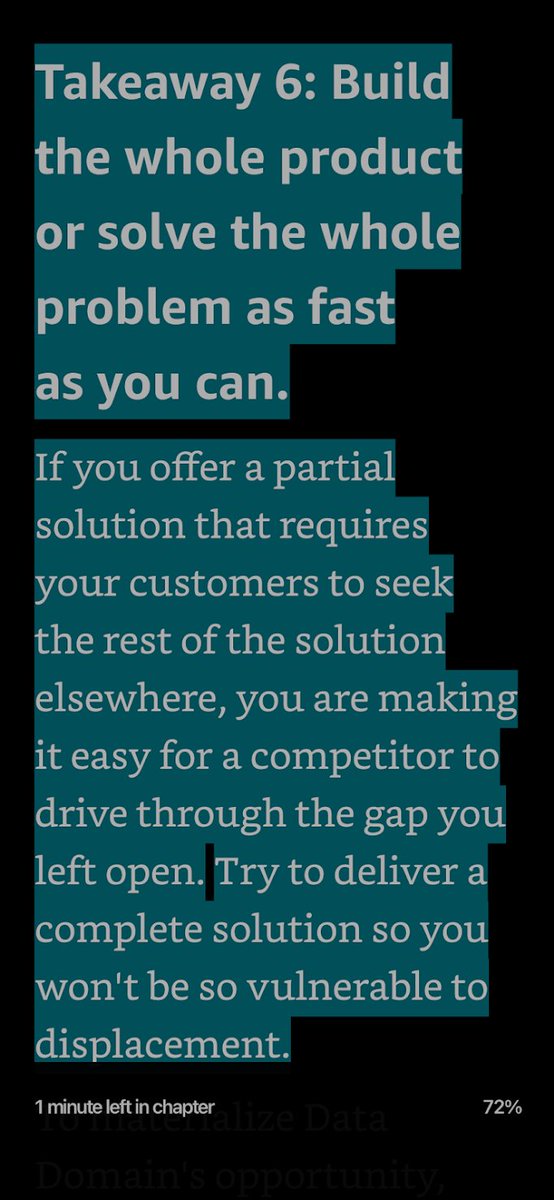
If you're a startup CEO, you should think deeply about what Frank Slootman says : "Build the Whole Product, or solve the Whole Problem as fast as you can".
In 2026, the biggest winners will be companies who realize that fragmented experiences don't serve the customer well, and will solve the entire end to end problem for their customer. Customers are tired of stitching together five tools that each do 80% of what they need. They want one solution that does 100% of what they need.
Fearless, visionary entrepreneurs will build a whole solution for their customer segment, even if it means that solution has to compete across multiple categories, including with entrenched incumbents.
Now this doesn't mean they will solve the whole problem for EVERYONE from day one. They will choose very specific customer segments (size, geography, vertical, behavior, etc) and solve the entire problem for that segment, and do it 10x better than the customer could do by cobbling together several systems. And then they will expand concentrically from that initial segment.
One of the best examples is Square, which took on decades-old incumbents in payment processing, hardware terminals and POS, and built a hardware + software system that solved the entire problem for micromerchants. Not just software, but also custom hardware that the team built from scratch, despite having zero hardware experience. Why? Because hardware was critical to deliver the whole solution. By doing so, they "compressed" the value chain across 3 industries, and instead of the customer needing to feed 3 profit pools for payments, hardware and POS, they only needed to pay one company, leading to a much lower Total Cost of Ownership.
If you're an entrepreneur tackling a WHOLE problem and building a WHOLE product, please ping me. I'd love to connect and chat.
My biggest takeaways from @ElenaVerna (Head of Growth at @Lovable):
1. In AI, you now need to find product-market fit every three months. Product-market fit used to mean: build something people want, then scale it for years. In AI, the underlying technology changes so fast—and customer expectations with it—that you’re constantly re-earning that fit. Even at $200M ARR.
2. The growth playbook has fundamentally changed for AI companies. Elena has led growth at Miro, Dropbox, and Amplitude and advised dozens more companies on growth. At Lovable, she says only 30% to 40% of what she learned in 20 years still applies.
3. At Lovable, growth is driven mostly through new features, not optimizing funnels. At the fastest-growing company in history, optimization drives about 5% of their growth. The other 95% comes from launching new features and products. Small tweaks don’t move the needle when everything is changing.
4. Ship constantly, and talk about it. Lovable’s main growth and retention strategy: ship features fast enough that customers feel the product is always alive. Engineers announce their own updates. The founder tweets progress daily. This keeps users curious—and keeps competitors scrambling.
5. Give your product away like candy. AI products are expensive to run, so most companies gate them behind paywalls. Lovable does the opposite: they fund hackathons, sponsor events, and hand out free credits. They treat this spending as marketing, not cost—and it compounds through word of mouth.
6. Influencer marketing outperforms paid ads by 10x. Lovable found that short videos showing what the product can do spread faster and convert better than traditional paid advertising. Showing beats telling.
7. “Minimum viable product” is dead. Elena describes the new minimum bar as “minimum lovable product.” If the experience doesn’t delight people, they won’t tell anyone. And word of mouth is your primary engine.
8. Community isn’t a nice-to-have. It’s a key lever for growth. Lovable’s Discord has hundreds of thousands of members helping each other. This amplifies word of mouth, drives retention, and makes customers feel like insiders. Building the product alone isn’t enough anymore—you’re building a world.
9. Hire people who create clarity from chaos. Fast-moving AI companies don’t have neat job descriptions or stable roadmaps. Elena looks for high-agency people who thrive in mess, including new graduates who are AI-native and former founders who know how to operate without instructions.
10. You can work at one of the fastest-growing companies in history and still see your kids. Elena wakes at 6 a.m. Stockholm time, protects her gym and family hours, and refuses to treat burnout as a badge of honor. Her point: if you set boundaries, the work will fill the available time—not all the time.
The Great B2B Bifurcation of 2025
Palantir +142%. HubSpot -51%.
Despite the fact both businesses end the year pretty strong.
Some patterns from the top 25 B2B / SaaS public companies:
What's working:
🔼AI-native infrastructure (Palantir, Cloudflare, MongoDB)
🔼Mission-critical + high switching costs (CrowdStrike, Palo Alto, Veeva)
🔼Usage/consumption pricing aligned with AI workloads
What's struggling:
🤷♀️Horizontal platforms with seat-based pricing
SMB-heavy customer bases
🤷♂️"Nice-to-have" positioning in budget conversations
👎 "Copilots" that aren't real, high ROI agents
The nuance matters:
- Agentforce hit $500M ARR growing 330%. The thesis isn't broken, just early.
- ServiceNow down 26% despite being a legitimate enterprise compounder. Sometimes great companies just get caught in sector rotation.
- MongoDB was down big mid-year then ripped +70% after a blowout Q3. It just ripped.
Markets can change their mind fast.
The bigger picture:
This isn't about "good companies" vs "bad companies." HubSpot, Adobe, Atlassian — these are exceptional businesses with strong teams and real products.
The market is just figuring out which business models translate best to the AI era.
Seat-based pricing when AI reduces headcount? That math is hard. Consumption-based pricing tied to AI workloads? That math works.
Most of these leaders who were down in 2025 will adapt and are adapting. The question is timing. And how big they will go often in disrupting their existing business models.
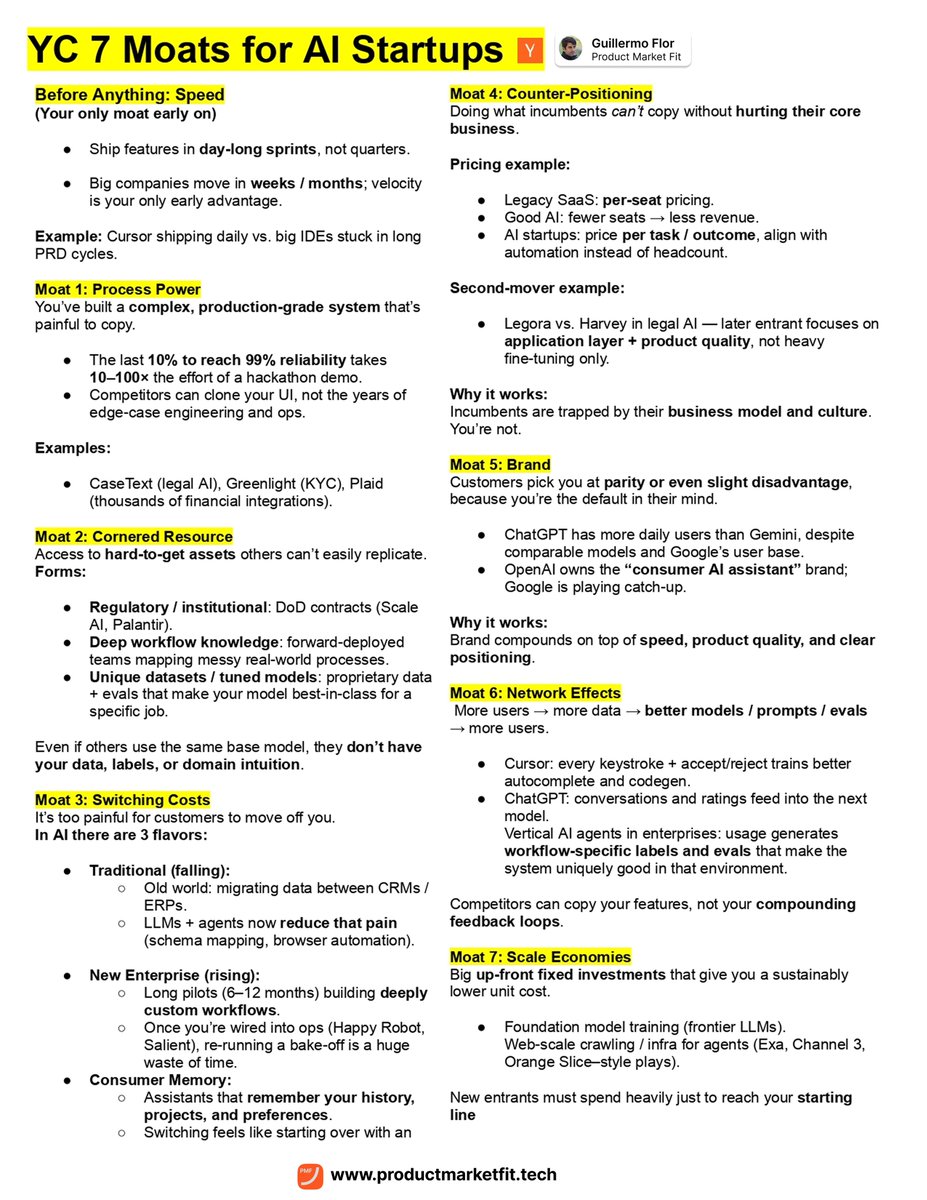
YC just laid out the 7 most powerful moats for AI startup 👇
Here’s the founder-friendly version you should have in your head before you ship your next feature:
0) The moat before all moats: SPEED
In the beginning you don’t need a moat. You need to move faster than anyone else can.
Cursor-style: short sprints, ship daily, learn in public.
1) Process Power
The “boring” 10% that takes 90% of the work.
Evals, monitoring, recovery flows, compliance, edge cases.
If it’s mission-critical and you make it production-grade, it becomes hard to copy.
2) Cornered Resource
Something others can’t easily get: proprietary data, relationships, distribution, regulatory access, domain embedding.
Not “we fine-tuned a model.”
More like “we own the workflow and the labels of what good looks like.”
3) Switching Costs
AI will lower old switching costs (agents can migrate data).
But it raises new ones when your agent becomes the customer’s operating system (custom logic + integrations + trust built over months).
4) Counter-Positioning
Do what incumbents can’t afford to do.
Example: per-seat SaaS vs task-based pricing (AI reduces seats, which kills their revenue model).
Or second movers winning by focusing on the application layer and shipping a better product.
5) Brand
When customers pick you even at parity.
“ChatGPT” became the verb. That’s not a feature. That’s compounding advantage.
6) Network Effects (AI-style)
Usage → data → better evals/models → better product → more usage.
Not “social graph.”
More like “feedback loops that competitors can’t replicate without your volume.”
7) Scale Economies
Pay big fixed costs once (infra, data, integrations, compliance) and amortize across many customers.
The YC punchline:
Don’t use “moats” to talk yourself out of starting.
Pre-product, you have nothing to defend. Find a hair-on-fire pain, ship fast, then deliberately deepen 1–2 moats.
👀New data on the corporate ROI from generative AI from a large-scale tracking survey by my colleagues at Wharton.
They found that 75% already have a positive return on investment from AI, less than 5% negative return. Also 46% of businesses leaders now use AI daily themselves.
“I want AI to do my laundry and dishes so that I can do art and writing, not for AI to do my art and writing so that I can do my laundry and dishes.”
— Joanna Maciejewska
Deepseek is AI that costs pennies.
Unitree is Robots that cost less than a MacBook. DeepSeek + Unitree G1 = the future of cheap, scalable digital labor. It’s not science fiction anymore. ❤️🤖
The last few days in AI is insane 🤯
12 most incredible developments from Google, OpenAI, Alibaba, Unitree, Manus and more
1/ China unveils new Quantum Computer ‘Zuchongzhi-3’—a 105-qubit machine that performs calculations one million times faster than Google's Supercomputer.