OG GenAI Skeptic; spoke at US Senate. Warned about hallucinations in 2001. Advocating world models & neurosymbolic AI ever since. Author, Marcus on AI & 6 books
Three thoughts on what really matters:
1. Fuck cancer
2. Friends are irreplaceable
3. The new "Marcus test" for AI is when AI makes a significant dent on cancer
May that happen sooner, much sooner, rather than later.
In memory of my childhood friend Paul.
“.the core question is whether demand keeps outgrowing committed cost.”
Anthropic’s slower Q3 combined with its massive future commitments suggests it won’t.
In which case it all falls apart.
15/16 also, don't confuse exposure with failure. anthropic had $16.3b of first-half revenue; compute expense was 55% of sales versus 201% a year earlier. the core question is whether demand keeps outgrowing committed cost.
CEO of snowflake joining Elon in calling top
When your competitor is over levered and you’re under levered in a bull market, your goal is to trigger a bank run
This way you tank the over levered players and look like a genius catching their customers on their way down
Bold
Anthropic as an organization is a bunch of millenarian fanatics chasing the dream of building Digital God. Anthropic as a potentially megaprofit-earning company is quite another beast. Its executives and engineers have to pretend to be the second to do the first. (1/4)
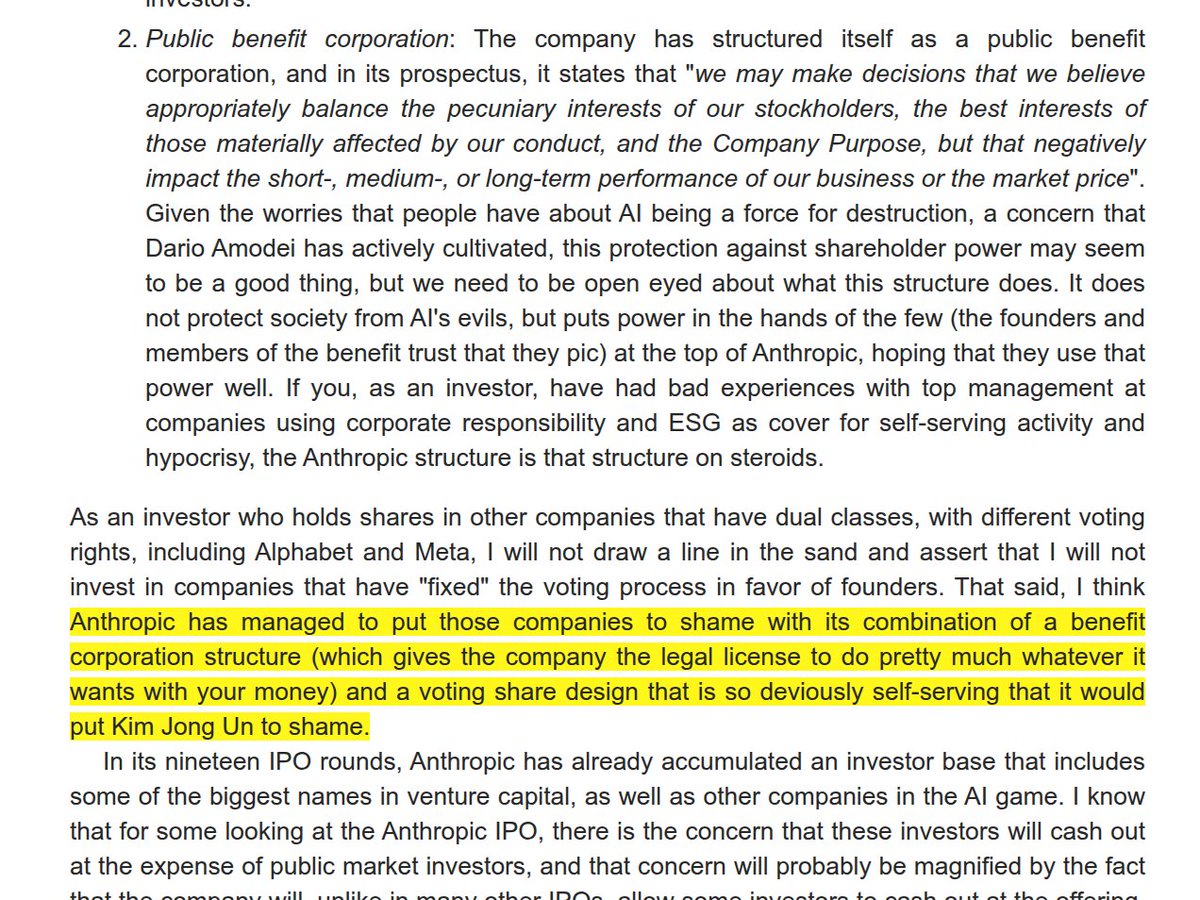
Dean of Valuation Professor Aswath Damodaran just published a long post valuing Anthropic at $1.475T.
He says Anthropic’s voting setup, where 7 co-founders hold 50.1% of votes through a single share, “would put Kim Jong Un to shame.”
> Anthropic is growing fast but slowing: first-half revenue was about 14x a year earlier, then third-quarter growth cooled as OpenAI won share and Anthropic ran short of compute.
> The headline $80.7B first-half loss is mostly a $72B non-cash bond charge; the real operating loss was just over $8B, and Anthropic says it made an operating profit last quarter.
> The biggest risk is over $600B in compute commitments, a fixed bill owed even if growth stalls, while founders hold 50.1% of votes, leaving public shareholders little say.
Free newsletter: Anthropic’s S-1 uses an anomalous quarter to con investors into becoming its exit liquidity, and explicitly states that its costs will grow aggressively as margins decline. Its $430bn in non-cancellable contracts are yet to start hitting.
https://t.co/YjzKFvUNMG
“With non-GAAP earnings metrics lacking a common standard and recurring costs routinely excluded from calculations, investors risk being presented with a DISTORTED picture of profitability just as the AI frenzy spread across public markets.
The 'AI boom' may be far less profitable than headline growth suggests.”
The AI EARNINGS ILLUSION is getting harder to defend:
Anthropic reported an -$80.7 billion net LOSS in H1 2026, yet its nonstandard adjusted metric showed a +$2.7 billion profit.
That adjusted figure excludes -$72 billion in liability valuation losses, -$9 billion in losses on other financial instruments, and -$2 billion in stock-based compensation.
The -$72 billion charge largely reflects the increased accounting value of convertible notes as Anthropic's valuation soared.
Meanwhile, Amazon, $AMZN, booked ~$63 billion in equity investment gains, primarily from Anthropic, accounting for most of its pretax profit, while Alphabet, $GOOGL, recorded $136 billion in investment gains, also representing most of its pretax profit.
Notably, Wall Street applies these inconsistent rules by excluding Anthropic's paper losses from its adjusted earnings while counting the corresponding paper gains from the same financing deals in Amazon and Alphabet earnings.
In Q2 2026 alone, gains at Amazon and Alphabet represented ~15% of S&P 500 earnings, raising serious questions about how much reported corporate profitability reflects actual operating performance.
With non-GAAP earnings metrics lacking a common standard and recurring costs routinely excluded from calculations, investors risk being presented with a DISTORTED picture of profitability just as the AI frenzy spread across public markets.
The 'AI boom' may be far less profitable than headline growth suggests.
This is one of the most important pieces of social science on human and AI interaction that I’ve seen in some time. Experts follow agentic advice the vast majority of the time (causally), but only a tiny fraction credit the agent—majority think they came to decision on their own volition.
Reminds me of the classic Nisbett and Wilson study on people following outside influence without realizing it
“ But as more work is handed to AI—including AI safety research—these judgment calls are the main levers for people's own values to influence outcomes.
If people defer to AI without noticing, then "human in the loop" might provide less assurance than people expect.”
AI's "Low-Cost Carriers" Are Eating The Frontier Labs Alive; Citadel Securities Says Tokenomics 2.0 Is Here And Margins Are Getting Destroyed https://t.co/rQtATpzJ5O
⚠️ RESEARCH: LLM token prices down 55% from the May top and now below where they started the year. Great for anyone using AI but not so great for the companies spending $165B a quarter on capex.
What if Anthropic just...stopped? Unilaterally? Right now?
I talked to @DKokotajlo@_NathanCalvin@geoffreyirving about why it's time to stop framing AI as a prisoner's dilemma and just do the right thing.
I hope a lot of people inside and outside Anthropic read this
🧵 1/n
there are just too many misrepresentations here to unpack. stochastic parrots isn’t my term and i didn’t endorse it; the s-1 has problems i have already shared( my principal claim was that LLMs wounpt work without adding symbols and now everybody adds symbols, so i was correct, etc
short version: read my actual work if you want to know my actual views.
Meta had an internal PR plan to try and discredit Jon Haidt because he was a critic of social media.
Meta was going to recruit academics, like Andrew Gelman, to write take down pieces. They were trying to turn academics against one another through a "whisper strategy".
This is a very serious problem for open academic debate. If academics who share negative evidence about a platform are targeted by campaigns to smear our credibility, we are in deep, deep trouble.
This creates a very serious conflict of interest for anyone who is paid to do this.
https://t.co/5Zxfm1h8Db
@TaylorLorenz what are you talking about? i don’t happen to agree w some of what Haidt says but he has been a professor at UVA and then NYU for something like 30 years.
it’s very strange to say he is not academic just because you disagree with his views or people pay him speaking fees.