@SephSeddon @csferrie Information is the number of possibilities. If something has d possibilities, I can use its state to write down something else with that many possibilities (and we say that's log_2(d) bits). Then, anything can be used to convey information, but in itself, information is a number
@brijhcu@csferrie Gonna be a bit more specific: the no-deleting theorem forbids deleting an unknown q. state via a closed quantum evolution. At best you can move around the state, but not get rid of it. It has to always be recoverable. That kT ln(2) emission? That's the information you just reset
@brijhcu@csferrie The no-deleting theorem forbids resetting an unknown q. state. At best you can swap it with a "clean" |0> state, and then dump the "dirty" state into a reservoir, emitting in avg kT ln(2) units of heat (assuming it was a qubit), which just happens to be Landauer's heat emission.
@brijhcu@csferrie I wouldn't be overly critical with the phrase "no physical connection". We all know what that means (and it does not mean "unphysical").
Information IS physical, yes. Landauer's heat-emitting erasure does point in that direction, and it has a link to the no-deleting theorem too.
⬇️CONDUCTAS DE MALTRATO EN LA ISLA DE LAS TENTACIONES⬇️
Casi en el día Internacional para la Eliminación de la Violencia contra la Mujer, tuvo lugar una situación clarísima de violencia psicológica en uno de los programas de televisión más vistos del país.
@ppalaciosav@astrocarlaa@litolobo Hey Pablo, te vi firmar no una, sino DOS veces en el "pronunciamiento de académicos sobre mal uso de análisis estadísticos"
Giancarlo Gatti: ¿Cuál es el futuro de la computación cuántica? Nuevo post en "Los caminos de Feynman" No se lo pierdan! @joancaceresr @nmonteblanco@KikeSolanoPhys https://t.co/Fd8c466lT2
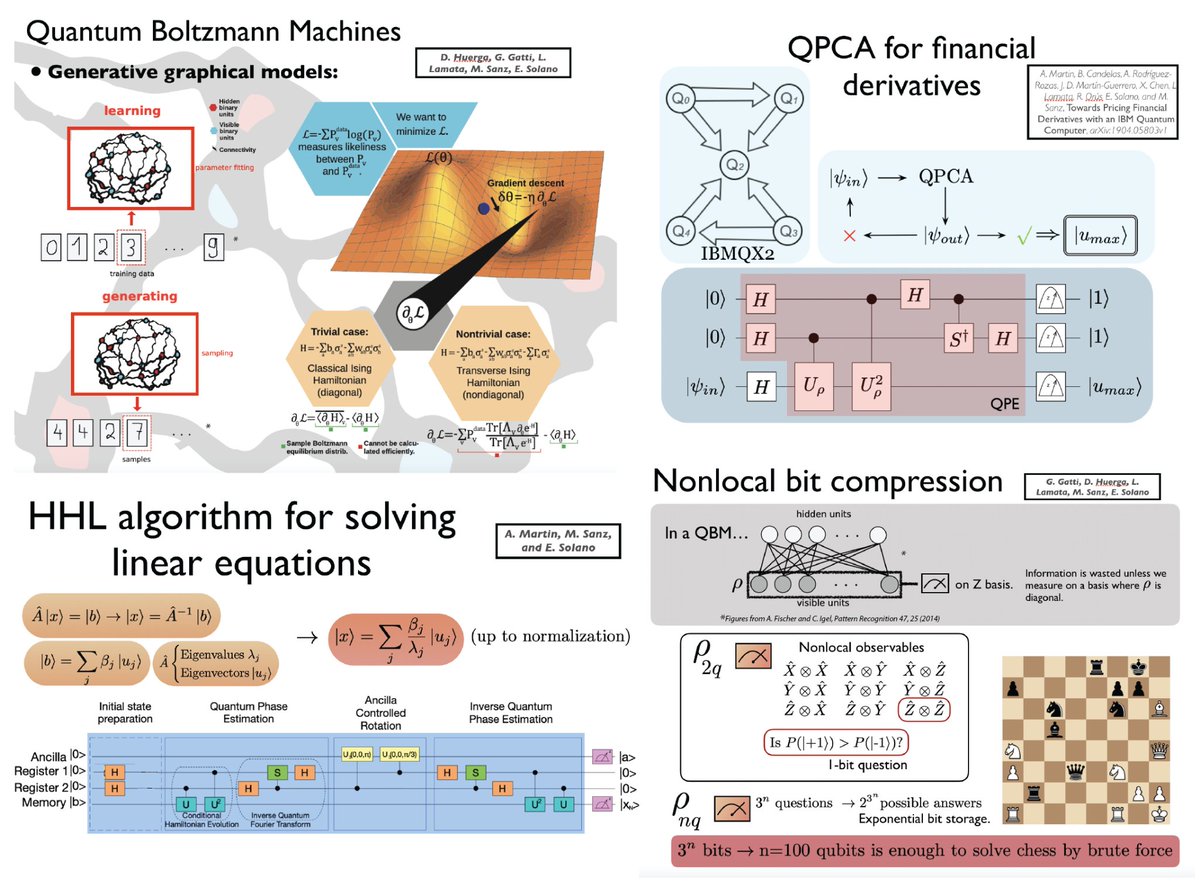
This protocol shows quantum advantage over state-of-the-art information storage capacity (a cloud server of 1 billion users with 100GB each) for more than 44 qubits. Also, just for fun, systems above 100 qubits would be sufficient to encode a brute force solution for chess. (2/2)
Our new paper in #arxiv today: "Random Access codes via quantum contextual redundancy", with
D. Huerga, @KikeSolanoPhys & @qmisanz
https://t.co/VyuQx5Y8j5. We propose a protocol to compress classical information in quantum systems, leveraging redundancy in quantum contexts (1/2)
Gracias por darlo TODO. Absolutamente todo. Me duele en el alma, y quiero gritarles que no fue en vano, que el país levanta la mirada y no vuelve a olvidar. #ContigoPeru#PeruDeLuto#heroesdelbicentenario
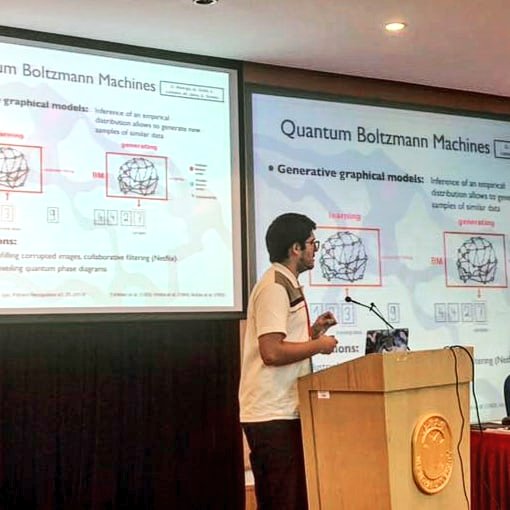
These are the four quantum algorithms that I presented in "Quantum Technologies: Academia Meets Industry" of Shanghai University & Huawei last week. Research currently underway by the QUTIS OpenSuperQ team: @qmisanz, D. Huerga, @quantum_ana, and I.
@QUTIS3 @OpenSuperQ @artist_qu