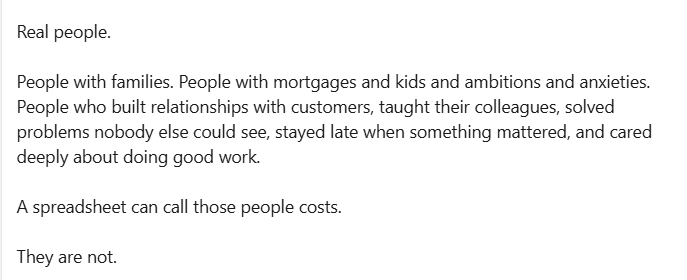
The industry has gone completely nuts.
Use tokens to generate AI code and documentation slop. Then use even more tokens to understand and review that slop.
Then judge engineers by token usage instead of how empathetic and clear their docs and code actually are, and completely neglect human comprehension.
Utter nonsense.
We are investigating unauthorized access to GitHub’s internal repositories. While we currently have no evidence of impact to customer information stored outside of GitHub’s internal repositories (such as our customers’ enterprises, organizations, and repositories), we are closely monitoring our infrastructure for follow-on activity.
@Starcloud_Inc1@ycombinator@nvidia Congratulations on launching the Nvidia H100 into space. I am pretty sure that will see more players joining the race with you to push datacenters into space.
If you work with databases, especially as a software developer, it's important to understand the difference between partitioning and sharding.
📌 𝐏𝐚𝐫𝐭𝐢𝐭𝐢𝐨𝐧𝐢𝐧𝐠 => the process of splitting a large table or index into smaller, more manageable pieces called partitions.
But remember,
◾ These partitions reside within the same database instance, sharing the same resources and management system.
◾ They cannot span multiple databases.
◾ But, they can be distributed across multiple storage devices within the same server.
◾ The database system parses the incoming query and based on the partition key values , it determines which partitions potentially contain the relevant data.
Horizontal Partitioning => partitioning by rows. (each partition has the same schema.)
Vertical Partitioning => partitioning by columns. (each partition contains a subset of the columns)
📌 𝐒𝐡𝐚𝐫𝐝𝐢𝐧𝐠 => take partitioning (usually -> horizontal partitioning) a step further by distributing data (partitions) across multiple database instances, each running on a separate server/node => it becomes Sharding 😉.
◾ These instances are called shards and each shard stores a portion of the overall data.
◾ When an application sends a query to the database, it's crucial to direct that query to the correct shard where the relevant data resides.
◾ This process is => query routing.
Remember,
◾ Sharding prioritizes scalability, making even data distribution across shards paramount.
◾ Partitioning focuses on query optimization within a single instance, so the query access patterns are more critical.
So,
Choosing the Right Partitioning or Sharding Key mainly involves :
(Common)
1. Cardinality - How many unique values are there in the column? (Uneven data distribution can lead to "hot spots")
2. Data Distribution - How evenly is the data distributed across those values?
3. Query Patterns - How will your application be querying the data?
(Subtle Differences)
4. Shard Key Immutability -The sharding key is ideally immutable (unchanging) to avoid the complexities and costs associated with re-sharding data if the key changes.
5. Growth Pattern - Choose a Partition key that can accommodate future data growth without requiring frequent repartitioning.
Follow @techNmak for your daily dose of tech insights.
how bad does the google cloud outage affecting business all over the world ?
I see lot of services getting down.
(Discord, Spotify, Twitch.)
Do you still wanted to go for single cloud provider for designing your complete system design ?
https://t.co/SGEzOeDocO
#GoogleCloudDown
Today i have tried to implement the MCP server with the help of Spring AI In my local machine. It is so hassle free and easy to implement.
Used Claude desktop as a MCP client.
I know java is verbose, spring made it very easy by making it plug and play config.
#SpringAI#MCP