What if an Armenian man changed agriculture in southern France? 🇦🇲🇫🇷
Meet Hovhannes Althounian, better known in France as Jean Althen.
Born in the early 18th century, Hovhannes became an expert in cultivating madder – a plant whose roots were used to produce a vivid red dye. 🌱
When he eventually made his way to France, he brought his knowledge of madder cultivation with him.
In 1758, he introduced the crop to the Vaucluse region of southern France.
Madder soon became an important agricultural crop, contributing to the region’s prosperity & establishing a lasting connection between an Armenian cultivator & the agricultural history of Provence.
Thousands of kilometres from his homeland, Hovhannes Althounian left behind more than his name.
He left behind knowledge, a crop, & a legacy.❤️
A statue of Jean Althen stands in the Jardin du Rocher des Doms in Avignon, overlooking the Rhône.
What other Armenian contributions have left their mark on the world?🌍
‼️BREAKING NEWS‼️
Archaeologists uncover one of the world’s oldest churches: “Sensational testimony to early Christianity” CBS NEWS
Archaeologists have unearthed the remains of an Armenian church dating back almost 2,000 years, making it the oldest structure of its kind in the country and one of the oldest in the world. Germany’s University of Münster, which partnered with a team at the Armenian Academy of Sciences on the archaeological dig, announced the discovery Friday and called it “a sensational testimony to early Christianity in Armenia.”
The joint team of archaeologists and researchers uncovered the building during excavations in Artaxata, once a thriving metropolis and commercial center, which for several centuries before and after the common era served as the capital of the ancient Armenian kingdom. Excavations were part of the larger Armenian-German Artaxata Project, an initiative started in 2018 to study the area.
Experts believe the church found recently in Artaxata was originally built in the 4th century A.D. That timing coincides with the construction of Etchmiadzin Cathedral, also in Armenia, which is considered the ancient kingdom’s first cathedral and is often regarded as the oldest cathedral in the world.
“The building, which dates back to the 4th century, is the oldest archaeologically documented church in the country — a sensational testimony to early Christianity in Armenia,” Achim Lichtenberger, a professor at the University of Münster who works on the archaeology project in Artaxata, said in a statement.
Mkrtich Zardaryan of the Armenian Academy of Sciences, who also worked on the project, noted separately that the architecture of the church may help researchers understand something new about Armenia’s history. The church is shaped like an octagon, with rectangular chambers extending out from four of the sides. It is the first octagonal church known to exist in Armenia, Zardaryan said, adding that churches with that shape typically appear in the eastern Mediterranean and can similarly date back as far as the 4th century.
The ancient church resembled early Christian memorial buildings, according to the University of Münster. It measured about 100 feet across and originally had mortar flooring, created mostly from sand and cement, with walls made from thick slabs of terracotta — a clay material that at the time was produced in places like Greece and Italy.
Pieces of the original material discovered at the site of the ruins suggested the church was decorated lavishly with terracotta, likely imported from the Mediterranean. Remains of wooden platforms found along with the clay helped researchers confirm the building’s ancient origins by way of carbon dating, the university said.
‼️SHARE EVERWHERE‼️
Visiting one of the oldest churches in Baghdad, one cannot help but reflect on the many layers of this city. Built in 1639, the Armenian Orthodox Church of Saint Mary the Virgin has witnessed centuries of coexistence.
Meet The Armenian Queens of Jerusalem 🇦🇲
Armenian women did more than witness Crusader history, they shaped it. Arda of Cilicia became the first Armenian Queen of Jerusalem when she married King Baldwin I. Her time as queen was brief, but it marked the beginning of a deep Armenian presence in the leadership of the kingdom.
The most influential Armenian queen was Morphia of Melitene, daughter of Gabriel, the Armenian ruler of Melitene (modern day Malatya). Baldwin II married Morphia before he ever took the throne, and they married for love, which almost never happened in royal politics.
Their daughter, Melisende, was the Armenian queen who truly ruled. Half Armenian and half Frankish, she governed Jerusalem for decades and became one of the most powerful female monarchs of the Middle Ages. Under her leadership, the kingdom saw rare stability and a flowering of culture.
These marriages were not accidents. Crusader leaders relied on alliances with the Armenians of the region, who were Christian, influential, and essential to the survival of the Crusader states. If you want to explore this history further, “Queens of Jerusalem” by Katherine Pangonis is an excellent and accessible read.
(Disclaimer, portraits in the video are artificially generated.)
🇳🇴🇦🇲 Sven-Erik Rise is Norwegian expert of Armenia, an author of articles and op-eds about the country and the Armenian genocide in Norway’s national and local newspapers. He also has published two books — Hayastan – Why I love Armenia (in Norwegian and English) and 44 days in Artsakh(in Norwegian). Rise has led numerous public lectures about Armenia for varied audiences.
Following our Nobel Peace Prize campaign, Sven has prepared a video message in which he describes how the secret process is taking place in Norway. Sven says that in the event of the release of the Armenian hostages and real peace, the Norwegian people will support Trump’s candidacy, but the obstacle to all this is clearly Aliyev.
Thank you for standing by our hostages!
#FreeArmenianHostages
#NobelPeacePrize
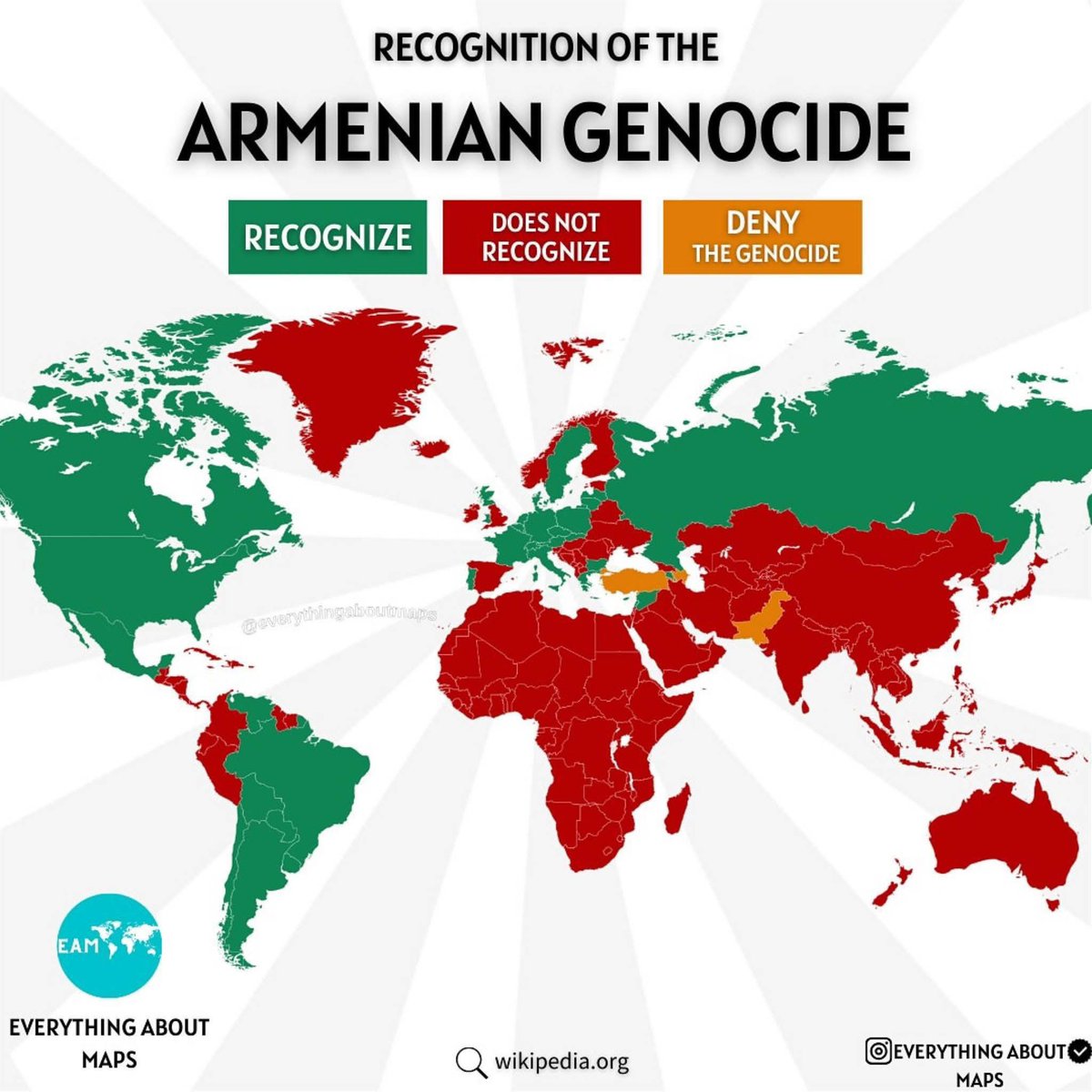
Recognizing and condemning the 𝐀���𝐦𝐞𝐧𝐢𝐚𝐧 𝐆𝐞𝐧𝐨𝐜𝐢𝐝𝐞 is essential to preventing future genocides. Unpunished crimes set dangerous precedents. “Never Again” must mean never again for anyone.
P.S. Check in on your Armenian friends today. A simple “How are you?” matters
Jerusalemite Armenians March to Commemorate the 110th Anniversary of the Armenian Genocide.
This year, the commemoration coincides with the Holocaust—a genocide that Armenia officially recognized in 1995.
Israel has yet to recognize the Armenian Genocide.
I am not going to take lessons on what is and what is not genocide from a Turkish government which STILL DENIES THE OTTOMAN GENOCIDE OF AN ESTIMATED 600,000-1.2 MILLION ARMENIANS FROM 1915-1923.
The traditional torchlight march commemorating the 110th anniversary of the Armenian Genocide has begun in Yerevan. Organized by the Armenian Revolutionary Federation’s Youth Union, the powerful procession honors the memory of the 1.5 million victims and serves as a call for justice, recognition, and resistance against ongoing denial and aggression.
The march began with the burning of Turkish and Azerbaijani flags, symbolizing defiance against historical and ongoing crimes. Participants carrying torches and Armenian flags are now making their way through the streets toward the Tsitsernakaberd Memorial, turning remembrance into a continued demand for truth and accountability.
April 24 is Armenian Genocide Remembrance Day, commemorating the 1915 genocide in which over 1.5 million Armenians were killed by the Ottoman Empire. We honor the victims, reflect on this tragedy, and stand against genocide denial. #ArmenianGenocide
Today marks Armenian Genocide Remembrance Day.
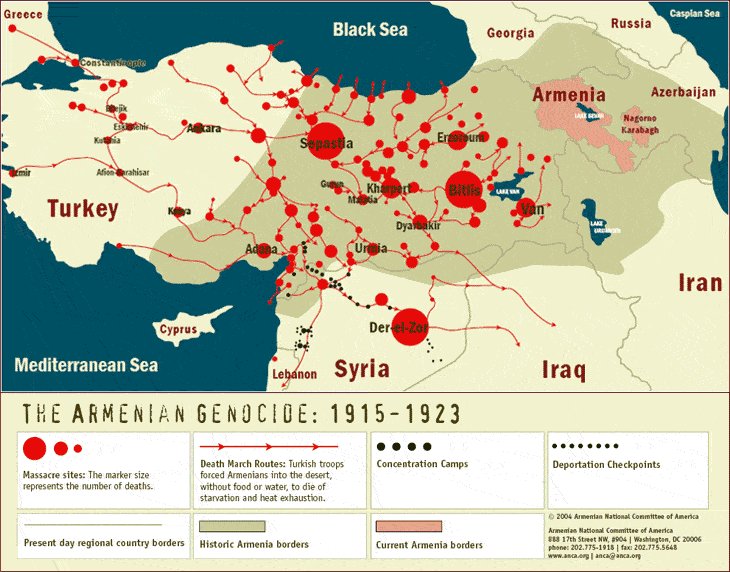
This map shows the death march roots into the Syrian desert. About 1,5 million Armenians were systematically murdered and countless others were forcibly removed from their homes by the Ottoman Empire.