I’m passionate about two things:
🤖 Artificial Intelligence
⚡ Engineering & Energy systems
Here I share ideas, experiments, practical lessons, and the journey of building with AI and engineering in Nigeria.
If you’re into AI, energy, tech, or solving real problems. Welcome.
Agriculture needs power
Trade needs power
Real estate needs power
Oil and gas need power
IT? yep, power
Entertainment? Power
Sports need power
Mortuary needs power
Financial services need power
Steel mills need power
Education needs power
Religion needs power
Ports need power
Politics needs power
Artists need power
Marriage needs power
SMEs need power
POS needs power
Construction needs power
Transportation needs power
AI? Before?
The rule of law needs power
Manufacturing needs power
Public utilities need power
Bigotry needs power
Social Media needs power
Medical services need power
Law needs power
Nuclear power needs power
Armed Forces and police need power
Catering and Accommodation need power
⚡ THE AIR AROUND YOU MAY BE HIDING A SECRET ENERGY SOURCE
Scientists in Japan have created a tiny device that generates electricity from moisture in the air. No sunlight, no wind, and no batteries required.
Using special materials, the device captures energy from invisible water molecules floating around us and turns it into a steady flow of power. Researchers believe future versions could help power small electronics, sensors, and medical devices.
What if the air itself becomes the next renewable energy source?
Source: Komatsu, K., et al. Humidity-powered electricity generation research. Kyoto University, Japan.
Jensen Huang says AI’s biggest challenge is no longer chips.
It’s power.
Every AI model.
Every AI query.
Every AI data center.
Needs electricity.
AI Energy watchlist:
• Utilities → $CEG $VST $NEE
• Nuclear → $OKLO $SMR
• Grid → $GEV $ETN $PWR
• Fuel Cells → $BE $FCEL
• Power Semis → $VICR $NVTS
That’s why AI Energy may become one of the biggest investment themes of the next decade.
This deceptive charlatan just exposed himself as the ultimate fraud!
He swore he’d serve only one term, just four years if he becomes president.
Now this dumb Aba trader is telling Nigerians to give him four years to fix electricity - so he is gonna spend his tenure battling electricity.
And the height of his deception? He vows to deliver 10,000 MW while Nigeria delivers 13,000 MW presently with plants theoretically capable of far more, the real crisis isn’t generation, it’s the collapsing transmission, the inefficient, profiteering DisCos failing to distribute what we already have, the chronic gas shortages, and systemic rot.
He’s not “articulate.” He’s not a thinker. He’s a cunning hustler peddling recycled soundbites, hoping desperate Nigerians won’t notice the contradictions.
Promising what already exists on paper while ignoring the real bottlenecks? That’s not vision, that’s deliberate misinformation.
Nigerians deserve better than this smooth-talking con artist who treats power sector reform like a market stall bargain in Aba.
deceptive experiment.
I live in Texas
I was without electricity
For four days
He wasn’t going to restore electricity.
I wasn’t upset. Why?
Because my dad worked for the electric company (in a different state)in generation, then distribution, and then interstate exchange, when I was a kid.
Grid challenges aren’t resolved by politicians or bureaucrats. Sometimes those folks cause the problems, but they never solve them.
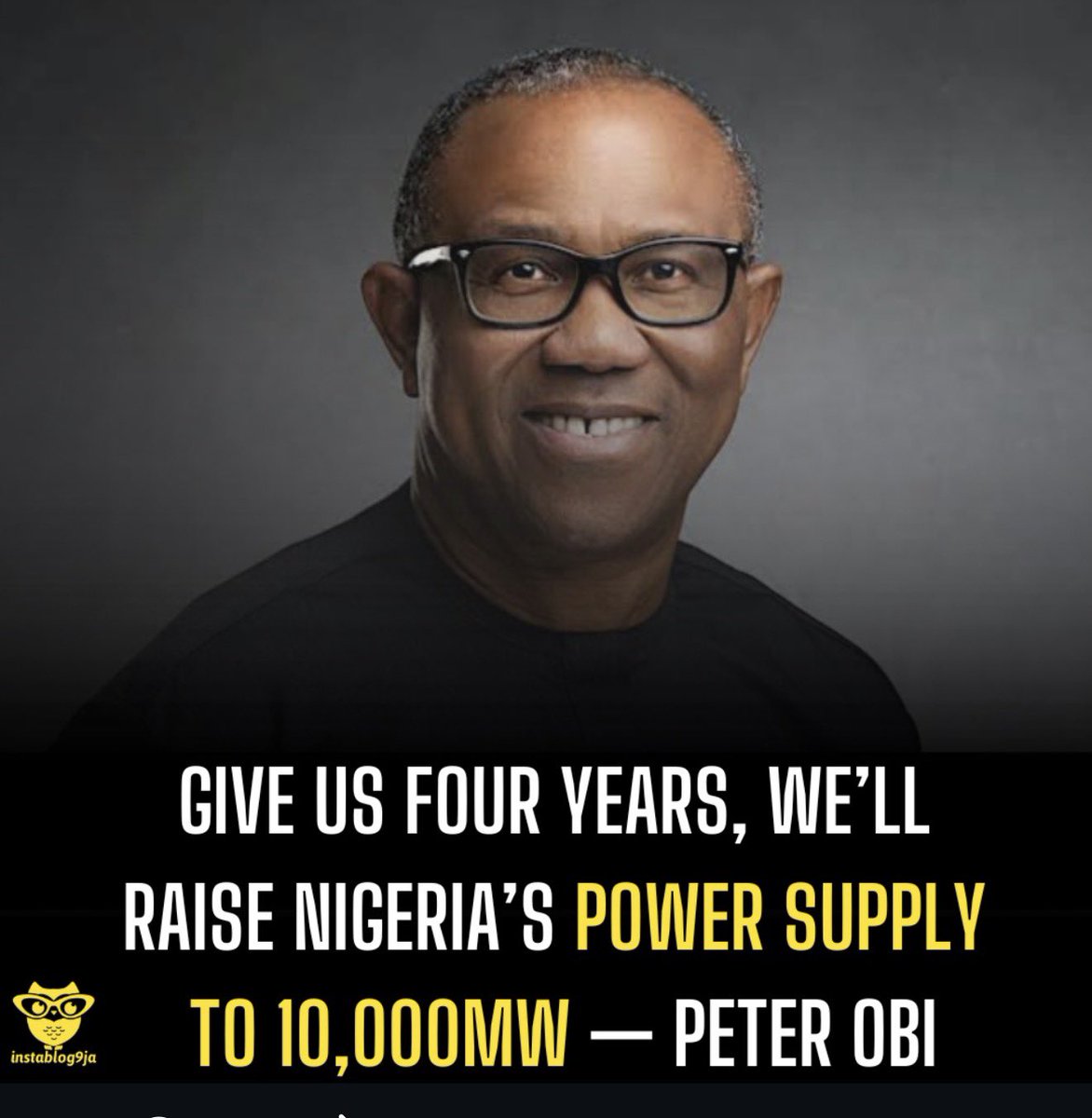
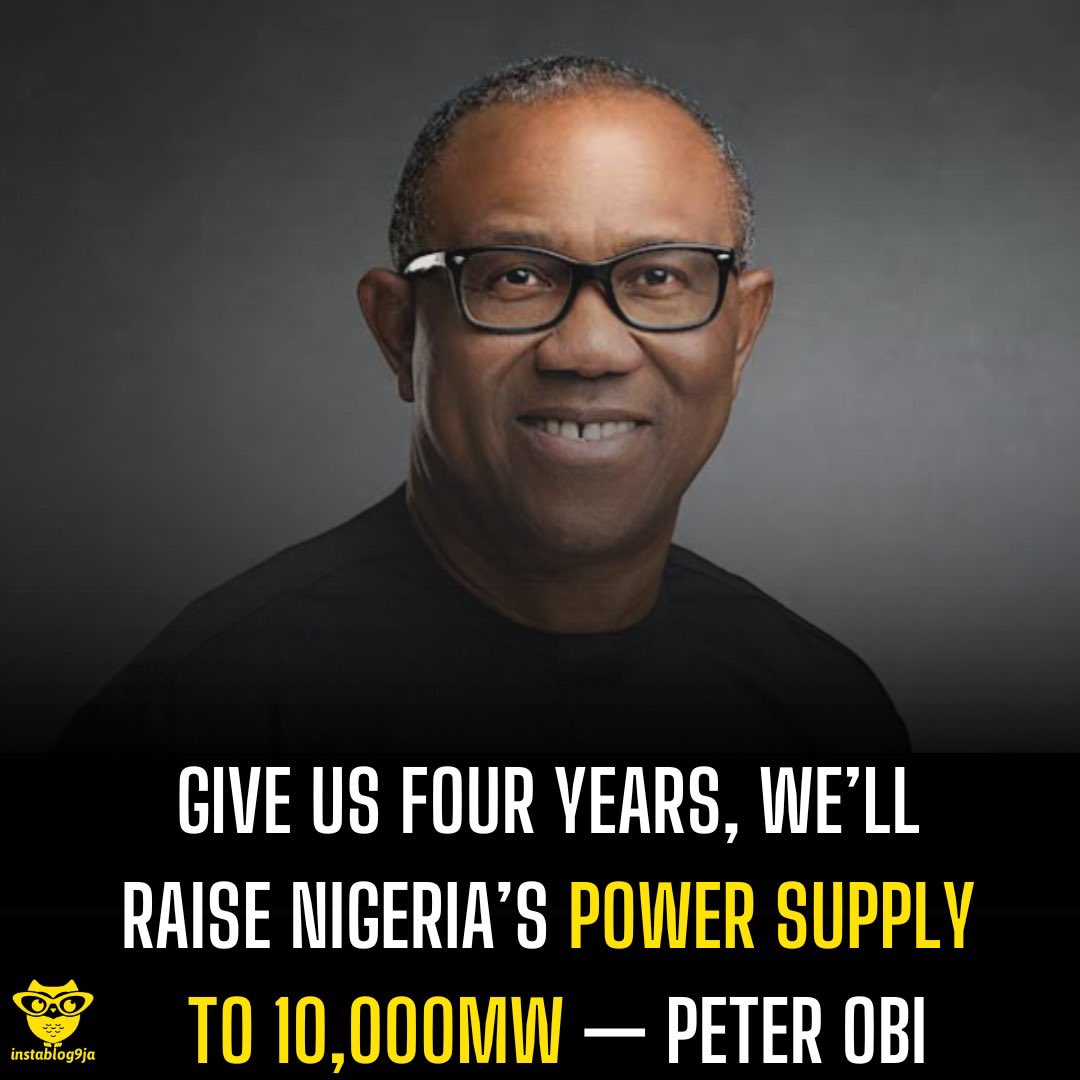
Give Us Four Years, We’ll Raise Nigeria’s Power Supply To 10,000MW — Peter Obi
Former Labour Party presidential candidate, Peter Obi, has vowed to raise Nigeria’s electricity generation and distribution capacity to 10,000 megawatts within four years if elected president in 2027.
“And I pledge, on our behalf of our government, that in four years, this country will generate and distribute at least 10,000 megawatts from the 4,000 they are doing today,” Obi claimed.
Obi, who spoke while outlining his economic plans, said his administration would not come into office with excuses over Nigeria’s long-standing power crisis.
“This is something we have carefully studied, and we are not going to come into government and start making excuses about why it cannot be done,” he said.
He described Nigeria’s current electricity output as unacceptable, noting that a country with over 200 million people still generates and distributes only about 4,000 megawatts despite millions lacking reliable power supply.
According to him, countries such as South Africa and Egypt, which have smaller populations than Nigeria, each generate and distribute over 40,000 megawatts of electricity.
“Nigeria is not even producing one-tenth of what those countries generate, and that must change,” Obi stated.
The former Anambra State governor also promised to tackle unemployment through what he described as honest and transparent economic policies.
He said his government would focus on supporting micro, small, and medium-sized enterprises through tax incentives, financial assistance, and access to affordable credit.
Obi argued that empowering small businesses would help stimulate economic growth, create jobs, and improve living standards across the country.
Product Market fit. Not just about Nigerians ability to pay for electricity. But if you find product market fit. Electricity is mostlikely a stakeholder in creating that product.
Can Nigerians Afford The Electricity Needed To Transform Nigeria?
========
Almost everyone agrees that electricity is Nigeria's biggest development challenge.
No serious country industrialises without power. No manufacturing sector thrives without power. No modern technology ecosystem survives without power.
The argument is correct.
But there is another question we rarely ask:
Can Nigerians actually afford the electricity required to transform the economy?
That is where the conversation becomes uncomfortable.
Today, many households and businesses in Band A areas already ration their electricity usage. Air conditioners are switched off. Appliances are used less frequently. Businesses monitor consumption carefully because electricity bills have become a major operating expense.
This tells us something important.
The problem is no longer supply alone.
The problem is also purchasing power.
Many people point to the GSM revolution and argue that electricity can follow the same path.
I disagree.
The economics are different.
Telecom operators invested billions because consumers were willing and able to pay for communication services. The market expanded rapidly and investors recovered their capital.
Electricity is a different game.
Power plants, transmission lines, distribution networks, gas infrastructure, meters, and renewable energy projects require enormous capital. Investors expect to recover those investments over time.
The challenge is that the money must ultimately come from consumers.
If tariffs remain too low, investors struggle to recover their investments.
If tariffs become fully cost-reflective, many households and businesses may struggle to pay.
That is the dilemma.
Nigeria does not just need more electricity.
Nigeria needs electricity that is reliable, affordable, and commercially sustainable.
Those three objectives must exist together.
Power remains the foundation of economic transformation. It can boost productivity, support manufacturing, attract investment, create jobs, and unlock entirely new industries.
But increasing megawatts alone is not enough.
The real challenge is building an electricity market where investors can earn reasonable returns and consumers can still afford to keep the lights on.
That is the conversation Nigeria needs to have.
Because the goal is not simply more power.
The goal is power that works for both the economy and the people.
@StockmanNigeria
@Arslandev97 AI isn’t just another industry, it’s the new electricity powering everything. Smart companies are already rebuilding around it. The future belongs to those who integrate it deep.
@Arslandev97 AI isn’t just another industry, it’s the new electricity powering everything. Smart companies are already rebuilding around it. The future belongs to those who integrate it deep.
⚡️ Countries that use the most electricity
1. 🇨🇳 China — 10,573 TWh | 7.5 MWh per capita
2. 🇺🇸 United States — 4,536 TWh | 13.1 MWh per capita
3. 🇮🇳 India — 2,083 TWh | 1.4 MWh per capita
4. 🇷🇺 Russia — 1,176 TWh | 8.2 MWh per capita
5. 🇯🇵 Japan — 1,030 TWh | 8.4 MWh per capita
6. 🇧🇷 Brazil — 762 TWh | 3.6 MWh per capita
7. 🇨🇦 Canada — 646 TWh | 16.1 MWh per capita
8. 🇰🇷 South Korea — 625 TWh | 12.1 MWh per capita
9. 🇩🇪 Germany — 520 TWh | 6.2 MWh per capita
10. 🇫🇷 France — 477 TWh | 7.2 MWh per capita
🖇️ Source: Ember
Dear Noel, we are sincerely sorry to hear about this. We will make this issue our top priority and get it resolved as soon as possible. Kindly share the meter or electricity bill account number, phone number, and address so that we can notify the technical team serving your area.
^Willgirl.
Elon Musk just admitted what nobody wants to say:
AI is no longer limited by chips but by electricity, because data centers are consuming power faster than the grid can produce it while power plants take years to build and AI improves in months:
🚀 Space exploration timeline:
1903 — Tsiolkovsky publishes the rocket equation
1904
1905
1906
1907
1908
1909 — Goddard writes first paper on liquid propellants as fuel for rockets
1910
1911
1912
1913
1914 — Goddard patents designs for a liquid-fueled rocket and a multi-stage rocket
1915
1916
1917
1918
1919 — Goddard publishes "A Method of Reaching Extreme Altitudes"
1920
1921 — Goddard begins experiments with liquid oxygen and gasoline rocket engines
1922
1923 — Goddard successfully tests first liquid propellant engine
1924
1925
1926 — Goddard launches world's first liquid-fueled rocket
1927 — VfR (Society for Space Travel) founded in Germany; von Braun joins as a teenager
1928
1929 — Goddard launches rocket carrying first scientific payload (barometer & camera)
1930
1931 — Korolev co-founds GIRD (Group for Study of Reactive Motion) in Moscow
1932 — Von Braun becomes chief engineer of German Army rocket program
1933 — Korolev leads launch of USSR's first liquid-fueled rocket
1934 — Von Braun's A-2 rockets reach 2.4 km altitude
1935
1936 — Korolev designs RP-318, USSR's first rocket-powered aircraft
1937
1938
1939 — Von Braun's A-5 rocket reaches 8 km altitude
1940
1941
1942 — Von Braun's A-4 (V-2) rocket becomes first human-made object to reach space (100 km)
1943 — V-2 production begins; JPL formally established in USA
1944 — V-2 used as weapon against London and Antwerp; first ballistic missile attacks in history
1945 — USA recruits von Braun
1946 — USA and USSR independently begin reverse-engineering V-2
1947 — First animals (fruit flies) launched to space aboard a V-2
1948 — Korolev's R-1 rocket successfully launched
1949 — Albert II, a rhesus monkey, becomes first mammal in space aboard a US V-2 rocket
1950
1951
1952
1953 — Korolev begins design of R-7
1954 — Korolev writes letter to Moscow advocating for an orbital satellite program
1955 — USA announces Project Vanguard
1956 — Von Braun's Redstone rocket successfully tested; R-7 development nears completion
1957 — Korolev's R-7 becomes world's first ICBM; Sputnik 1 — first artificial satellite in orbit; Sputnik 2 carries Laika — first living creature in orbit
1958 — USA launches Explorer 1; NASA founded; first US attempt at Moon probe (Pioneer 0) fails
1959 — Luna 1 (USSR) — first spacecraft to escape Earth's gravity; Luna 2 — first human-made object to reach the Moon; Luna 3 — first photos of Moon's far side
1960 �� First weather satellite (TIROS-1) launched by USA; first communications satellite (Echo 1); two Soviet dogs (Belka & Strelka) orbit Earth and return safely
1961 — Gagarin — first human in space, April 12; Alan Shepard — first American in space, May 5
1962 — Mariner 2 — first spacecraft to fly by another planet (Venus); Telstar 1 — first active communications satellite
1963 — Tereshkova — first woman in space
1964 — Ranger 7 — first close-up photographs of the Moon's surface
1965 — Leonov — first spacewalk; Mariner 4 — first close-up images of Mars
1966 — Luna 9 — first soft landing on the Moon; first orbital docking (Gemini 8); Surveyor 1 — first US soft Moon landing
1967 — Apollo 1 fire kills three astronauts; Venera 4 — first probe to enter another planet's atmosphere (Venus)
1968 — Apollo 8 — first crewed mission to orbit the Moon; famous Earthrise photograph
1969 — Apollo 11 — first humans on the Moon; Apollo 12 — second Moon landing
1970 — Apollo 13 — Moon mission aborted after explosion; Luna 16 — first robotic Moon sample return; Lunokhod 1 — first lunar rover
1971 — Salyut 1 (USSR) — first space station; Mariner 9 — first spacecraft to orbit another planet (Mars); Apollo 14 & 15 Moon landings
1972 — Apollo 16 & 17 — final Moon landings; Pioneer 10 launched toward Jupiter; last humans on the Moon
1973 — Pioneer 10 — first spacecraft to fly by Jupiter; Skylab — first US space station
1974 — Mariner 10 — first gravity assist maneuver; first flyby of Mercury