Our research with @nanopore 's adaptive sampling has been published (https://t.co/yCIJSgX44S). 'Human host depletion' in clinical metagenomes resulted in increased total sequencing depth, thus higher taxonomic profiling sensitivity while preserving the microbial composition.
Just coming back from a workshop exactly addressing this topic for the situation in 🇩🇪- I am keen to read global experts’ meaning on #AMR genomic surveillance in @TheLancet
New blog post: https://t.co/OWnmLPQs5g
I took the ONT data from my last post, subsampled to various depths and assembled with Flye.
Reveals what ONT-only accuracy looks like with a 'normal' read depth and Flye assembly (as opposed to extra-deep reads and Trycycler assembly).
New preprint📢 miniBUSCO: a faster and more accurate reimplementation of BUSCO.⚡️Assess assembly completeness for a human genome within 30 minutes⏱️and achieve improved agreement with annotation completeness.🧬Thanks Dr. Li
@lh3lh3 https://t.co/upGNoSG2xc
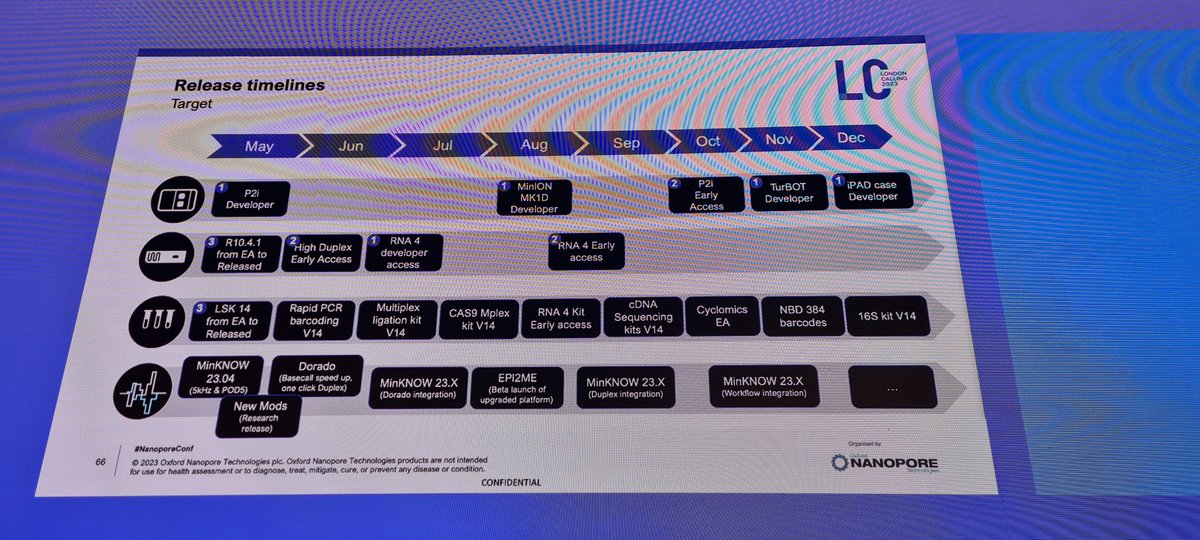
Improvements in latest MinKNOW update:
•5kHz sampling rate replaces 4kHz sampling rate - for improved accuracy
•POD5 is now the default raw data file type
•Addition of 5mC/5hmC Remora Model
•Automatically stop your runs with Run Until
Learn more: https://t.co/1YqCzLtkb0
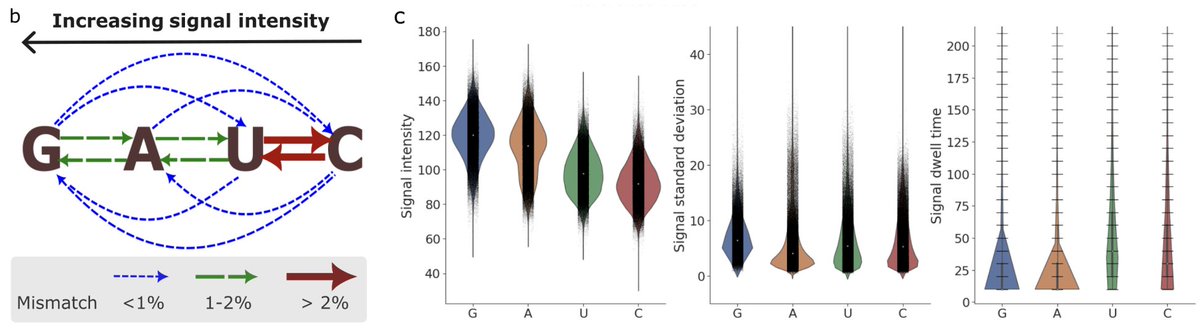
Looking forward to the direct RNA update tomorrow #nanoporeconf! Meanwhile, we also updated our preprint on dRNA-seq systematic errors with signal analysis, first is the mismatch error relationship between the 4 bases and their signal features (esp. intensity and dwell time) 1/3
Innovation continues towards enabling the analysis of #anythinganyoneanywhere with a new ASIC in development, which is now generating Q20+ sequencing chemistry, and will underpin a new family of lower-cost, lower-power instruments. #nanoporeconf
Oxford Nanopore was the first to enable direct RNA sequencing. The new kit (RNA 004) and flow cell for direct RNA sequencing demonstrates increased accuracy and output, with the potential to unlock a new field of biological analysis. #nanoporeconf https://t.co/mchKktqzAd
We're expanding access to Bard in US + UK with more countries ahead, it's an early experiment that lets you collaborate with generative AI. Hope Bard sparks more creativity and curiosity, and will get better with feedback. Sign up: https://t.co/C1ibWrqTDr
https://t.co/N8Dzx1m0fc
Finally published our experiments with adaptive @nanopore sequencing to detect antimicrobial resistance genes; TLDR: make sure your database has similar genes and (counterintuitively) longer reads are not always better -- https://t.co/nSPMdLhcZb
@RyanCookAMR Is the sequencer actual sequencing less viral dna or is it due to the DNA length per read? E.g. would splitting the reads help or sheering the input DNA?
#OpenAI is planning to stop #ChatGPT users from making social media bots and cheating on homework by "watermarking" outputs. How well could this really work? Here's just 23 words from a 1.3B parameter watermarked LLM. We detected it with 99.999999999994% confidence. Here's how 🧵
I asked ChatGPT to write a FASTA parser. It returned a fully working Python implementation with comments and everything. I asked it to port it to Rust. It did that, and produced a correct Rust program that compiles without any warnings. What is this sorcery??!