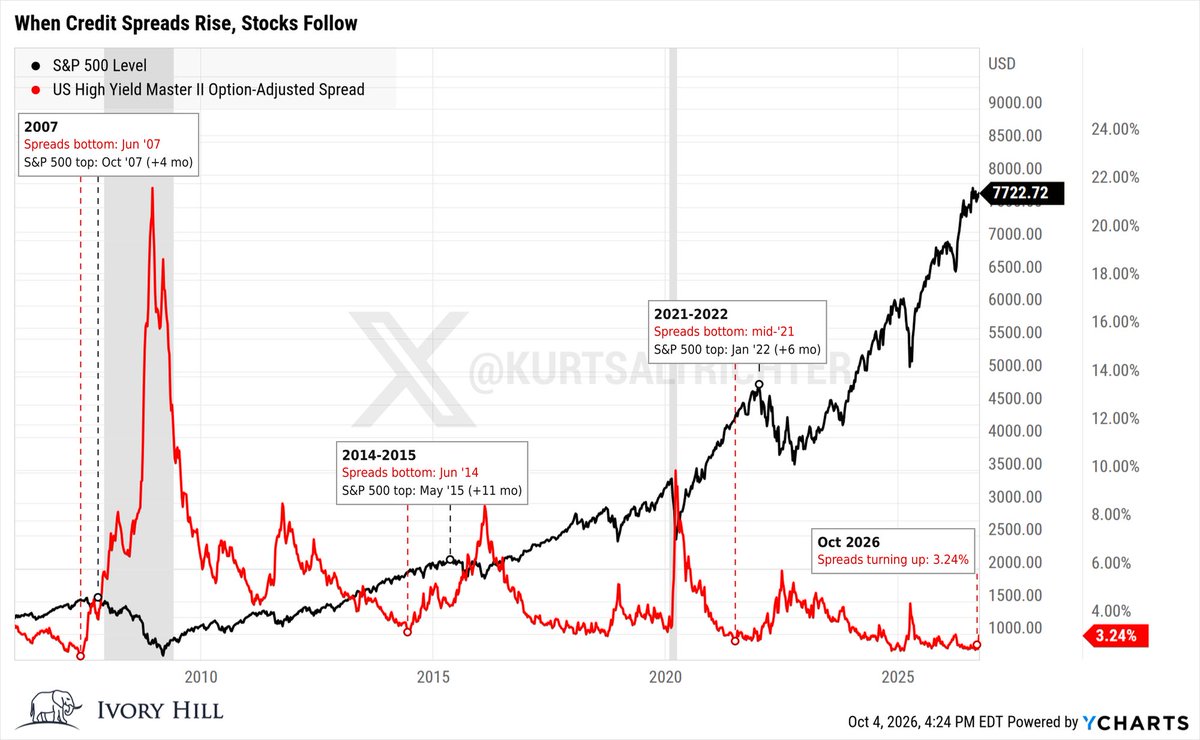
Every major stock top had the same tell: credit cracked first.
Junk spreads turned up 4 months before the 2007 top, 11 months before the 2015 top, 6 months before the 2022 top. Lenders see the stress before stock buyers do.
Spreads just turned up again.
Jim Bianco, a Wall Street veteran and longtime market watcher, is turning bullish on US Treasuries for the first time in six years after benchmark yields surged to two-decade highs, creating an enticing entry point https://t.co/Q7cHh9UU12
In my view, a broadly diversified 60/20/20 model continues to make sense. The chess pieces are always moving, and currently it’s Bitcoin and commodities in the lead, followed by the Mag 7 which has perked up in recent weeks. At the bottom are (what else?) long yields.
After 27 years in the markets, one thing is clear:
Trading rewards patience, discipline, and repetition.
You can spend years studying charts, reviewing trades, journaling, and refining execution before the results truly show.
Most people quit during that phase.
But if you stay consistent long enough, experience begins to compound.
There are no shortcuts.
Time in the market only matters if you keep learning.
Do not give up!
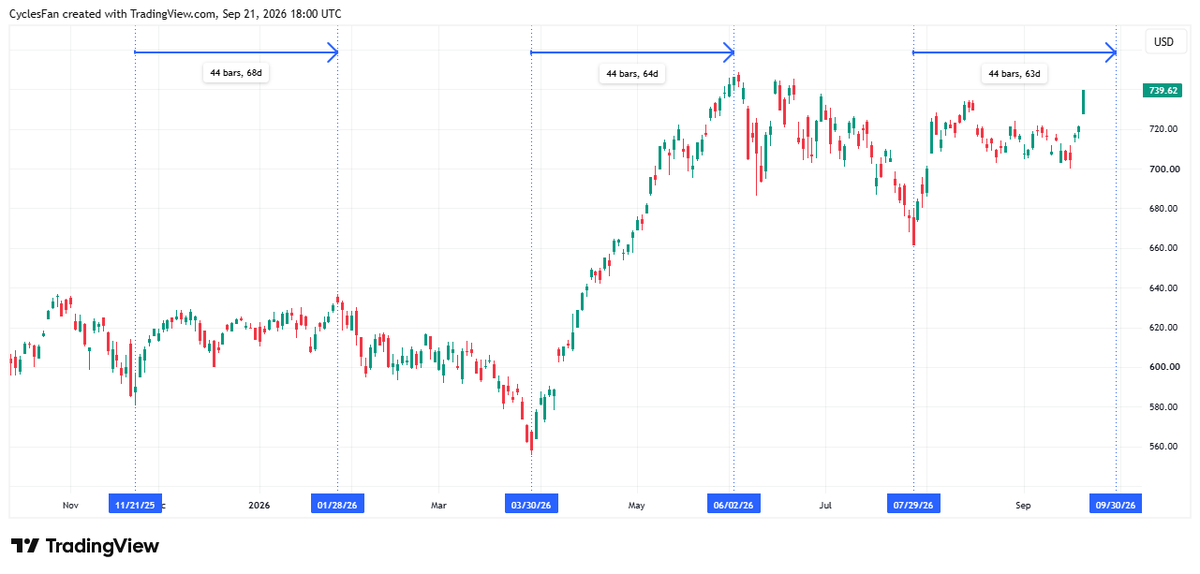
$QQQ - In the last 2 intermediate term cycles the top was made on day 44 of the cycle. If the same thing happens in the current cycle the top of this cycle will occur on September 30. Given that it has exceeded the August high we're looking at a retest of the June high.
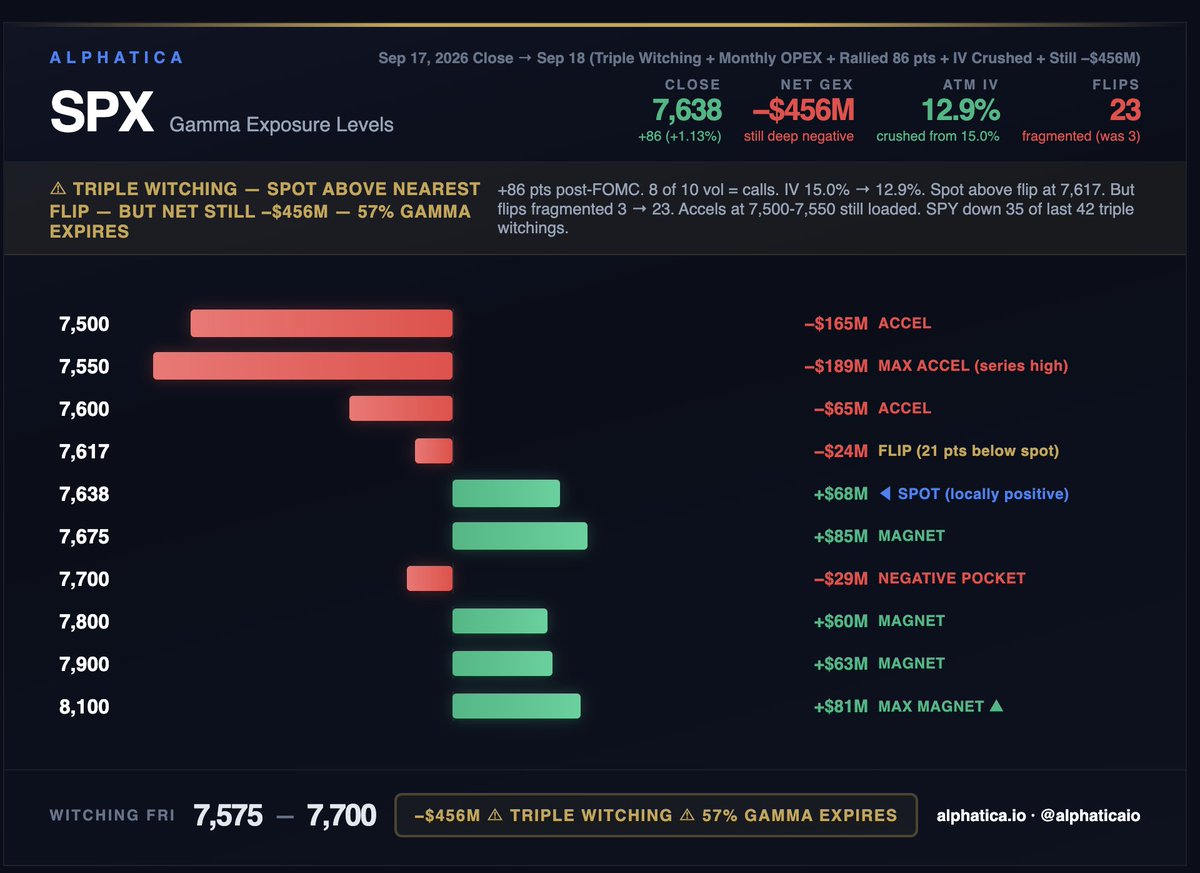
SPX GEX: Sep 18, Triple Witching
86-point rally. IV down 210 basis points. Net gamma moved zero.
Still -$456M.
The market ripped through a 25bp hike, calls dominated eight of ten volume strikes, and implied vol collapsed from 15.0% to 12.9%. Every behavioral signal turned.
The accelerators at 7,500 and 7,550 are still sitting at -$165M and -$189M. A rally does not remove open interest. It only changes who is buying.
Spot cleared the flip at 7,617 and is locally positive for the first time in a week. But the boundary fragmented from 3 levels to 23 across a 200-point band. Clean on Wednesday, unreadable today.
The positive pocket spot occupies runs 7,625 to 7,675. Fifty points wide. Above 7,700 there is a negative pocket before the magnets.
Now add the calendar. SPY has closed lower on 35 of the last 42 triple witchings. September is 9 of 10 down, median -0.91%, and the loss is almost entirely the gap. Average -0.52% at the open, then flat.
Monthly OPEX carries 57% of remaining gamma. Every crisis-level negative in this series has been cleared by a monthly drain.
Two forces, one session, opposite directions. This is the cleanest test the calendar has handed us.
Range: 7,575 to 7,700.
$SPY $QQQ $IWM
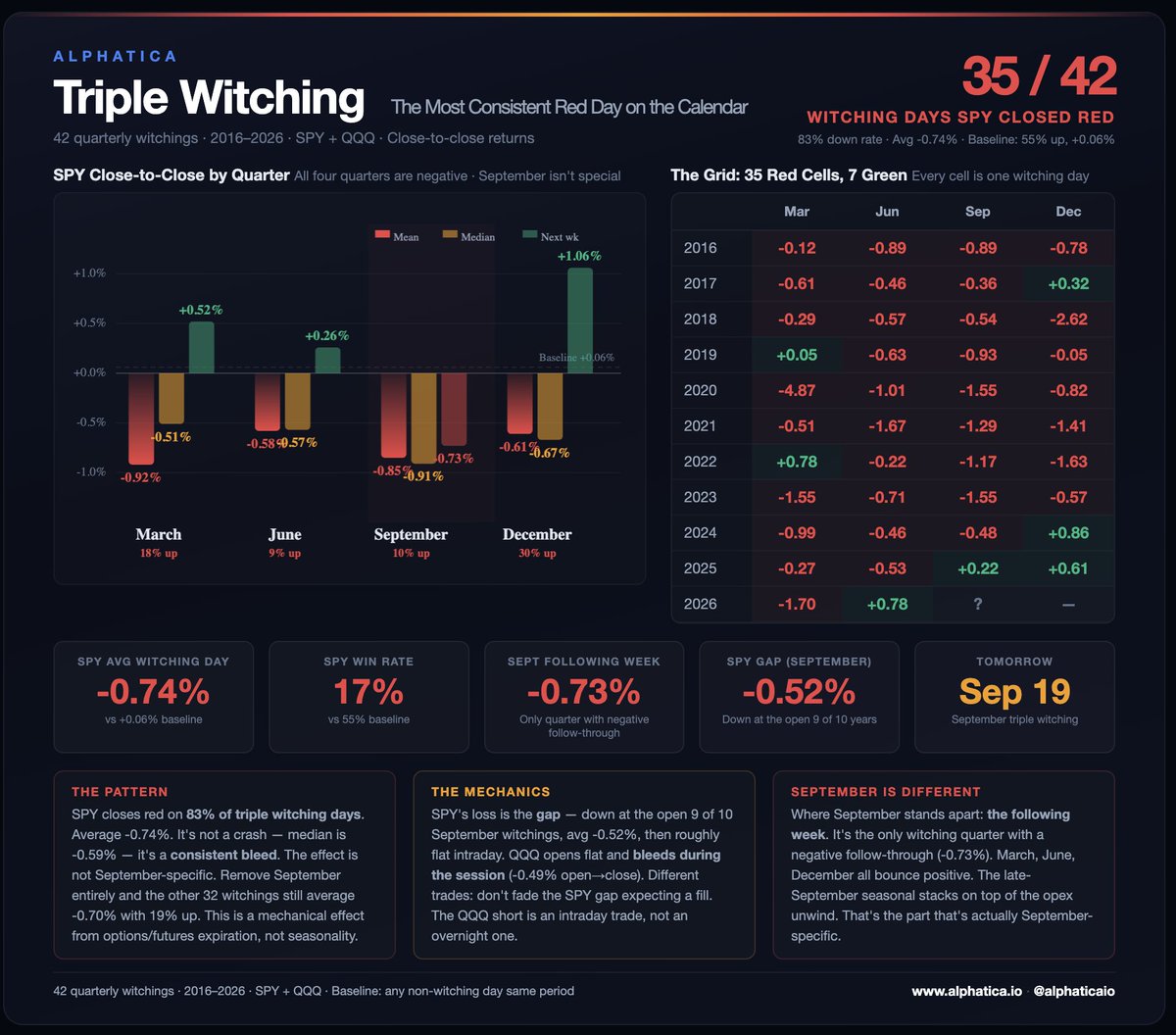
🚨🚨Tomorrow is September triple witching. We studied the last 42 quarterly witchings. This is one of the most lopsided calendar effects in the market.
SPY has closed red on 35 of the last 42 triple witching days. 83% down rate. Average: -0.74%. Baseline for any random day: 55% up, +0.06%.
This is not a September story. All four quarters bleed:
March: 18% up, -0.92% avg
June: 9% up, -0.58% avg
September: 10% up, -0.85% avg
December: 30% up, -0.61% avg
Remove September entirely and the other 32 witchings still average -0.70% with 19% up. The effect is fully intact without it. This is mechanical meaning options and futures expiration driving dealer flow, not seasonal.
Where September IS different: the following week. It's the only witching quarter with a negative follow-through (-0.73%). March, June, and December all bounce positive the next week. The late-September seasonal stacks on top of the opex unwind.
The mechanics are different by ticker. SPY's loss is the gap, down at the open 9 of 10 September witchings, avg -0.52%, then roughly flat intraday. QQQ opens flat and bleeds during the session (-0.49% open→close). Don't fade the SPY gap expecting a fill. If QQQ is the trade, it's an intraday trade, not an overnight one.
The caveat: 4 of the last 7 witchings have been green. Dealers may be adapting to a well-known pattern. But 35 out of 42 is the base rate, and the base rate says tomorrow is red.
Tomorrow's stack: triple witching + FOMC hike Wednesday + oil above $100 + September seasonal. Four headwinds in one week.
$SPY $QQQ $IWM
$SPX
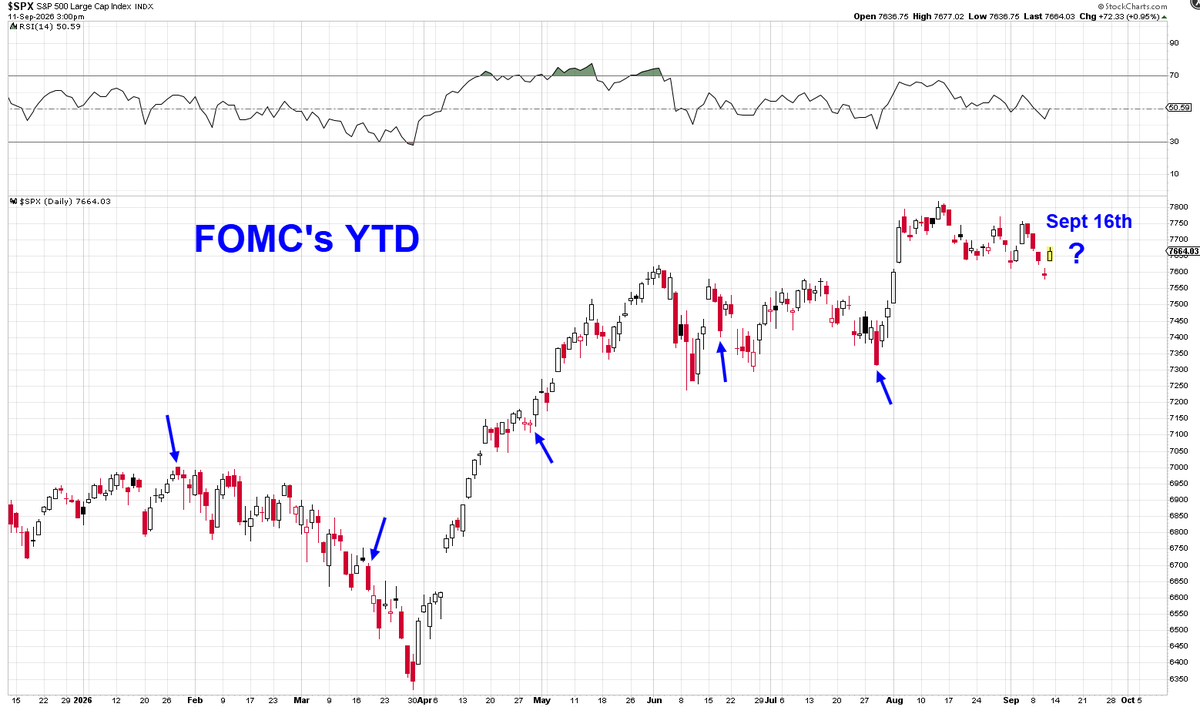
All 5 FOMC rate announcement days this year ended up red.
January and March FOMC's led to more follow through downside the next day(s), but notice January's the next couple days it came back up briefly to get you back to breakeven.
April, June, and July's all had monster rallies the next day.
Past FOMC performance is not indicative of future FOMC performance but still worth noting.
So the last 3 FOMC's were big btfd moments, one was neutral, and one led to further losses.
Just speaking about the near term performance post FOMC.
In response to the clip going around with the African lady saying 'WHAT WHITE CULTURE!?!'
Because I can explain it in more detail than anyone else... here are the main things that create western civilisation.
The principle, the law of nature that is an adaptation to and what operation it creates in our civilisation.
THE WESTERN CIVILISATION STACK
Western civilisation can be understood as a set of adaptations to the laws of nature that allow millions of people to cooperate, solve problems and innovate together.
1. SOVEREIGNTY — Let people act.
Law of nature: Knowledge and ability are distributed among individuals.
No ruler or institution can know everything everyone knows. Sovereignty gives people freedom to choose, experiment and solve problems for themselves. That creates millions of independent problem-solvers instead of waiting for one authority to find the answer.
2. RECIPROCITY — Don’t impose your costs on others.
Law of nature: Cooperation survives when it benefits both sides.
Freedom cannot mean freedom to steal, defraud, injure or force others to carry your costs. Reciprocity means pursuing your interests while respecting the same right in others. It turns conflict into cooperation and makes peaceful life among strangers possible.
3. RESPONSIBILITY — Make people accountable for consequences.
Law of nature: Every action produces consequences.
Freedom works when the person making a decision also bears responsibility for its results. When people can keep the benefits of their choices while forcing the costs onto others, cooperation breaks down. Responsibility reconnects choice with consequence.
4. PROPERTY — Make control and consequences clear.
Law of nature: Resources are scarce and cannot satisfy every competing use at once.
Property establishes who controls something, who may use or exchange it, and who bears the consequences of those decisions. That reduces conflict, encourages people to improve what they possess, and makes investment and long-term planning possible.
5. TRUTH — Correct error faster than reality punishes you for it.
Law of nature: Reality does not change because we believe something false.
Truthful testimony, open criticism and evidence allow people to discover mistakes before those mistakes become catastrophes. A civilisation that can criticize and correct itself can learn faster than one that protects comforting falsehoods.
6. CONTRACT — Make cooperation possible across time.
Law of nature: Cooperation requires predictable future behaviour.
Promises backed by reputation and law allow strangers to trust one another enough to cooperate. Contract lets one person invest today because another can credibly promise performance tomorrow. That makes enormous networks of specialization, trade and investment possible.
7. RULE OF LAW — Replace arbitrary power with predictable rules.
Law of nature: People have conflicting interests, and power creates opportunities for predation.
Law provides a common procedure for resolving disputes without violence or personal rule. When rulers and citizens are both constrained by known rules, people can cooperate, invest and experiment without constantly fearing arbitrary interference.
8. DUE PROCESS — Test accusations instead of trusting authority.
Law of nature: Human beings are biased, mistaken and sometimes dishonest.
An accusation is not proof. Evidence, defense, confrontation, impartial judgment and appeal create an adversarial process for discovering error. Due process protects both society from wrongdoing and individuals from arbitrary punishment.
9. DECENTRALISATION — Let many solutions compete.
Law of nature: No one knows in advance which adaptation will work best.
Families, firms, towns, institutions and governments can try different solutions to different problems. Failures can remain local while successful solutions spread. Decentralisation therefore turns society itself into a continuous experiment.
10. MARKETS — Let reality select among competing solutions.
Law of nature: Evolution advances through variation, selection and retention.
Markets allow people to try different products, services and ways of organising resources. People select among them through voluntary choice. Successful solutions attract resources; unsuccessful ones disappear or improve. Markets turn millions of choices into continuous social learning.
11. SPECIALISATION — Let differences become advantages.
Law of nature: People differ in knowledge, ability, resources and circumstances.
Instead of everyone doing everything badly, specialization lets people become exceptionally good at different things and exchange the results. Cooperation converts human differences from a source of conflict into a source of increasing productivity.
12. SCIENCE — Institutionalise error correction.
Law of nature: A false model eventually fails when tested against reality.
Science turns doubt into a productive institution: observe, propose, test, criticize, replicate and correct. Knowledge therefore does not have to depend upon authority or tradition. Every generation can discover where the previous generation was wrong and build upon what it got right.
13. CAPITAL — Preserve successful adaptations.
Law of nature: Progress compounds only when successful adaptations survive.
Tools, businesses, infrastructure, institutions and knowledge allow yesterday’s successful experiments to become tomorrow’s starting point. Each generation does not begin again from zero. It inherits accumulated solutions and adds another layer.
14. EDUCATION — Transfer accumulated knowledge between generations.
Law of nature: Individuals die; knowledge does not have to.
Writing, schools, apprenticeships and universities allow discoveries to survive their discoverers. Instead of every generation rediscovering mathematics, engineering, medicine and law, it begins with thousands of years of accumulated learning.
15. COMMONS — Build things that make everyone more capable.
Law of nature: Cooperation can produce benefits no individual could produce alone.
Courts, roads, standards, security, scientific knowledge, infrastructure and trustworthy institutions multiply everyone's ability to act. A successful civilisation does more than protect private interests: it continually creates shared capital that makes future cooperation cheaper and more productive.
THE RESULT
These principles form a system:
Sovereignty creates experimentation.
Reciprocity makes it peaceful.
Responsibility makes it sustainable.
Property makes interests clear.
Truth corrects error.
Contract creates trust across time.
Law suppresses predation.
Decentralisation preserves alternatives.
Markets select successful solutions.
Specialisation multiplies productivity.
Science accelerates discovery.
Capital preserves what works.
Education transmits it.
Commons multiply everyone's capabilities.
That is the deeper logic of the Western stack:
Stable rules + distributed freedom + relentless error correction = cooperation at scale and accelerating innovation.
Last wk, oil +9% & ylds +11-26 bps across 2/30 curve w/ S&P/Nas/R2K -0.3%/-0.7%/-2.4%. This wk, I am watching reaction to 1) oil/rates, 2) calls to slow down AI development & 3) Fed on 9/16. I remain on the cautious side till US mid-terms on 11/3.
This weekend, the CEO of Anthropic called for a slowing of frontier model development over safety concerns. This follows comments along similar lines by the CEO of OpenAI to employees last week if other companies were willing to do the same thing.
The fundamental issues I have with this is 1) foreign adversaries would welcome the US slowing down AI development, 2) I view this as an attempt to slow down open-weight model development which would help the market dominance of OpenAI and Anthropic which are currently in the lead and 3) I do not see other companies agreeing to anything that slows down progress catching up to these two market leaders. Having said that, I could see 3rd party evaluators to limit liability risk going forward and some sort of executive order from the White House. But I hope the longer-term result of these actions is broadly distributed personal AI capabilities for all individuals versus having it become concentrated in the hands of a few companies.
Along this vein of AI competition, after releasing their paid API of Muse Spark 1.3 two weeks ago with open-weight versions coming later, $Meta launched their personal AI agent Muse last week with the stock gaining 5%. With 3.6 billion daily active users, a hit product could yield large results. Meta is increasingly showing other ways they can monetize their AI capex spend. This should help the stock to re-rate from a 17x CY27 PE to a multiple closer to peers trading in the low 20s. Meta Connect on September 23–24 is another potential catalyst given their leading frontier model Watermelon should be coming at the latest by October.
On the front of broadly distributed AI capabilities, $AAPL stock gained 4% last week on their new product launch. The foldable Duo will provide a personalized AI agent in your pocket with a 50% larger screen than a Pro Max. I continue to see a big upgrade cycle next year. The change from a 4” screen to 5.5” screen with the iPhone 6 drove revenue growth from 7% in FY14 to 28% in FY15. The Android ecosystem has had a foldable Samsung phone since 2019.
As for the Fed on Wednesday, I believe Warsh will raise by 25 bps and echo his hawkish statements from Jackson Hole on August 28th that “Price stability is not self-executing… 65 months of sustained, elevated inflation sits squarely with the Central Bank.” The ECB statement last week when they hiked might provide some hints: “For inflation excluding energy and food, the baseline foresees 2.5% in 2026, 2.6% in 2027 and 2.3% in 2028. Compared with June, the baseline projection for inflation in 2026 is unchanged, while it has been revised up for 2027 and 2028… The outlook remains highly uncertain, with risks to the upside for inflation and to the downside for economic growth.”
In summary, my caution between now and the US mid-terms on 11/3 remains for reasons I have fleshed out in prior posts including:
1. Don’t fight the Fed: The market historically under-performs during a hiking cycle with the bond market discounting 2 raises by year-end and 3.5 raises by mid-June of 2027.
2. Seasonal headwinds: September is down -0.5% on average and up only 48% of the time since 1957.
3. Historical volatility: S&P drawdowns of 10% between 7/31 and 11/9 have occurred in the lead-up to mid-terms since 1990.
4. Regulatory friction: There is bipartisan pushback against datacenter expansion that could hurt the AI buildout in the near-term.
5. Geopolitical risk: Despite US efforts to de-escalate, I believe Iran drags out hostilities at least through the 11/3 US mid-terms, keeping oil prices elevated.
6. Macroeconomic pressure: Long-term government bond yields are hitting multi-decade highs for several countries, slowing down growth and providing a reasonable alternative to stocks.
I believe in not fighting the Fed, the bond market or seasonality. I like the odds stacked in my favor which should improve at least seasonally following the mid-terms.
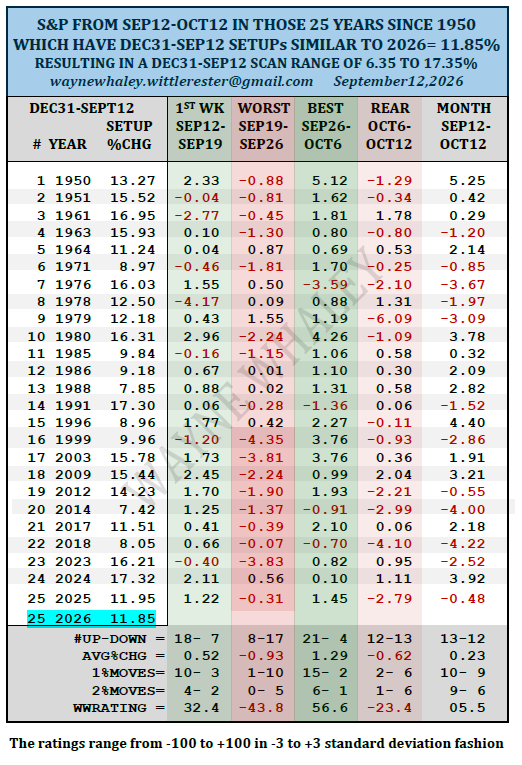
WHALEY S&P SEASONAL ROADMAP FOR THE MONTH OF SEPT12-OCT12
Constructed from years with tailwinds similar to 2026
As of September 12, 2026, the S&P is up 11.85% for the 2026 calendar year.
Focusing on those 25 years since 1950 which experienced Dec31-Sep12 starts to the year most similar to this year's 11.85% level gives us the collection of 6.35-17.35% setups identified on the far left of the below table.
Next week (Sept12-19), which tends to be highly correlated to the September, Third Quarter, Option Expirations Week, has had a modest, but discernable, positive bias when provided a positive calendar year tailwind of the 6.35-17.35% variety, going 18-7 for a 0.52% avg gain.
The worst week inside the upcoming Sep12-Oct12 month in those 25 years we are focusing on was Sep19-26 which was 8-17 for an avg loss of 0.93% with 1% moves 1-10 resulting in a performance rating of -43.6. Nine of the last ten have been negative, possibly as Opex has become an increasing influence with this particular week highly correlated to the Sept Post Opex Week time frame.
The best period inside the upcoming month in those 25 years and the study's surprise finding was Sep26-Oct6 which was 21-4 for an avg gain of 1.29% with 1% moves 15-2 resulting in a solid performance rating of 56.6.
The last six days of the upcoming Sept12-Oct12 rolling month in those 25 years appears to the casual observer to be of little consequence with a 12-13 won-loss ledger but upon additional review, worth noting the 2% moves during that time frame were 1-6 pushing the avg return to -0.62% suggesting a small chance of a meaningful gain.
We do this every week across several widely followed markets and one of 15 studies shared with Study Subscribers this week. [email protected] for Study Subscription inquiries.
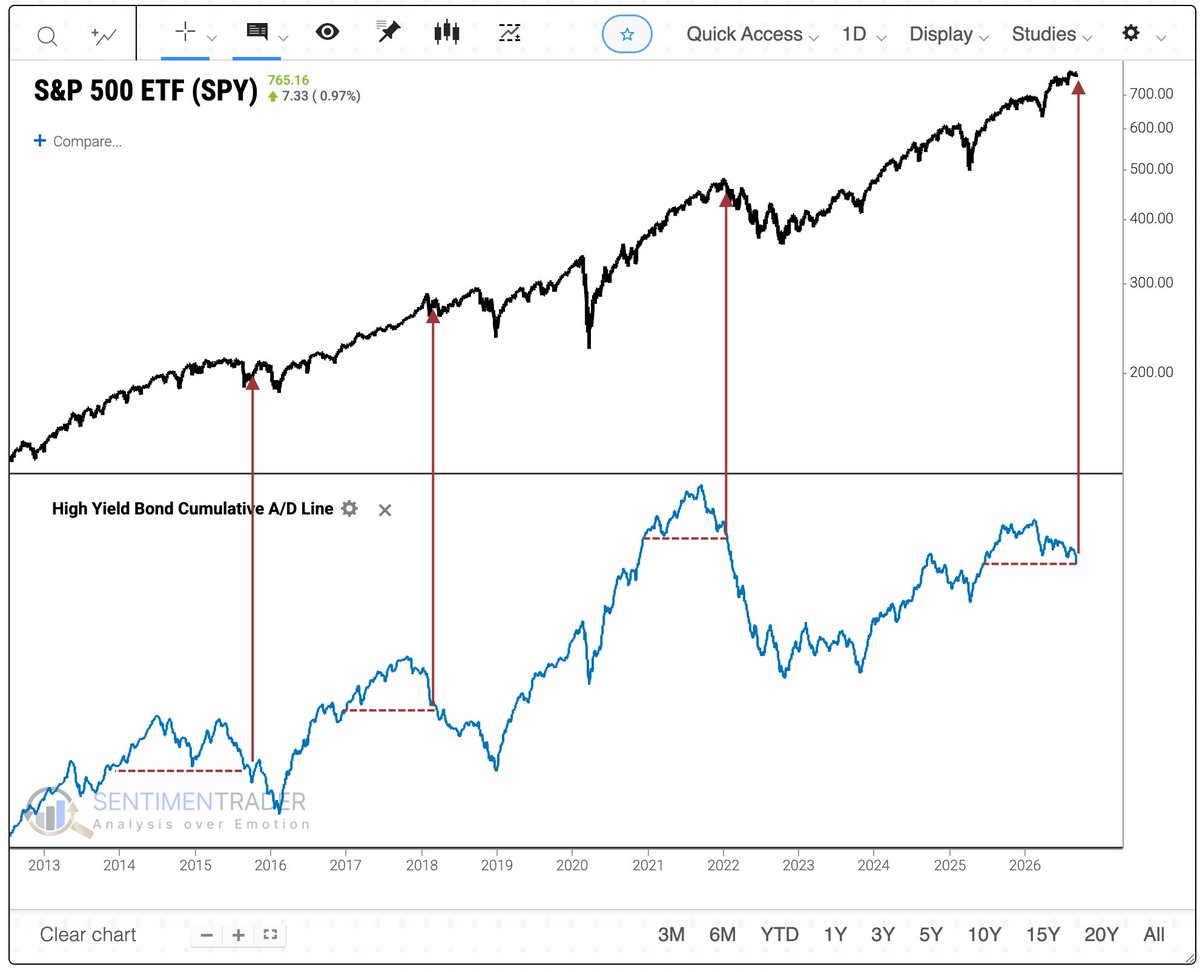
One of the more reliable warning signs is when junk bond traders flee before stock market investors catch on.
It's not like it predicts a crash or anything; just a generally tough market environment until the junk bond A/D line starts rising again.
An Exceptional Rally Is Entering A Harder Phase
The chart shows U.S. stocks approaching a 100% gain within a four year election window beginning in 2023. That puts this advance well above the historical median.
But the starting point matters. The window begins after the 2022 decline, capturing a recovery from depressed prices. It measures returns already earned, not the opportunity available today.
A market that doubles and then falls 20% still stands 60% above its starting point. An impressive historical record can survive a painful correction.
What The Headline Leaves Out
As of September 8, the 10nyear Treasury yield is near 4.8%, the 30 year exceeds 5.25%, and Brent crude is near $97. Those conditions raise financing costs while absorbing money households and businesses could otherwise spend elsewhere.
Earnings provide genuine support, but their composition deserves scrutiny. Aggregate third quarter earnings estimates rose during July and August even as 7 of 11 sectors received downward revisions. Energy led the increases. Higher fuel prices can strengthen producers while squeezing their customers.
Some exceptional profit growth also reflects rising investment valuations. Alphabet and Amazon reported substantial investment gains alongside strong operating growth. Those gains have economic value, but they are less dependable than recurring operating income and do not necessarily bring in cash.
That creates a vulnerability. If valuations stop rising while investment spending remains elevated, reported earnings can weaken before the underlying businesses stop growing.
What History Suggests Comes Next
The 1966 credit crunch showed how financing could deteriorate sharply in particular markets while the broader economy continued expanding. The late 1990s showed that financial disruptions and expensive stocks could coexist with further gains when earnings and policy support remained strong. Neither precedent provides a reliable countdown to a market peak.
In a late cycle setting, the more useful sequence is persistent cost pressure, weaker cash flow, more selective lending and eventually disappointing earnings.
My base case over the next 6 to 12 months is a choppier market with a broader correction as investors become less willing to pay for growth that requires heavy spending and favorable financing.
The first adjustment can happen through falling valuations while profits still rise. If expensive energy and refinancing pressure subsequently weaken demand, earnings downgrades can deepen the decline.
I expect financially resilient companies with dependable cash generation and reasonable valuations to gain relative ground. That does not make every value stock safe. Banks can face credit losses, and apparently cheap cyclical companies can lose their earnings advantage.
A sustained decline in energy costs and broader operating growth would weaken this bearish outlook. Until then, the greater risk is assuming that an exceptional recovery has made the market less vulnerable. Late in a cycle, past gains can conceal how demanding the next set of expectations has become.
Tokyo and Washington spent a fortune defending the yen. The market just smashed through the floor their intervention built.
The yen hit its strongest since February, breaking below 155 and topping the 155.23 high set after the coordinated US-Japan intervention. Up 2.4% in a week. The first intervention fizzled. This leg is organic, powered by bets the Bank of Japan hikes on Sept 18, possibly back to back.
Here is why a Tokyo currency move is your problem. The yen is the world's funding currency. For years traders borrowed it near zero to buy US tech and global risk, the carry trade. When the yen rips higher and stop-losses below 155 cascade, that trade unwinds and the selling hits the assets it financed. The August 2024 mini-crash was the preview.
Central-bank firepower is losing its grip, and the carry trade is the next domino. Watch USD/JPY into the BOJ's Sept 18 meeting. A hawkish BOJ that keeps the yen bid is how a Japanese rate decision becomes a Wall Street selloff.
Steve Kerr says Roger Federer taught his Warriors team the secret to sustained success wasn’t outworking everyone, it was building a life around your craft you never want to escape from
“I’ll tell you a great story about Roger Federer. We were playing in China with the Warriors in 2017. Roger was in Shanghai for the Masters tournament, so we invited him to come speak to the team.”
“Draymond Green asked him, ‘How do you sustain success? How have you managed to win majors 20 years after you first won one?’ Everyone was expecting him to say, ‘I work harder than everybody,’ the will, all the clichés.”
“Roger Federer says, ‘I get up every morning and I make breakfast for my kids. Then I take them to school and drop them off. Then I go practice tennis for about two hours, and I’ve figured out a really good routine where I don’t destroy my body, but I can get all the work in I need.”
“‘Then I go have lunch with my wife. In the evening, we cook dinner together. The kids are all home from school. We ask them about school. There’s so much joy in the house. We put them to bed, and then I put my head on the pillow and go, “Man, that was just a great day.” And I’ve been doing that for 20 years.’”
“And it was like, yes. That’s it. That’s the formula. That’s what leads to sustained success. He loves tennis. He loves his family. He loves life. It’s not outworking everybody and banging your head against the wall, ‘I’m going to be better than everybody.’ It’s allowing your natural talent to shine through with a work ethic, with a great family life, with perspective, with peace, with mindfulness.”
“It’s perspective. It’s joy. It’s passion. It’s mindfulness. It’s an awareness that we are truly lucky. To get the most out of ourselves, it’s our daily rituals and experiences and love and joy.”
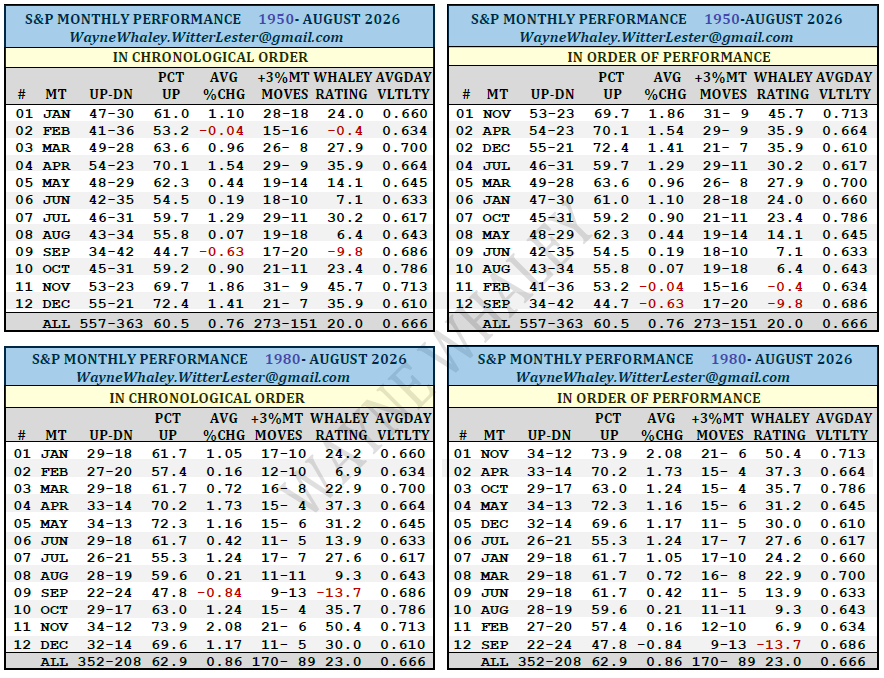
THE S&P MONTHLY SEASONALS
In the top table below is an update of the S&P monthly seasonals from 1950 through August of 2026 listed in Chronological Order on the left and Order of Performance on the right.
The Whaley performance rating is based on an avg that underweights outliers so that a 9/11 type anomaly doesn't drive the results.
That measure leans back toward the median, but not completely, as all years are considered.
In an effort to make the measure more easily comprehendible, it is then normalized to -100 to +100 in -3 to +3 standard deviation fashion
October's performance has improved measurably since 1990 going 23-13 since 1990 for an avg gain of 1.47% as opposed to 22-18 from 1950-1989 for an avg gain of 0.38% with 1987 (-21.7%) weighing heavily on the latter avg.
Thus, the motivation for posting the second list of shorter duration arbitrarily chosen from 1980.
October was the one obvious big mover from 1950 to 1980 list with November and April 1 & 2 in both list while September and February brought up the rear in both.
The volatility measure in the far-right column is based on the avg daily move observed in each month.
October was the most volatile month over both periods while the holiday laden month of December, the least.
Personally, I like to take the monthly collars off seasonal performance and I maintain a list of the top ten most aberrant periods during the year over the last 50 years for the 14 markets I maintain databases on which is based on an evaluation of all 10614 time frames during the year from 7 to 35 calendar days across the year with the top ten mutually exclusive cases then being identified.
And acknowledging that trends can evolve over time and taking note of the October phenomenon, that model's rating methodology gives twice as much weight to year 50 as it does to year 1.
I maintain a second list of the Top 100 Multi Market Seasonals which is a merger of all 14 markets.
[email protected] for Weekly Study subscriber inquiries.
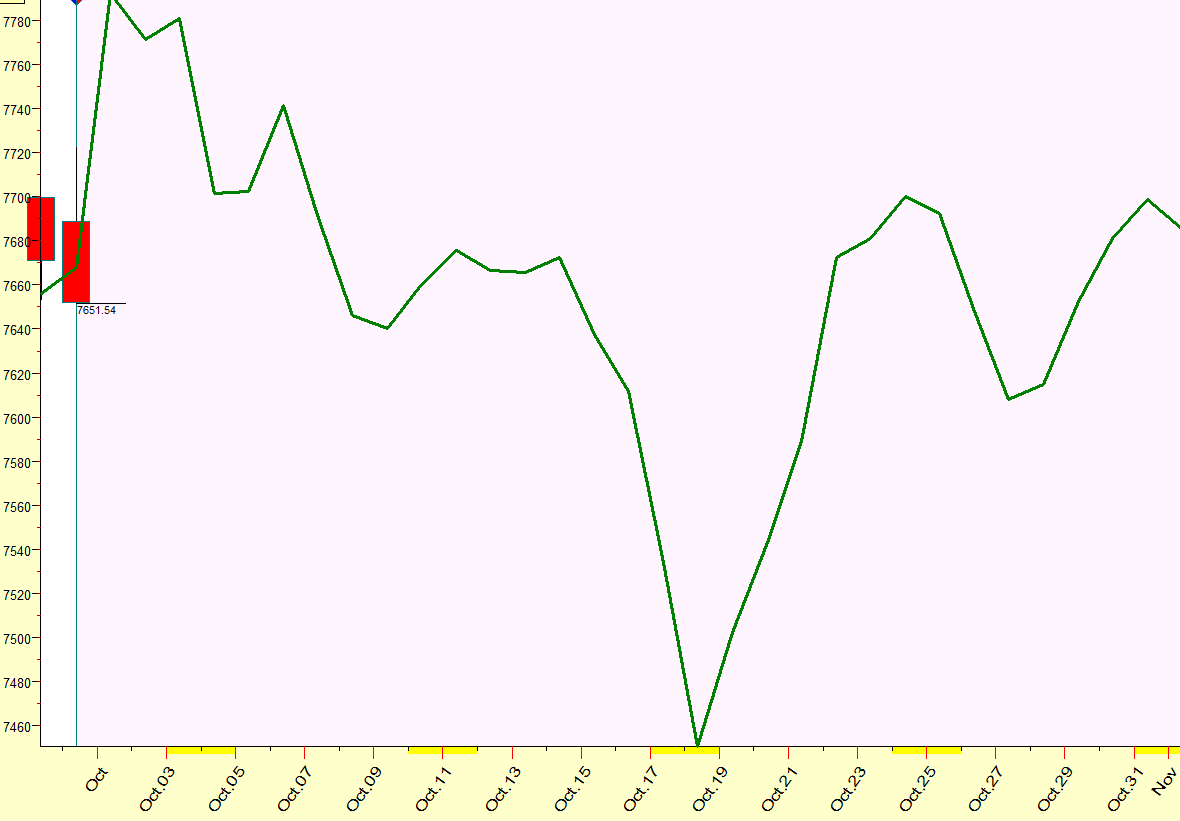
$ES_F: Bearish MACD crossovers in the ES Mini futures have been meaningful, the last 2 occurrences triggered moves of only -2%. A new crossover is imminent, suggesting at least a -2% is coming. 7,700 is essential.
Repost & comment "futures" for the daily plan for Tuesday DM. $SPX