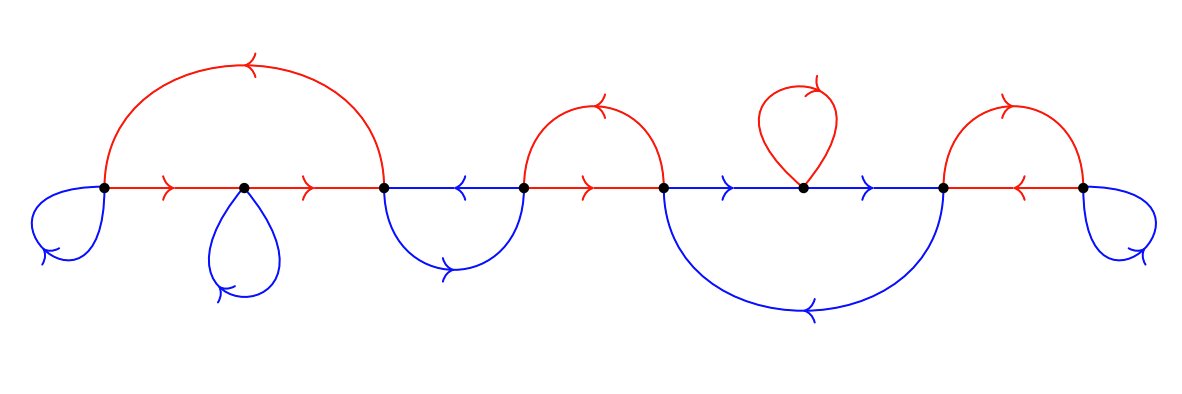
@dujella1 I built a small tool that factors monic, integer polynomials using LLL. Not the most efficient method, but it was fun to make.
https://t.co/EX9Mys9uDt
I'm genuinely impressed with #ClaudeCode -- not necessarily with the model fidelity but more with the interface. Not having to copy and paste code is a much bigger time saver than I thought it would be.
I've recently been talking a bit about how difficult it is to carefully check even well-written mathematics. I want to try to explain something about this by telling the story of some errors in the literature that (in part) led to the two papers below. 1/n
@ben_levinstein If you're willing to use Inkscape, there is an extension that can convert most simple drawings (beziers, fills, and gradients) into tikz code
@FrnkNlsn I have some old course notes from Bob Gompf's course on contact topology here, complete with some tikz diagrams I spent way too long making: https://t.co/ghjDRTeEIU
Not a lot of literature out there compared to its symplectic cousin
Update: my return trip was cancelled. This wouldn't be as bad if I wasn't in a small town that's a $100 Uber ride to my airport. @amtrak refund of $15 is kinda worthless at this point
Insert your adjacency matrix and optional styling parameters, and it will produce the graph as well as the TikZ code used to create it. Backend uses #Flask, #LaTeX, #networkx and hosted on #GoogleCloud. Enjoy!