At HumanLayer, we’re on a mission to solve the AI slop code problem.
In 2025 we open-sourced our Research, Plan, Implement framework, now deployed inside fortune 500s like Block and Uber - places where shipping slop is just not an option
And that was just the beginning.
Today, we’re opening access to HumanLayer - an Agentic IDE, collaboration platform, and building blocks for your software factory.
HumanLayer enables engineers solving hard problems in complex codebases to:
> move 2-3x faster across the entire SDLC (not just coding)
> maintain rigorous standards for system architecture and program design
Hundreds of engineers at companies of all sizes are already using HumanLayer to ship fast without sacrificing quality.
I'm excited to invite you to try humanlayer today at https://t.co/cQ648EkrnG, and I'm even more excited to see what you build.
@0xblacklight and I are deeply grateful to our team, our customers who give us so much incredible energy and feedback, our investors who have always been in our corner, and our friends and family who have supported us along this crazy journey
if you're a staff or principal engineer trying to make AI coding work at scale for your team, we'd love to hear from you
as @swyx likes to say - let's make this the year of no more slop
loops can help you build more effective, more autonomous agents
this post dives into a few loops:
1. the agent loop
2. the verification loop
3. the event driven loop
4. the hill climbing loop
and how you can compose them with langchain primitives!
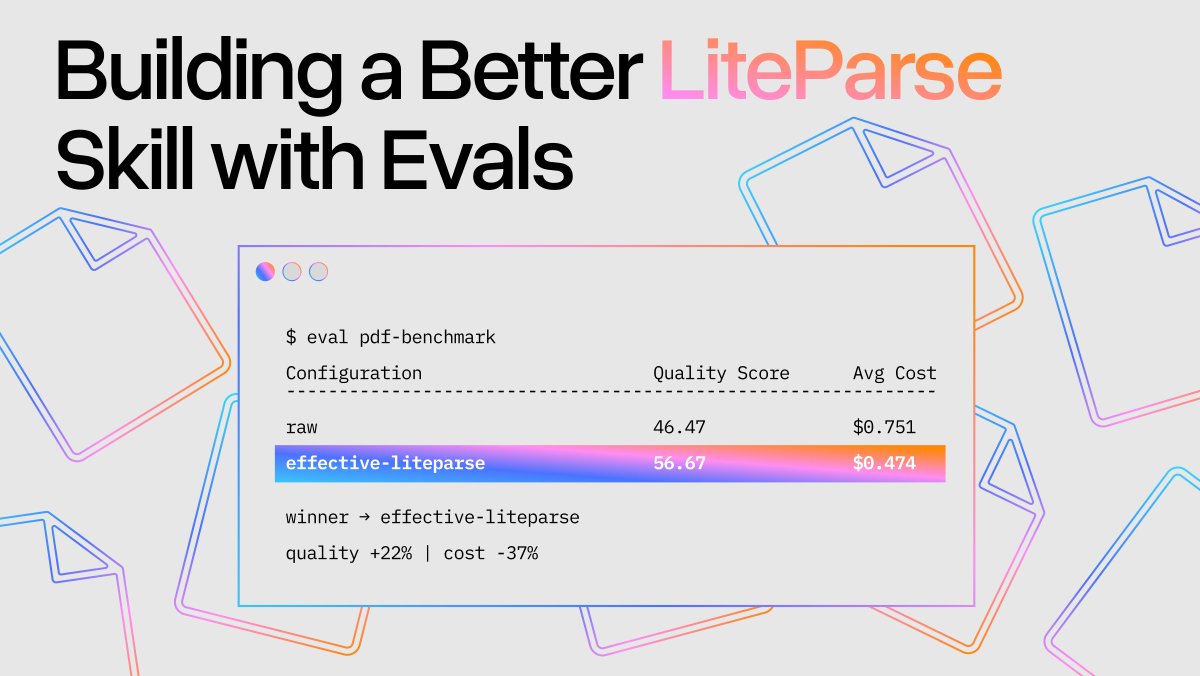
We made Claude better and faster at understanding PDFs
The trick isn’t just creating the fastest free document parser out there (with liteparse), but also *tuning the skill itself* so that Claude Code can use it with fewer turns and expensive file operations.
This is a fantastic blog post by @itsclelia which dives into the decision traces of Claude Code in how it operates over your filesystem, and identifies opportunities for optimization. We were able to incentivize the right skill behavior by doing the following:
✅ Preventing expensive mistakes like re-parsing the PDF for every search, leaving OCR on, reading screenshots when unnecessary, and preventing huge grep dumps
✅ Providing a simple BM-25 backed retrieval on parsed text
✅ Reducing the number of `grep` and `seq` sequential turns to reduce latency
The net result is that we are 37% cheaper and higher accuracy than using Claude Code over raw PDFs.
LiteParse is fully free and open-source, and you can plug in the skill today!
Blog: https://t.co/bL3EfKDpqf
Repo: https://t.co/JNER0mVcB8
Our latest economic research introduces a framework for tracking Claude Code as it scales.
Who is using Claude Code, and what are they using it for? How is the value of tasks changing? And how much does domain expertise shape whether a session succeeds?
https://t.co/IjjwQvrESo
How's Linear so fast?
Build with a core philosophy: never make users wait.
→ local-first storage
→ optimistic updates
→ sync architecture
→ caching
→ keyboard shortcuts
→ animation
https://t.co/RkFDzUqP1D
We've moved more than 50% of Linear to StyleX so far.
It's given us more control over how components compose, what can be overridden, and improved render performance too.
Whoa this blew up overnight and burned through ~$150 in tokens in a couple of hours. Topped off credits, switched default model to Sonnet and now scrambling to set up Stripe billing to support Opus costs 😅
🚨 속보 | 앤트로픽, OpenClaw,OpenCode 같은 서드파티 툴의 클로드 구독(OAuth) 사용 다시 허용 — 단, “그냥 부활”은 아님
요약 먼저:
1.발단 → 2026년 1월 9일 앤트로픽이 사전 공지 없이 서드파티 OAuth 토큰을 막았다가 커뮤니티 반발로 며칠 만에 번복 , 2월엔 약관을 고쳐 OAuth를 Claude Code,https://t.co/negKgHhGhb 전용으로 명문화 
2.강수 → 4월 4일, Pro,Max,Team 구독으로 OpenClaw,OpenCode,NanoClaw 등 외부 하네스(harness, 모델을 에이전트로 감싸는 실행 껍데기) 돌리는 걸 공식 차단 
3.반전(핵심) → 5월 13일, 4월 정책을 크게 뒤집어 서드파티 에이전트의 구독 사용을 다시 허용 . 단 기존 구독 한도에 그냥 얹는 게 아니라 별도의 ‘Agent SDK 크레딧’(플랜별 20~200달러, 정식 API 요금 기준)으로 분리 
4.발효 → 6월 15일부로 Agent SDK,claude -p 같은 프로그래밍 방식 사용은 인터랙티브(채팅) 한도와 분리된 별도 크레딧 풀에서 차감 . 이 크레딧을 다 쓰면 일반 구독 한도로는 못 메우고, 추가 크레딧을 따로 사야 함 
💬 그러니까 “구독으로 예전처럼 공짜 무한루프” 시대가 부활한 건 아니다.
왜냐면 앤트로픽이 손해 보던 핵심은 비효율(서드파티는 프롬프트 캐시를 못 살려 매번 토큰을 새로 태움)인데, 이번 크레딧 구조는 그 비효율 비용을 사용자 지갑으로 다시 떠넘기는 설계라서다.
반면에 “그래도 내 OpenClaw,OpenCode가 다시 살아났다”는 점에선 개발자 입장에선 분명한 화해 제스처다 — 차단당하고 사과 크레딧 받던 4월을 생각하면 격세지감.
어쩌면 이게 최종 균형점일 수도, 아니면 또 한 번 바뀔 수도 있고(이 회사 전적상…). 일단 저장해두면 다음에 또 정책 바뀔 때 타임라인 안 헷갈린다.
#Anthropic #ClaudeCode #OpenClaw #AIAgents
🔗 출처:
•반전 정책 상세(크레딧 단서 포함) → VentureBeat: https://t.co/KoBWInqHgr
•6월 15일 발효 정리 → TechTimes: https://t.co/dJHYTJwlMu
•전체 타임라인(1월,2월,4월) → DEV Community: https://t.co/UkqfI3oa2L
People keep treating Fable 5 as a model Anthropic disabled. It isn't one.
It's a screen in front of Mythos 5. Clear it (≥95% of sessions) and you get the raw model. Trip it on cyber, bio/chem, or distillation and you get rerouted to Opus 4.8, with a notification. It sticks too: /model fable won't pull you back while the context is still flagged.
Claude Code 창시자, 소프트웨어 엔지니어의 종말을 말하다 [유튜브]
- 에이전트형 코딩 도구 Claude Code는 코드 작성 자체보다, 제품을 만들고 업무 흐름을 재구성하는데 더 큰 변화를 일으킴
- Microsoft 업무 AI 사용자 조사에서는 빠른 AI 채택 압박, 새 작업물 생…
https://t.co/MZofASmlH4
🚨 Claude Fable 5 is NOT a vanilla LLM but an agentic system dressed as a regular model.
A leaked system prompt (link in replies) confirms what many suspected:
• Full Linux sandbox with bash & file editing
• Persistent storage API + web/image search
• Safety classifiers that silently fall back to Opus 4.8 while you still pay Fable rates
Anthropic’s own docs say Fable 5 is built for “multi‑day autonomous sessions, delegating subagents, checking its own work”.But benchmarks compare it to raw models like GPT‑5.5.
That’s not a level playing field.
It’s comparing a model + agent harness to a bare LLM.
Full X thread with all findings including leaked prompt breakdown and invariant gaps coming later.
#Fable5 #NewCategory #AgenticAI
🎨 GPT Image 2 위한 최고의 프롬프트 컬렉션
https://t.co/vMsXoHnx9Y
한국어도 지원되는데 좋네요! 엄청난 퍼포먼스를 보여주는 GPT Image 2 프롬프트를 싹다 모아놨어요.
10,000+ 넘는 정말 다양한 프롬프트들이 있고, 소셜에서도 활용할 수 있는 것들도 다채로움..
다국어 텍스트 렌더링과 캐릭터 일관성이 정말 좋아요.
여기에 퀄리티 높은 이미지 생성은 말할 것도 없고, 멀티턴 편집에서도 이전보다 훨씬 안정적인 결과를 보여줘서 활용해보시면 좋을 듯..
그나저나 OpenAI에서 준비 중인 빌보드는 진짜 예술적이고 감각적이네요..👍🏻
google just turned karpathy's llm-wiki gist into a spec today: the open knowledge format. markdown files, one required field.
the format question is now settled. the hard part still isn't.
what it changes:
- portability. a bundle is a tarball or a git repo. it moves between orgs and tools with no translation layer.
- version control. knowledge lives beside the code it describes, with diffs and history for free.
- decoupling. a human writes the bundle, an agent reads it, with no shared tooling between them.
- no SDK, no account. you read and write plain markdown.
what it leaves to you:
- contradiction resolution. a new source fights an old claim. OKF stores both and never says which wins.
- staleness. timestamp is a field. retiring a dead fact is a call the format won't make.
- merge policy. which page a fact lands on, what gets forked or overwritten. the producer agent owns it.
- retrieval. index.md holds for a few hundred pages. past that you need hybrid search and a reranker.
OKF standardized the filing cabinet. the librarian is still yours to build.
This is really big news. Google introduced the Open Knowledge Format (OKF) - a standardized way to store information in a directory of markdown files. Makes it really easy to make a digital brain that agents can use.
These files can serve as a living wiki. You can give agents the ability to query them or edit them. They can interlink.
Seems to me this could replace Notion or Obsidian. I can think of so many uses for this.
Google's blog post: https://t.co/DqSjg4UpvH
An easier to understand explanation is the SPEC.md file:
https://t.co/A3qSz3Tfas
I gave those two links to Antigravity and asked how we could use it for any of the projects we're working on. It came up with so many ideas. I would imagine Claude Fable 5 would whip up some pretty amazing things based on this system.
Currently creating an OKF library of our pepper garden. It's going to be a fun weekend.
"A calculator app? Anyone could make that."
Not true.
A calculator should show you the result of the mathematical expression you entered. That's much, much harder than it sounds.
What I'm about to tell you is the greatest calculator app development story ever told.
Meaghan Choi, design lead for Claude Code:
"Claude Code is unopinionated by design."
so the taste has to come from you.
hand it nothing, and it invents a new look on every screen.
i handed it my design system instead: nine of ten screens came out on-brand on the first try, up from two.
this free writeup beats the $500 design-systems course you keep eyeing.
how to hand Claude Code that system is in the article.