Sun et al: Evaluation of Intracranial Pressure in Patients with Severe Brain Injury Using Contrast-Enhanced Ultrasound: A Pilot Study with Preliminary Findings
Link: https://t.co/Wxkn5to8CH
@neurocritical#neurocritcare
Today's Paper of the Day is:
Should I Target the Blood Pressure from the Arterial Line or the Cuff? A Practical Approach for Dealing with Widely Discordant Measurements
https://t.co/JKgcYjlUQ5
Join us to read 1 paper per day
I’ve created a quick-reference chart of the main #Antiplatelet agents used in the #angiosuite. I hope you’ll find it useful to keep close at hand.
Feedback is welcome—please let me know if you notice any errors, omissions, or think something should be added.
#NeuroIntervention #NeuroIR #Endovascular #FOAMed #MedEd #neurosurgery
*This chart is intended for quick reference only and does not replace clinical judgment or local guidelines.
💧 Fluid Management in Liver Failure and Ascites
Circulatory Dysfunction and Effective Hypovolaemia
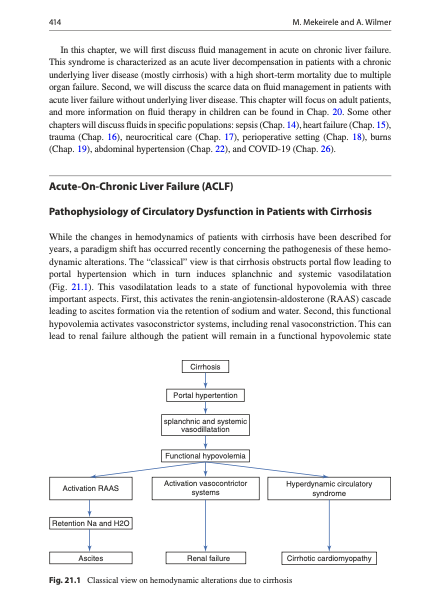
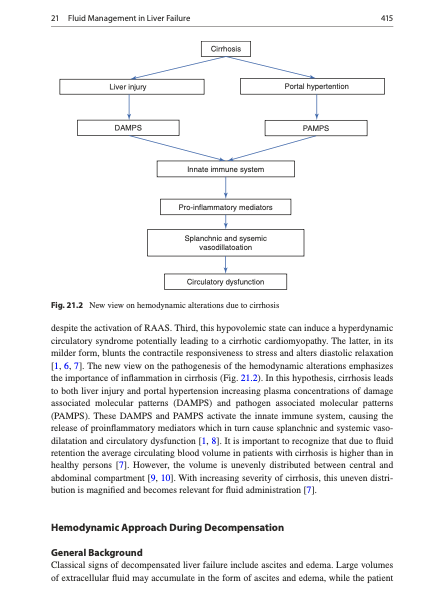
The liver failure chapter explains that despite edema and ascites, many patients with cirrhosis are effectively underfilled due to splanchnic vasodilation and low effective arterial blood volume. This creates a delicate balance: excessive fluids exacerbate ascites and hyponatraemia, while under‑resuscitation risks renal hypoperfusion and hepatorenal syndrome.
Albumin, Paracentesis and Vasoactive Drugs
The authors review indications and dosing for albumin following large‑volume paracentesis, in spontaneous bacterial peritonitis and in prevention/treatment of hepatorenal syndrome, drawing on key clinical trials. Practical tables link specific clinical situations (e.g. tense ascites, SBP, HRS) to albumin and vasoconstrictor strategies while reinforcing sodium restriction and diuretic stewardship.
📘 Full liver failure chapter in Rational Use of Intravenous Fluids in Critically Ill Patients:
👉 https://t.co/7pvDxZGh4I
🔵 IFAD 2026 will address albumin use and fluid management in decompensated cirrhosis and liver ICU.
👉Registration: https://t.co/wATwBWAIge
#LiverFailure #Ascites #Albumin #HepatorenalSyndrome #ICU
When TCD imaging is combined with gray-scale and contrast-enhanced US techniques, it expands the clinical utility of transcranial US, poising it to play an increasing role in modern neuroimaging.🧠
https://t.co/GJQ6ALx4Hy
#SCCMNeuro#NeuroICU#NeuroX#NeuroTwitter
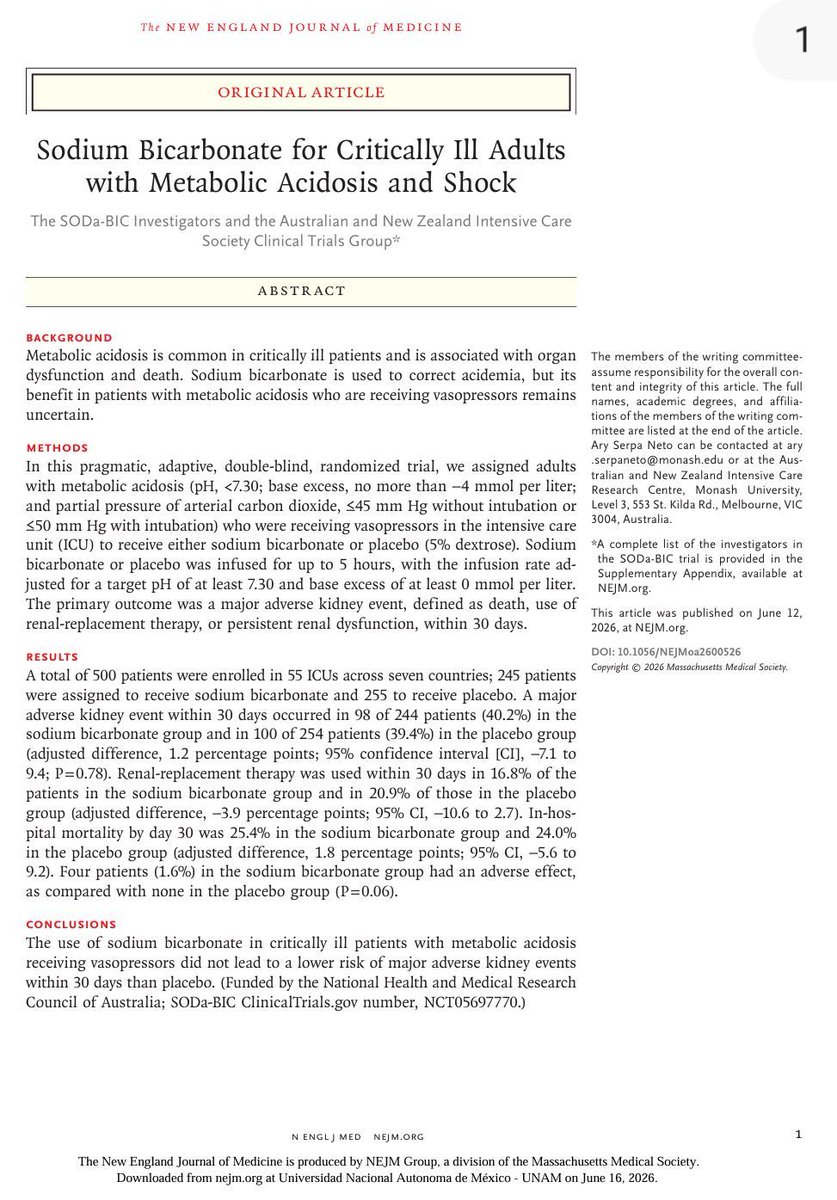
🧂Sodium Bicarbonate for Critically Ill Adults with Metabolic Acidosis and Shock: Are We Finally Closing the Debate?
Sodium bicarbonate has long been one of the most controversial therapies in critical care. The newly published SODa-BIC Trial in NEJM provides the most rigorous evaluation to date.
This international, double-blind, placebo-controlled RCT enrolled 500 critically ill patients with metabolic acidosis (pH <7.30) requiring vasopressor support across 55 ICUs in seven countries. Patients received either protocolized sodium bicarbonate infusion or placebo, targeting pH ≥7.30 and base excess ≥0 mmol/L. The primary endpoint was a composite of death, renal replacement therapy (RRT), or persistent renal dysfunction at 30 days.
The primary outcome occurred in 40.2% of patients receiving bicarbonate versus 39.4% receiving placebo, showing no significant difference. Mortality was similar between groups (25.4% vs 24.0%), and no benefit was observed for persistent renal dysfunction or RRT dependence. Importantly, no predefined subgroup demonstrated a significant treatment effect, including patients with more severe acidemia (pH <7.25), advanced AKI, or septic shock.
However, bicarbonate clearly achieved what it was designed to do physiologically.
Patients receiving bicarbonate experienced faster correction of acidemia, higher bicarbonate levels, improved base excess, and significantly fewer recurrences of metabolic acidosis during the first week (32.0% vs 55.7%). Open-label bicarbonate administration was also less frequent.
The key message is therefore nuanced.
Bicarbonate effectively corrects laboratory abnormalities but does not improve clinically meaningful outcomes.
This distinction is fundamental. Critical care history repeatedly reminds us that normalization of physiological variables does not necessarily translate into improved survival or organ recovery. The SODa-BIC trial reinforces the importance of focusing on patient-centered outcomes rather than surrogate markers alone.
From a practical bedside perspective, these findings suggest:
• Routine bicarbonate administration for vasopressor-dependent metabolic acidosis cannot be recommended solely to improve survival or renal outcomes.
• Bicarbonate remains useful when rapid correction of severe acidemia is clinically desirable.
• Decisions regarding bicarbonate therapy should remain individualized and based on the underlying cause of acidosis rather than pH correction alone.
• Future studies may need to focus on highly selected phenotypes rather than treating metabolic acidosis as a homogeneous syndrome.
Reference ���
The SODa-BIC Investigators and the Australian and New Zealand Intensive Care Society Clinical Trials Group. Sodium Bicarbonate for Critically Ill Adults with Metabolic Acidosis and Shock. New England Journal of Medicine. 2026. doi:10.1056/NEJMoa2600526
🚨 New #VExUS post on https://t.co/hqYw2WlFqR
Confused by abnormal hepatic vein Doppler waveforms? This post breaks them down using physiology, making it easier to connect waveform changes to the underlying hemodynamics.
🔗https://t.co/smNhInCSx9
#POCUS#echofirst#Nephpearls
If a component of VExUS feels difficult, the answer is to understand it better, not to eliminate it altogether. Simplification can be helpful to some extent, but oversimplification often comes at the cost of losing valuable physiological information.
@POCUSpeek 1/ Sure. There is a force driving venous return to the heart that is made of a combination of intravascular volume & vascular compliance—more volume and/or stiffer vessels increase this force is called “mean systemic filling pressure” or Pmsf.
The ARISE FLUIDS trial was just published in the NEJM examining early IV fluids vs early vasopressors in septic shock. Just a reminder, fluids aren't the cure for sepsis
https://t.co/7V6d0RWkTL
💦 Diuretics in the ICU are not kidney therapy, they are fluid balance therapy, and only work safely when renal perfusion is adequate.
Recent PubMed indexed literature emphasizes that loop diuretics are first line for fluid overload in critically ill patients, but they should not be used as a reflex response to oliguria. Before giving furosemide, ask: is the kidney perfused? Is MAP adequate? Is venous congestion present? Is cardiac output sufficient? Is the patient still fluid responsive or already fluid overloaded? (Ostermann et al., 2024).
A practical ICU approach:
First, restore perfusion pressure and stop unnecessary fluids 🚨
Second, confirm congestion: lung ultrasound, venous Doppler, echo, CVP trend, weight, cumulative balance, edema, oxygenation and renal function.
Third, give a loop diuretic if congestion is present and perfusion is acceptable. Typical ICU furosemide dosing may start at 20 to 40 mg IV in diuretic naive patients, but higher doses are often required in CKD, chronic loop exposure or severe congestion. Continuous infusion may help maintain natriuresis, but dose response matters more than delivery style (Ferrari et al., 2025).
The furosemide stress test is not a “diuretic trial.” It is a tubular function test. Common dosing is 1 mg/kg IV if furosemide naive or 1.5 mg/kg if previously exposed; urine output below 200 mL in 2 hours suggests high risk of AKI progression or need for RRT (La Via et al., 2025).
Diuretic resistance should trigger reassessment, not blind escalation: check renal perfusion, albumin, chloride, sodium, nephrotoxins, intra abdominal pressure, venous congestion, and drug delivery. Sequential nephron blockade with thiazide type diuretics, acetazolamide or mineralocorticoid antagonists may help selected patients, especially in acute heart failure (Marques et al., 2025; Prata et al., 2025).
Do not persist with diuretics when there is refractory hyperkalemia, severe acidosis, uremic complications, pulmonary edema with failure of diuresis, severe AKI with oliguria/anuria, or hemodynamic intolerance. That is when fluid removal becomes RRT.
The ICU question is not about how much furosemide?, Is this patient congested, perfused, responsive, and safe to diurese?
#ICU #CriticalCare #AKI #Diuretics #Furosemide #FluidOverload #Deresuscitation #RRT #Cardiorenal #HemodynamicsReferences
Ferrari, F., Clinical Pharmacokinetics, 64(7), 987–997. https://t.co/dsCxzyPDTn
La Via, L., Journal of Clinical Medicine, 14(8), 2595. https://t.co/Uk4c8cJhdD
Marques, P.,. Cardiorenal Medicine, 15(1), 462–483. https://t.co/GWaEKpLB56
Ostermann, M., Intensive Care Medicine, 50, 1331–1334. https://t.co/x1P2DmNW39
Prata, A. A.,. Critical Care, 29, 474. https://t.co/g6lcN4esPn
Video Atlas of the Detailed Neurologic Examination by Dr. Martin Samuels
A classic neurologic examination series that was included as part of Harrison’s. Highly recommended for anyone learning or refining their neurological exam
https://t.co/2SukhwUvIB
great illustration about how our approach to antimicrobial stewardship is painfully obtuse
everyone assumes that ABX with a narrower spectrum of activity cause less resistance, but this is often wrong
TBH its hard to find solid EBM about which ABX induce the least resistance😢
Thomas et al: Valproic acid for the management of agitation in neurosurgical intensive care unit patients
Link: https://t.co/itLUoFsilO
@neurocritical#neurocritcare
Author take 🏡 points:
1. ONSD sonography demonstrates moderate diagnostic accuracy for detecting elevated intracranial pressure in adult traumatic brain injury, with pooled sensitivity of 0.88 and specificity of 0.76.