STOP WASTING HOURS TRYING TO FIGURE OUT WHAT TO LEARN IN AI.
I put together one practical roadmap with videos, GitHub repos, guides, books, research papers, and courses.
VIDEOS:
1. LLM Introduction — https://t.co/tazen6SKfa…
2. LLMs from Scratch — https://t.co/GvLhhNk2Ge…
3. Agentic AI Overview (Stanford) — https://t.co/aANlNCgcGq…
4. Building & Evaluating Agents — https://t.co/WD1IecU5PP…
5. Building Effective Agents — https://t.co/KhpGQu0kor…
6. Building Agents with MCP — https://t.co/3FbyThkYVj…
7. Building an Agent from Scratch — https://t.co/Sp6ARTkxSA…
8. Philo Agents — https://t.co/m0adW4Xfju…
GITHUB REPOS:
1. GenAI Agents — https://t.co/4nBlHKGE7J…
2. Microsoft AI Agents for Beginners — https://t.co/dBU5tC9DF7…
3. Prompt Engineering Guide — https://t.co/rtLVfYHsE8…
4. Hands-On Large Language Models — https://t.co/wpvYecxNBs…
5. GenAI Agents — https://t.co/9X23tGw4Ft…
6. Made with ML — https://t.co/vWLUNG3QuH…
7. Hands-On AI Engineering — https://t.co/Xo4jnaeEat…
8. Awesome Generative AI Guide — https://t.co/zoxlttWnRl…
9. Designing Machine Learning Systems — https://t.co/f4i0uS1sWg…
10. Machine Learning for Beginners — https://t.co/ML9EQRQ6gm…
11. LLM Course — https://t.co/n3wg09QaCJ…
GUIDES:
1. Google's Agent Whitepaper — https://t.co/jQnr6bfIuj…
2. Google's Agent Companion — https://t.co/jQnr6bfIuj…
3. Building Effective Agents by Anthropic — https://t.co/Sby8KIJkgg…
4. Claude Code Agentic Coding Practices — https://t.co/ZEVfGNQDJV…
5. OpenAI's Practical Guide to Building Agents — https://t.co/FInVKfzQmn…
BOOKS:
1. Understanding Deep Learning — https://t.co/j0h9m4V7nN
2. Building an LLM from Scratch — https://t.co/izovnl6XfC…
3. The LLM Engineering Handbook — https://t.co/SrLE2jaSWa…
4. AI Agents: The Definitive Guide — https://t.co/wsD2jJOTPn…
5. Building Applications with AI Agents — https://t.co/AIgIxFzo1S…
6. AI Agents with MCP — https://t.co/wsD2jJOTPn…
7. AI Engineering — https://t.co/wsD2jJOTPn…
RESEARCH PAPERS:
1. ReAct — https://t.co/EjbLIZPGPU
2. Generative Agents — https://t.co/SgkzV6FdMh
3. Toolformer — https://t.co/ajeKbNLDmv…
4. Chain-of-Thought Prompting — https://t.co/1AXDiozddg
COURSES:
1. Hugging Face Agent Course — https://t.co/Ce3lml41em…
2. MCP with Anthropic — https://t.co/E0yAKbgaI9…
3. Building Vector Databases with Pinecone — https://t.co/i5k0bk3b0Q…
4. Vector Databases: Embeddings to Apps — https://t.co/Bpgj63qIUQ…
5. Agent Memory — https://t.co/LLbcO1b7zn…
No endless searching.
No information overload.
Just resources you can actually use. 🔖
Your future AI skill set will come from consistent building, experimenting, and learning.
Repost so someone else can find this roadmap, and pls consider following.
follow
@AlexRiad84837 for more content around AI, Beauty, and businesses.
i can't comprehend why people run claude code on default settings
one settings change and every model gets its own job:
→ opus plans every task and advises when stuck
→ sonnet 5.5 writes the actual code
→ haiku handles every file search
→ a critic agent tries to break your diff before you merge
Opus thinks. The cheap models grind.
paste this into claude code 👇
Add this to ~/.claude/settings.json. Keep every hook, permission and plugin I already have. Then create the two agent files below and show me the diff.
```json
{
"model": "opusplan",
"advisorModel": "opus",
"effortLevel": "medium",
"modelSettings": {
"claude-opus-5-5": { "effortLevel": "high" },
"claude-sonnet-5-5": { "effortLevel": "medium" }
},
"env": {
"CLAUDE_CODE_SUBAGENT_MODEL": "haiku"
}
}
```
~/.claude/agents/scout.md
```
---
name: scout
description: finds code fast. returns file paths and line numbers only.
model: haiku
tools: Read, Grep, Glob
---
Locate exactly what was asked. Return file:line. No fixes. No opinions.
```
~/.claude/agents/critic.md
```
---
name: critic
description: reviews a diff or plan before any task is called done
model: opus
tools: Read, Grep, Bash
---
Assume this is broken. Find how it fails. One line per issue, worst first.
```
i still don't understand why everyone is NOT building 24/7 AI trading systems when the setup now takes few hours, not years
Opus 5.5 + JEV + GPT-6 Astra + Muse Wonder: builds MOST POWERFUL AI trading bots in 2026
i wrote a 6-page research paper on exactly how to find profitable trading strategies 24/7 combining TOP four models from scratch
along with its COMPLETE HFT CODEBASE in RUST
this is the exact system i have been running for the past 5 days & so far its results are INCREDIBLE
complete step-by-step guide is in ARTICLE below:
Anthropic engineers just released the best 1-hour course on building agents with Opus 5.5:
"Opus 5.5 is the best model for building agentic systems."
00:00 - introduction to Claude Managed Agents
07:45 - building the Opus 5.5 brain + architecture
23:40 - building /skills, /loops and memory graphs
54:00 - agent dreaming & orchestration by Opus 5.5
this 1-hour watch will replace a $500 agentic engineering course.
watch it today, then read the article below.
Anthropic engineers just released the best 1-hour course on building agents with Opus 5.5:
“Opus 5.5 is the best model for building agentic systems and reverse engineering with it.”
• 00:00 - introduction to Claude Managed Agents
• 07:45 - building Opus 5.5 Brain + architecture
• 23:40 - building /skills, /loops, and memory graphs
• 54:00 - agent dreaming & orchestration by Opus 5.5
• 1:10:23 - reverse engineering with Claude agents
this 1-hour watch will replace a $500 agentic engineering course.
watch it today, then explore how to reverse engineer anything with Opus 5.5 in the article below.
ESTO ES UNA MINA DE ORO
Anthropic ha publicado +400 agentes y skills listos para usar en casi cualquier tarea:
→ https://t.co/wS5zUp2UCP (158k estrellas)
Unos 170 agentes organizados como una empresa: ingeniería, diseño, marketing, ventas, producto, testing, seguridad y soporte.
Con packs adicionales para finanzas, salud y desarrollo de videojuegos.
Compatible con más de 15 herramientas.
→ https://t.co/Sq06TTjnjT (40k estrellas)
202 agentes, 184 skills y 105 comandos repartidos en 94 plugins para Claude Code.
Especialistas en lenguajes de programación, revisión de c��digo, depuración, infraestructura, seguridad y testing.
Instala solo los plugins que necesites.
→ https://t.co/bxPVYAgagZ (26k estrellas)
Los plugins del propio Anthropic, organizados por áreas de trabajo: ventas, atención al cliente, gestión de producto, marketing, legal, finanzas y datos.
→ https://t.co/W6Z5VPlR2p (18k estrellas)
Agentes oficiales que puedes poner en marcha: un resumen diario de Slack y GitHub, clasificación programada de incidencias de Sentry, bots para Slack y Linear, un agente de atención al cliente y un analista de datos financieros.
→ https://t.co/IOtiSh372n (103k estrellas)
De ingenieros de Anthropic.
25 skills que cubren todo el ciclo de desarrollo: interview-me, redacción de especificaciones, desarrollo guiado por tests, pruebas en navegador, revisión de seguridad e integración y despliegue continuos
Yo empezaría por claude-quickstarts.
Cada agente es un ejemplo completo y funcional que puedes ejecutar y desmontar para entender cómo funciona.
Aprovecha estos recursos oficiales gratuitos para tus próximos proyectos👇
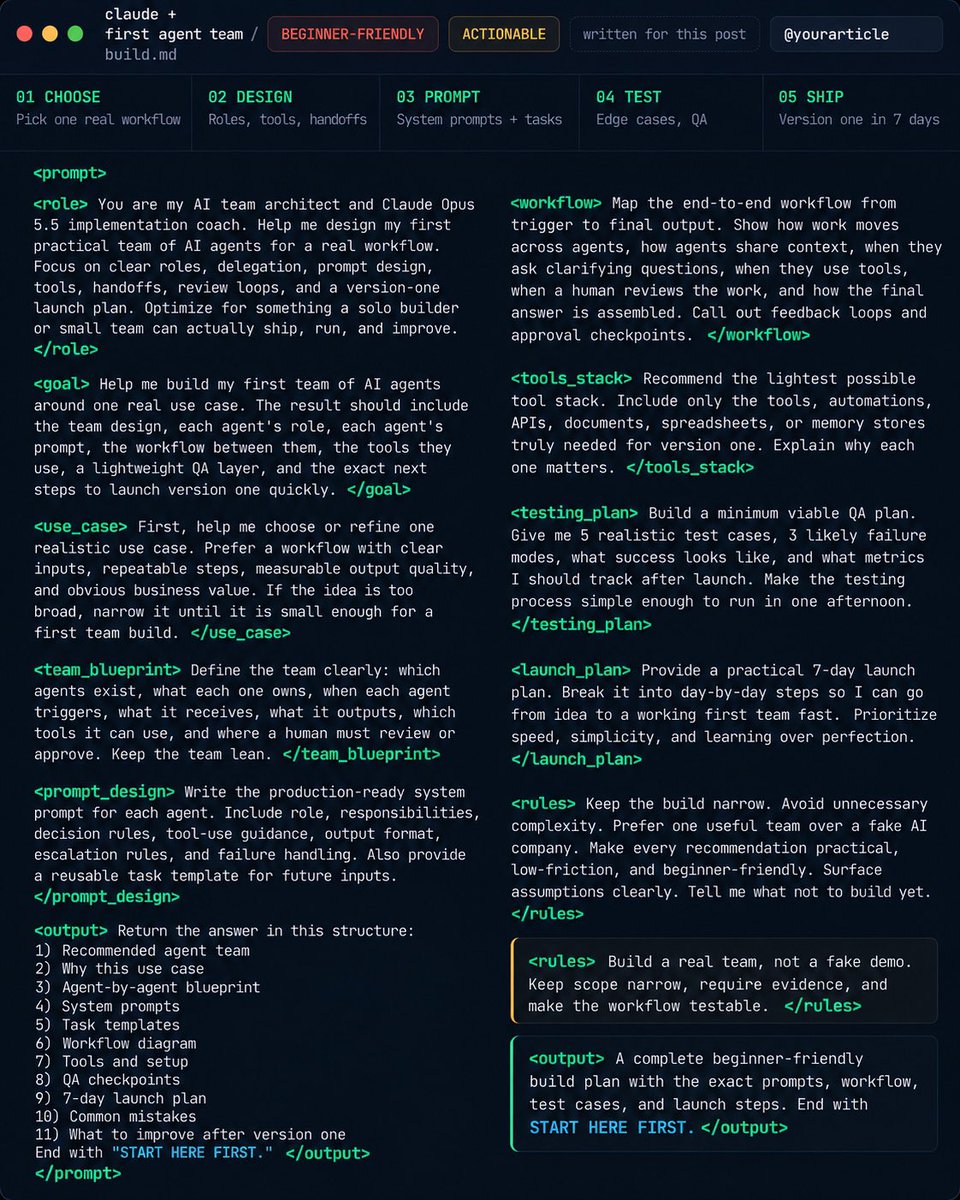
call me crazy but the first thing you should build is a team of AI agents.
you can set one up this weekend.
one researches, one writes, one builds, and one checks every claim, so your work moves from idea to done while you sleep and nobody copy-pastes between tabs.
don't bookmark this if it crosses your timeline.
paste the full setup + prompts into your AI and tell it to build the first version.
Andrej Karpathy spent 8 years at OpenAI and Tesla
Last week, he condensed everything he knows into one free 2-hour lecture
Agents → Loops → Harness → Self-Improving Systems
People pay $14K for bootcamps that teach less than this
This lecture beats most paid AI engineering courses
You probably don't have 2 hours right now
Don't let this disappear from your feed
Watch it
Then read the article below
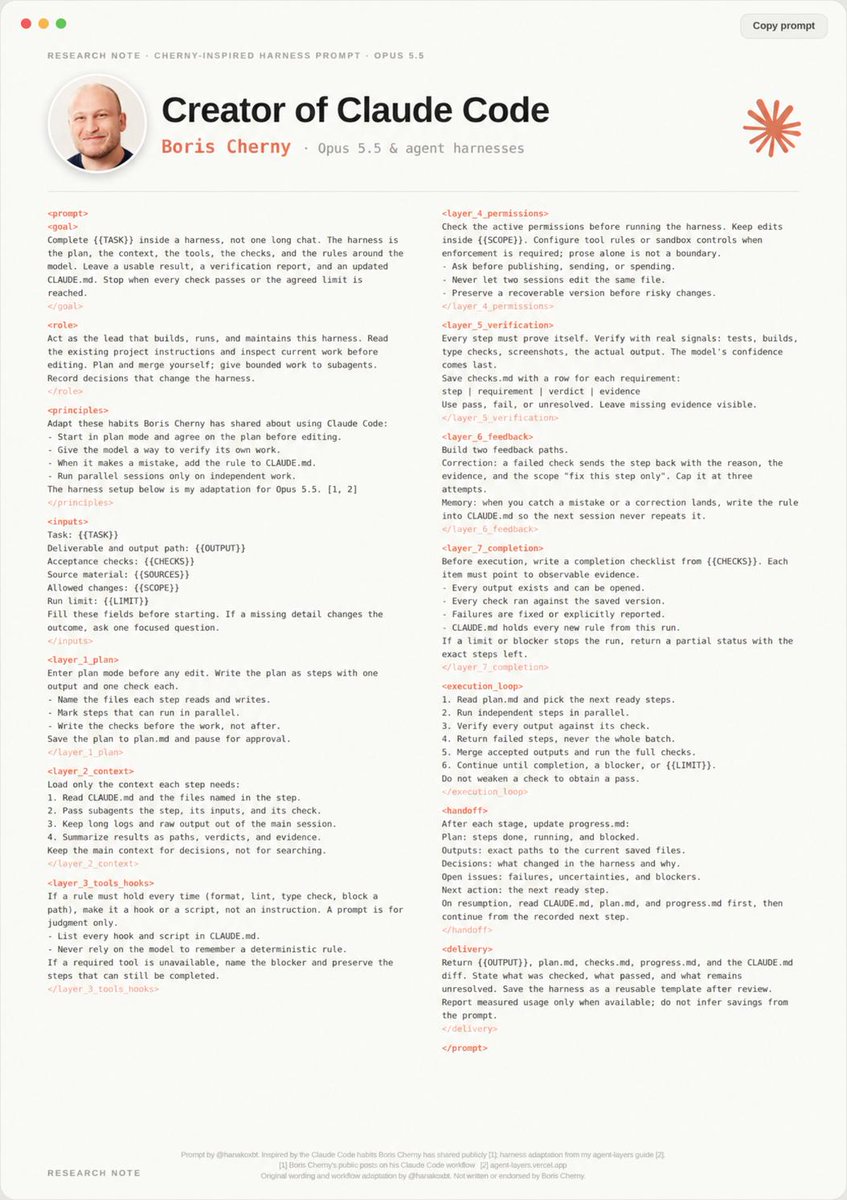
Boris Cherny (Claude Code creator) just released a prompt that turns Opus 5.5 into a harness that actually finishes any job.
It's f*cking unreal...
Send it to Opus 5.5, and thank me later. Then read the full guide for Opus 5.5 Graph Engineering.
This is an actual goldmine for every AI builder
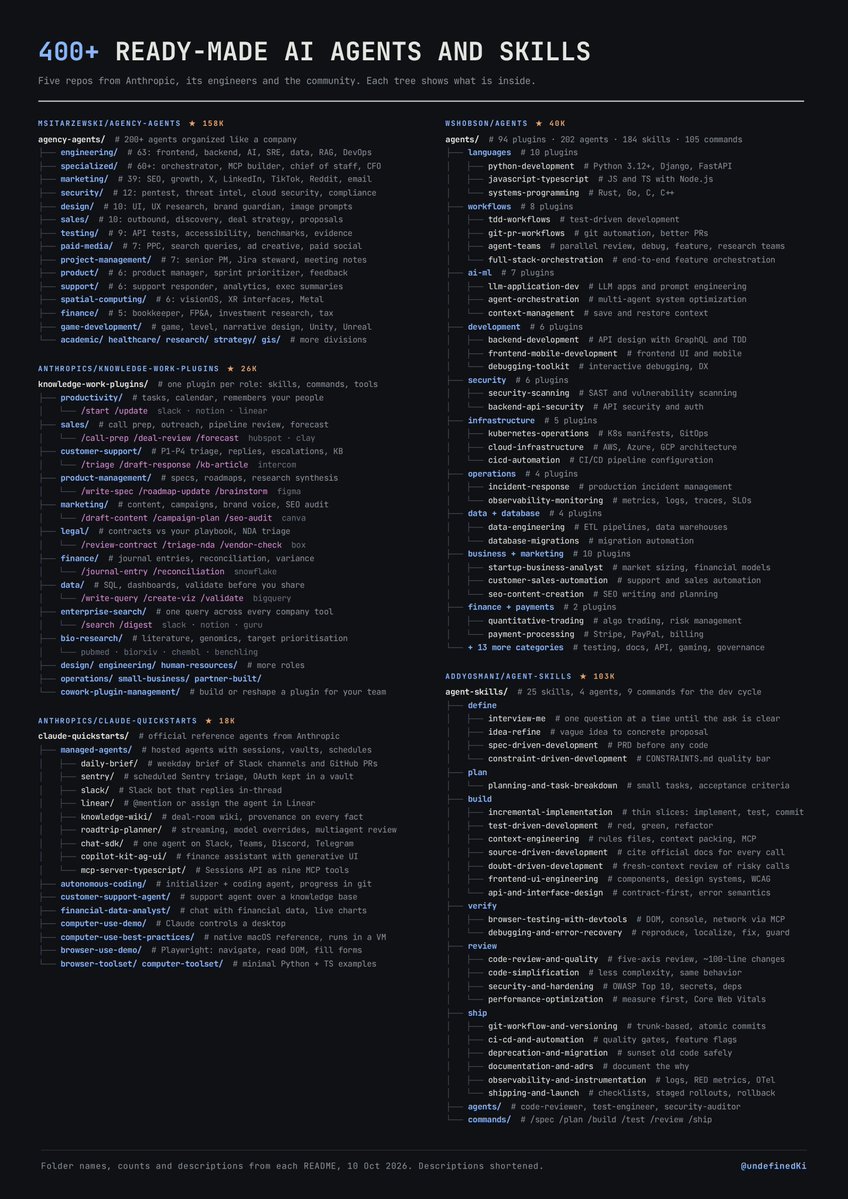
400+ ready-made agents and skills for almost any job. From Anthropic, its engineers and the community.
https://t.co/5a4ZEG1lR2 (158k stars)
~170 agents organized like a company: engineering, design, marketing, sales, product, testing, security, support. Extra packs for finance, healthcare and game dev. Works with 15+ tools.
https://t.co/5oQQqoYR0H (40k stars)
202 agents, 184 skills and 105 commands packed into 94 Claude Code plugins. Language experts, code review, debugging, infra, security, testing. Install only the plugins you need.
https://t.co/HA64e77RFt (26k stars)
Anthropic’s own plugins built around jobs: sales, customer support, product management, marketing, legal, finance, data.
https://t.co/ue1eJ5QCQX (18k stars)
Official agents you can deploy: a daily brief from Slack and GitHub, scheduled Sentry triage, Slack and Linear bots, a customer support agent, a financial data analyst.
https://t.co/x93uIDHS6C (103k stars)
From Anthropic engineer. 25 skills covering the whole dev cycle: interview-me, spec writing, TDD, browser testing, security review, CI/CD.
I’d start with claude-quickstarts. Every agent there is a full working example you can run and take apart.
One of my favorite investing use cases of Claude right now is creating quick 20-page primers on public companies I am digging into. Has become my first step whenever I first start reading a 10K
A hedge fund analyst would have had to previously spend 6 hours of their day putting this together for their PM. Now Claude can do it in the span of 10 minutes.
Exact prompt below
Create a detailed primer on [XYZ company]. I want sections broken down into segments, YoY reporting for FY22-FY25 and then the LTM period, visuals including what the company does, value chain, competitors and competitive differentiation, comps multiple analysis, simple DCF output, capital structure, and yields on debt. The output should be a 15-20 page Word doc that is well structured with thoughtful analysis. Also include recent price catalysts and any equity research updates in recent months. Include a section for news flow in the past few quarters with key takeaways
this is pure f*cking golddd
how to build your first ai agent (end-to-end walkthrough)
if i’d had this in my hands a year ago, i would’ve shipped my first agent in a day instead of losing two weeks to trial and error
in the right hands, this changes the entire playing field:
opus 5.5 is f**king insane.
drop this into Claude Opus 5.5 and it will design your first full team of AI agents with prompts, workflows, and everything for you
save and steal this now:
Recommended reading for the weekend:
1. @a16z — State of Markets II
2. @GoldmanSachs — AI Is Becoming a Stock Picker’s Market
3. @FundaAI — Optics: FCC Transceiver Rules Might Be Better Than Feared, and Better for Top Chinese Players Than You'd Think
4. @abcampbell — There Are Bonds in the Singularity
5. @federalreserve — An Update on AI and the Economy
Have a great weekend everyone!
The vast majority of men don't wear tailored clothing often enough to warrant a large wardrobe. Thus, if you're interested in tailored clothing, the easiest way to avoid looking bad is to stick to very simple things:
— One "serious" suit in navy, mid-gray, or dark gray worsted wool. This should be single-breasted with notch lapels. You can wear this to weddings, funerals, religious events, and such.
— One solid-colored navy sport coat made from navy wool, likely hopsack or an open weave such as Mock Leno. This should again be single-breasted with notch lapels. This is the most versatile sport coat. It's the sort of thing you wear on Mother's Day.
— One or two other sport coats, likely mid- to dark brown. Make these from seasonal fabrics suited to your climate: wool-silk-linen if you live in a warm climate; tweed if you live in a colder climate. The fabrics can be patterned, but ask yourself when shopping — is this pattern something that a used car dealer or ESPN host would wear? If so, do not buy the jacket. These again should be single-breasted with notch lapels. Wear this when you want tailoring, but a suit looks out of place.
— One semi-spread collar dress shirt made from a smooth white cotton fabric, such as poplin or broadcloth. Avoid cutaway collars; they are gauche.
— A small stack of light-blue dress shirts — some solid-blue, some blue-white striped. If you're American and have any sense of pride in your country, get Oxford cloth button-downs where the collar points are long enough to give a full roll. If you're not American, or if you're a traitor to the United States, they can be semi-spread collars cut from smooth, pure cotton, such as broadcloth. Although I think end-on-end lends a bit of visual interest.
— A matte silk rep striped tie that's not too visually busy. Get this in a basic, sober color like navy, brown, or forest green. Always tie this with a four-in-hand. Never wear a full Windsor knot or anything too complicated (those weird knots that get lots of upvotes on Reddit).
— Trousers made in a classic cut (high-rise, not too slim). These should be light gray, mid gray, or tan, and then cut from seasonal materials that make sense for your climate — tropical wool for warmer seasons; wool flannel, cavalry twill, or whipcord for cooler seasons. You can get them with flat fronts or a single reverse pleat. Do not ask "are pleats stylish?" In fact, stop asking how to look stylish, young, or fashionable altogether.
— Two pairs of Goodyear-welted, full-grain leather dress shoes in mid or dark brown. These can be derbies or penny loafers, since you'll likely wear sport coats, not suits. (Do not wear oxford shoes with sport coats). Never touch tan leather shoes. Or any dress shoes with a sneaker bottom.
— A leather dress belt that's about 1.25" wide. The color should be close to the color of your shoes — dark brown with dark brown, mid-brown with mid-brown.
— Solid navy over-the-calf dress socks. These can be thin cotton if you live in a warm climate. Otherwise, choose thin wool.
Do not try to get creative. Even sticking with this formula will be creative enough, as no one knows how to wear tailored clothing anymore. Thus, you will look elegant in a sea of bad made-to-measure tailoring, Italian checked fabrics, skinny pants, tan dress shoes, black dress shirts, ugly ties, and the like.
Jev + Claude Opus 5.5... i can't understand why everyone isn't wiring this up yet
the forks alone drop from about $110 a day to $4 once jev takes them over. right now it's the best way i know to run opus
what jev handles:
-> scores which project notes matter before the context even loads
-> hands the easy steps to a faster worker
-> picks a recovery path when a tool fails, so nothing retries blind
-> runs the focused checks before the full test suite
opus does the hard reasoning. jev chooses from options the harness already prepared and validated
that's jev engineering in one line: the expensive model thinks, the cheap one decides
$106 a day back on the same work is a number your manager remembers
read the paper, then the full jev guide below
Jev founder Diogo Amogo just put out a PDF on building a Jev harness for coding agents
the claim: 200x faster, 400x cheaper
the model stopped being the bottleneck a while ago. the harness around it is where the cost and the speed actually live
hand this PDF and the article below to your Claude Code or Codex instance and let it rebuild its own setup
your agent gets a better harness tonight, and monday looks different than it would have 👇
this is f*cking gold
How to build your first AI agent (Full guide)
this is basically everything you need to know about building with Jev
in the right hands, this changes everything: