Distributed Cloud Inference is the Future for Physical AI
BENCHMARK results from @generalsequence
Physical-AI models are moving to the cloud: bigger models, more of them, running for real robot deployments. Serving them well turns out to be a distributed-systems problem, not just a modeling one. Here's what the data shows.
Latency is a deadline and we can solve it.
Decompose a single robot-inference call and the model is a small slice: on an open policy like pi0.5-DROID, ~106 ms. A naive cloud path (Runpod, etc.) spends ~1,494 ms per call, dominated by connection setup, observation upload, and routing overhead. Optimize the path and it drops to ~144 ms (a 10.4× reduction, only an additional 38ms) from our networking optimization, which holds across models (pi0.5, Cosmos3-Edge, GR00T, DreamZero). (See Image 1 and Image 2)
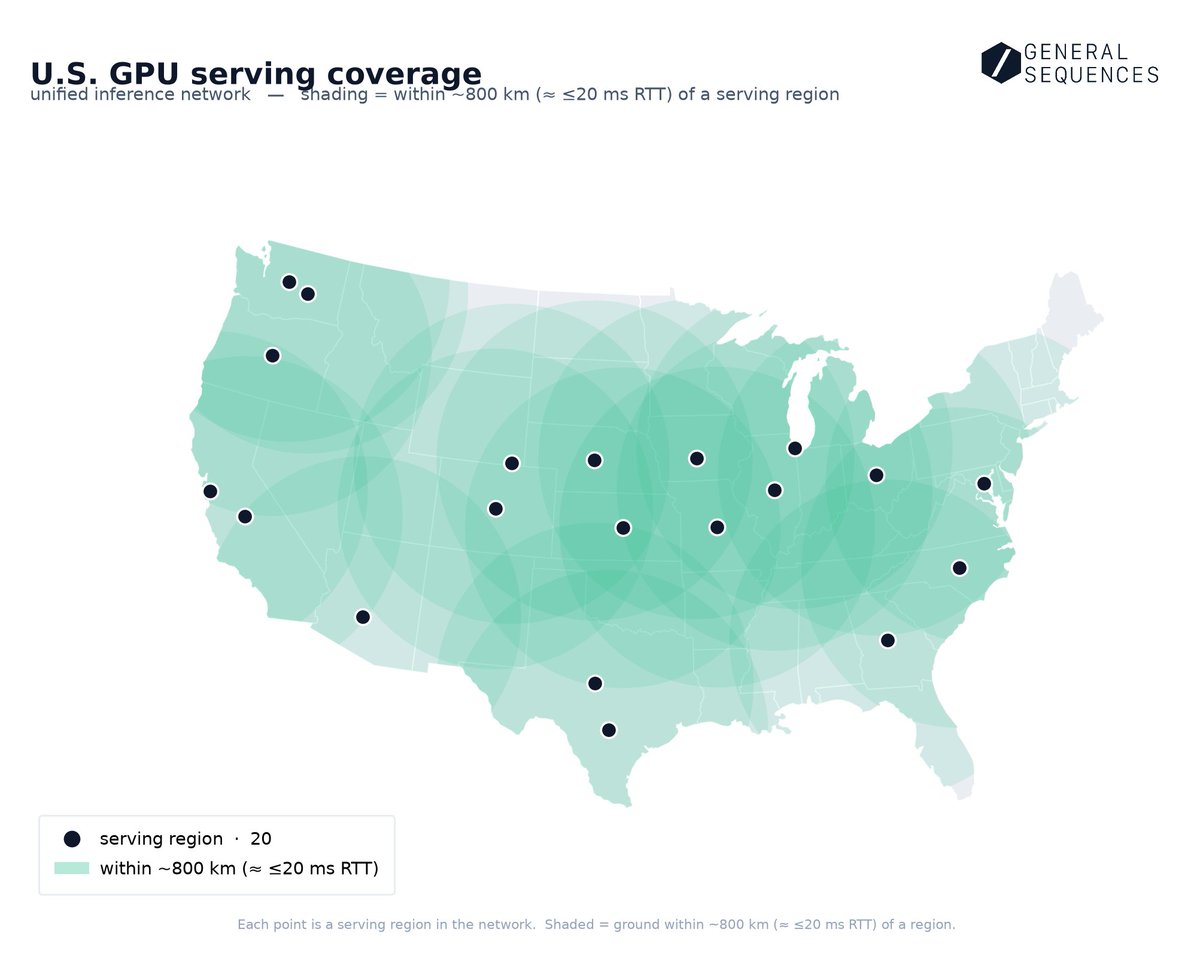
And regional coverage works.
Your customer might carry your robot around the US and things gets unstable. By routing it to the closest data centers with the multiple neocloud providers we support, we provide low latency and reliability on the table. (Image 3)
@generalsequence believe that robotics inference should be distributed, routed across providers to the nearest, warmest GPU, with an optimization layer on top.
This is exactly what we've providing as a platform service. If you're running inference at scale and across the US, contact us.
Shout out to our investor @bcristei from OPTIM VC for making this possible.
We just hit 100M ARR within 10 months of starting deployments.
We are in factory lines. On construction sites. In kitchens. In data centers.
Cleaning. Welding. Building. Cooking.
Deploying.
Robot foundation models are getting good.
Running them is still the hard part.
General Sequences is a router HTTPS endpoints for all of it.
Six models. Per-robot-hour pricing. No GPU.
https://t.co/CSLwzedl9T
Introducing S1, our new foundation model that learns from one example.
It can be taught 10-minute long tasks that it has never seen before, from one video prompt without any fine-tuning.
Watch S1 operate in real-time via in-context learning: