Introducing Claude Science, a new app designed with every stage of research in mind.
Artifacts traced to their code, environments managed on demand, and 60+ optional scientific databases that you can connect.
Available now in beta.
Everyday is a F'in struggle in US academia. Just a barrage of utter crap thrown at us every week, rules constantly changing, incredible instability for the academic work force. All while expecting us to be hyper competitive on shoe string budgets. 1/
New @CellCellPress
The hallmarks of cancer, refined from the original concepts 25 years ago, as an outgrowth of our expanding knowledge base
https://t.co/kjAYDRxvKD
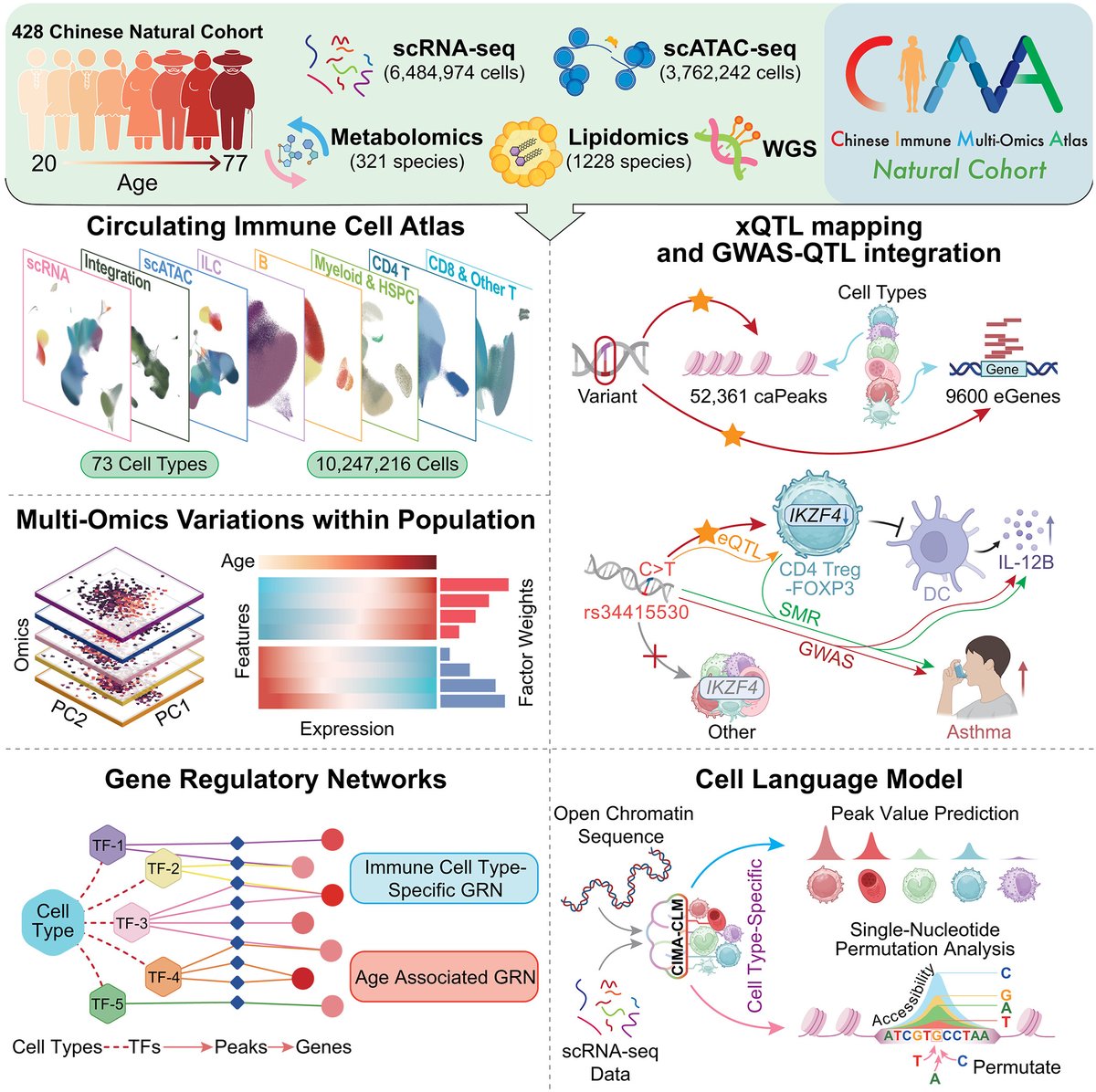
We're learning more about our immune system from a new, comprehensive, multi-omic atlas in @ScienceMagazine today, such as the stronger immune system in women and the age-related features of immunosenescence
https://t.co/4B85BwohBb
The @ENCODE_NIH Phase 4 Registry of candidate cis regulatory elements (ccREs) (2.37 million human and 967,000 mouse cCREs) is officially out
https://t.co/uuJAsO334Z
https://t.co/wtCW3beYlv
Congrats to @MooreJillE@ZhipingWeng & everyone else.
Lots more incoming ...
A new preprint reports one of the most fascinating and in-depth investigations of a GWAS locus that I’ve seen.
Locus 9p21.3 is the first robust GWAS signal linked to coronary artery disease (CAD), discovered in 2007 by multiple research groups. The risk variants show the largest effect sizes known for common variants influencing CAD.
One of the most interesting aspects of this locus is its ancestral heterogeneity. The signal appears sharply in GWAS of CAD performed in Europeans, East Asians, and Admixed Americans, but is absent in African populations—despite many of the top risk variants being common in African ancestries.
In this preprint, the authors attempt to solve this puzzle by diving deep into this locus across multiple ancestries and arrive at a compelling conclusion.
The most likely reason African GWAS of CAD were unable to capture the signal at 9p21.3 is not lack of power, rare variants absent in Africans, or gene–environment interactions. Instead, it reflects differences in linkage disequilibrium (LD) and haplotype structure between African and other populations.
The 9p21.3 locus spans a relatively large regulatory region (~0.4–0.5 Mb) and contains a complex haplotype structure. It is a noncoding locus with multiple regulatory variants contributing to risk independently. These variants are distributed differently across LD blocks in African ancestries compared to others.
In European genomes, the risk variants tend to sit on shared, longer LD blocks, effectively amplifying the GWAS signal. In African genomes, the same variants are spread across multiple shorter LD blocks, diluting the signal.
The takeaway: absence of 9p21.3 CAD locus isn’t missing biology in Africans, it’s rather shared biology hidden by greater haplotype diversity.
Alkhairo et al. medRxiv
https://t.co/9AkUblxVkm
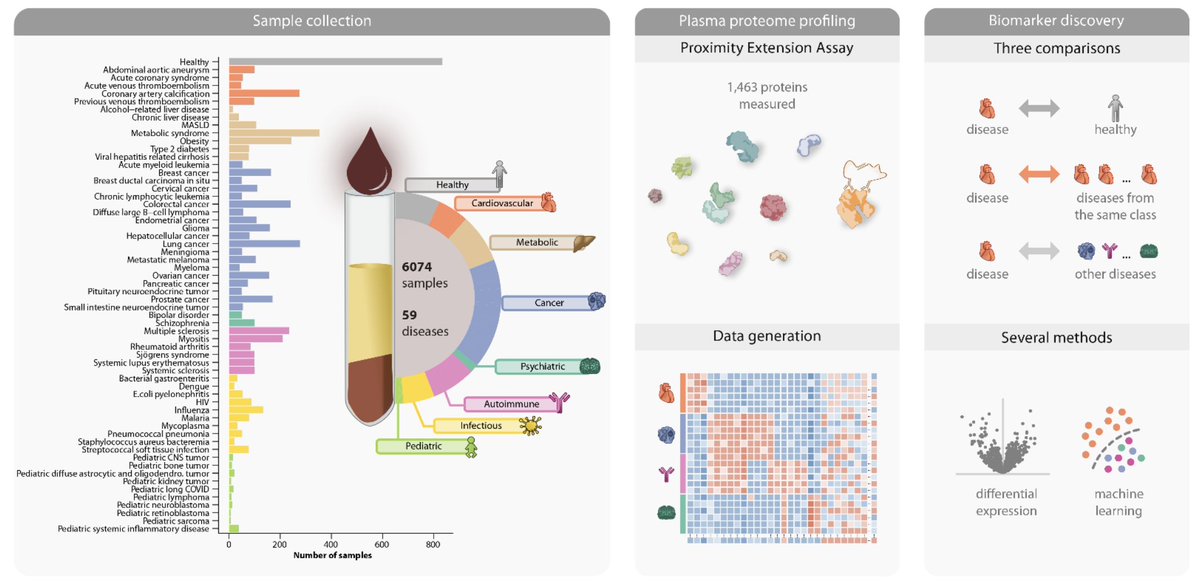
Most blood proteomics analyses of human disease focus on a single disease endpoint missing assessment of specificity.
This analysis of 8,262 individuals across 59 diseases offers an atlas of Olink proteomic signatures across the disease spectrum.
@AskPerplexity@smlungpathguy@grok This answer democratizes how anyone can get basic idea about the tissue subtypes, disease pattern and community notes.
@kirk3gaard@nanopore The big box approach by all companies, now ONT is not helping communities beyond 1 or 2 core labs of a institute. It needs to go to masses now!
In 2020, we returned to our family’s heritage tea estate in Darjeeling with the intention of selling it.
Our family had been custodians of Darjeeling’s estates for three generations. However, facing bankruptcy and collapse, due to climate change and the pandemic, our family was simply unable to hold on to it. But, @SparshAgarwall and I were inspired by the forests, the people, and the promise of Darjeeling. Our journey led us back to our roots.
We spent the next few years trying to reimagine the space of the tea estate. We started with moving to Selim Hill Tea Estate in Darjeeling, & eventually carbon markets emerged as the most promising path for creating supplementary incomes for these large, heritage tea estates, and its local communities. After months of deep research; across labs, farms, and policies — we formally launched @AltCarbonIndia in Q4 2023.
Alt Carbon is a deep-tech, science and data company for undertaking climate action. We bring together farmers, scientists, and engineers to remove CO₂.
With Speed. At Scale.
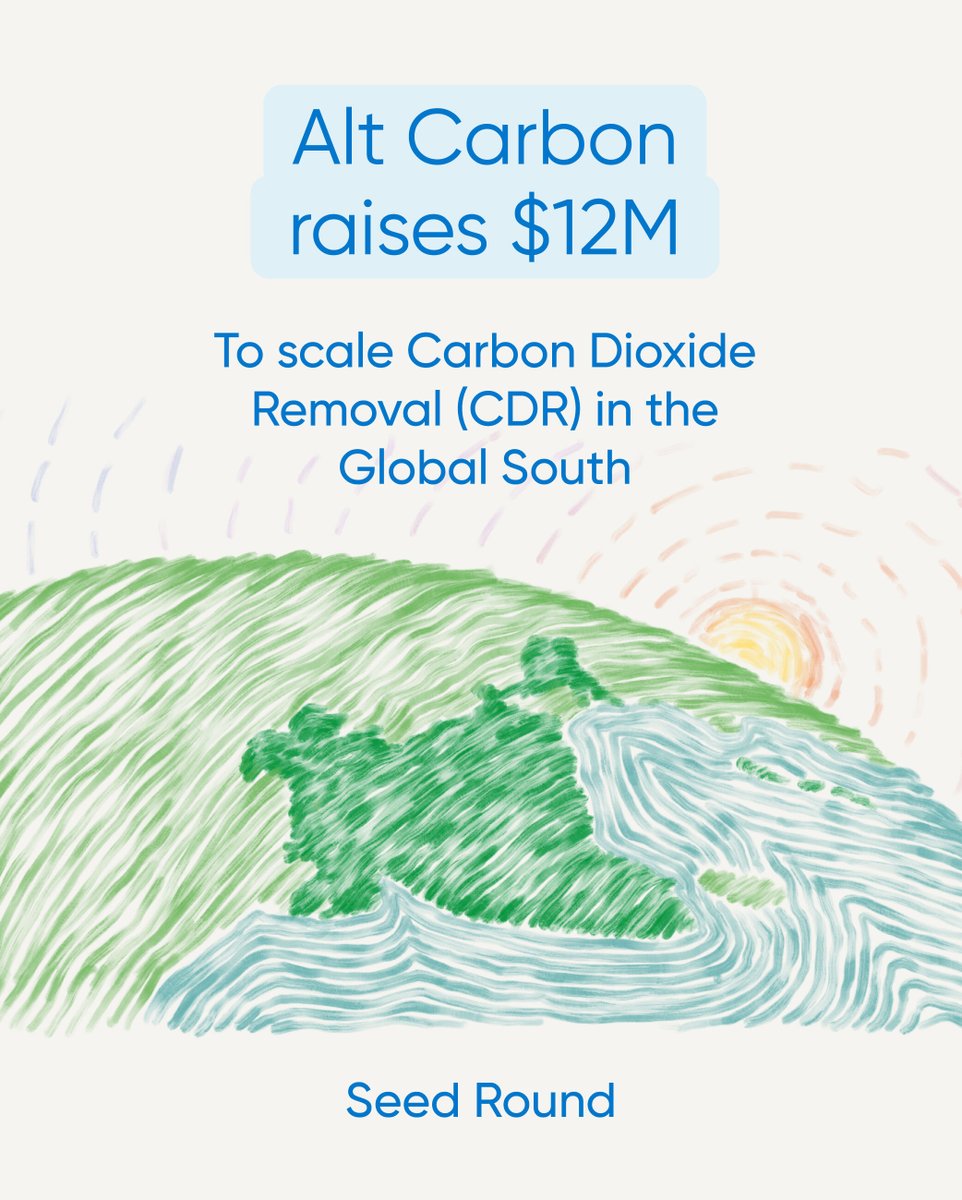
We are glad to announce our latest $12 million seed round - led by @lachygroom, with participation from existing funds like Shastra VC and angel investors including @jasonzhao, Amrendra Singh, @thetanmay , @arjunssoin, @NakuulMehta, @arjun_ramani3, @AdvaithV, @ultasawaal and more…
Shoutout to Alankrita, Sruthi and the @actgrants team for enabling us with catalytic philanthropic capital.
Here’s what’s next:
1. We will build the agricultural infrastructure for Climate Action — to bring down costs & enable Carbon Dioxide Removal (CDR) across South Asia. Our mission: Remove 5 million tons of CO₂ by 2030.
2. Scientifically prove the scalability of ERW through the Darjeeling Revival Project. Scale our learning. Design more projects. Chart a path to gigaton removal by 2040.
3. Improve our science, conduct advanced R&D, collect high quality data, create Machine Learning models that accelerate our operations across the board.
4. Build credibility and demand for ERW from the Global South, for the world.
5. Sipping on the world’s greatest tea while doing this. (DM me about Chandni xD)
We started Alt Carbon because of a romantic love affair with Darjeeling.
To those who saw what we saw — thank you for fueling this journey and believing in us early: @awaisahmedna, @EvanMula, @acv , @vsiv, @SinglaAnirudh@somani_utsav, Ravish Ratnam, Sangarsh Nigam, Mukesh Chamedia, Ashish Nayak, Jivesh Madan, Rahul Sunder, @Mandybuoy, @vidyamadhavan2, Abhimanyu, Ajeet, Tsuji-san, Sawamura-san, Yamazumi-san, Kawaguchi-san, Murao-san, Hirose-san and so many more...
We’re hiring across all teams. Come build the future of climate action with us.