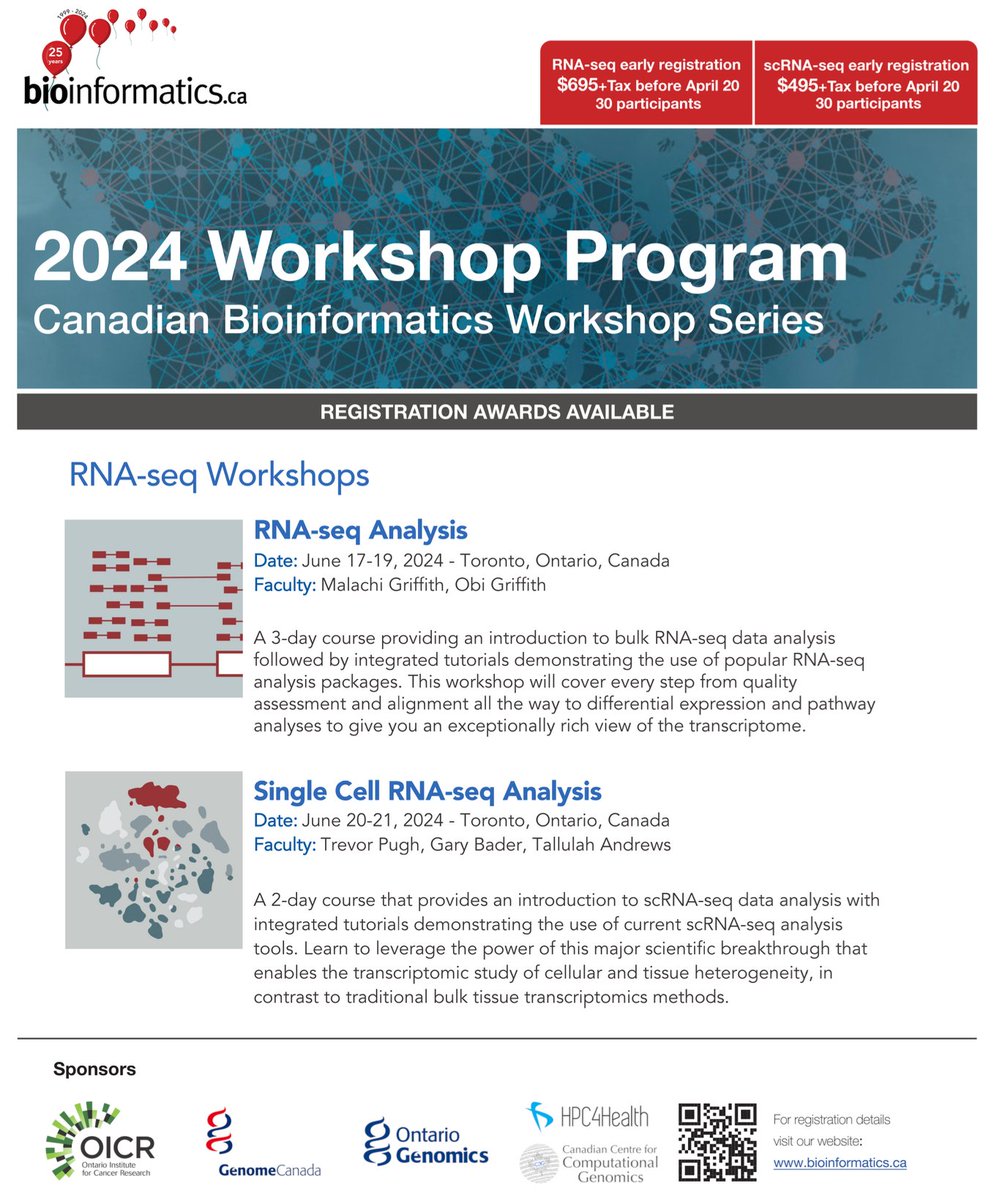
There are still spaces available for this upcoming CBW workshop focusing on transcriptome analysis (but also acting as a general introduction to bioinformatics analysis). https://t.co/KqBBEJ6F7W. Check it out and join us!
The ITCR Training Network (ITN) https://t.co/JwLwo7hVH9 develops training materials for informatics and research.
We have a short survey ~3-9 min about your experience & preferences for learning as a researcher.
Link: https://t.co/rq2d2efbb1
Excited to announce that we will be delivering a Canadian Bioinformatics Workshop (CBW) covering RNA-seq analysis and general bioinformatics this summer in Toronto. Hosted by Ontario Institute for Cancer Research (OICR). https://t.co/n8y5XDBDN8
Excited to announce Splam is now published in @GenomeBiology! Splam, trained on thousands of splice junctions from GTEx, is your go-to tool for scoring splice junctions from alignment or annotation files.
@elapertea@StevenSalzberg1@alan_mayonnaise
https://t.co/52pYjGhuRk
TCR constant region not exactly constant:
"For TRBC1, ...83%...contained TRBC1∗03, 2 carried (11%) TRBC1∗01, and only a single haplotype carried TRBC1∗02. Lastly, for TRBC2, we identified 6 alleles, including 4 novel alleles..."
https://t.co/pCImccSvAV
Our featured GCBR of the Week is CIViC, a community driven resource that improves the clinical interpretation of genetic variants in cancer.
Click the link to find out more :
https://t.co/05bQIVDYbd
@genome_gov#globalbiodata#openscience
Applications are open for the Advanced Sequencing Technologies & Bioinformatics Analysis course @CSHL. This intense 2wk course will immerse you in genomics technologies and teach you the fundamental computational skills you need to analyze your own data.
https://t.co/15oH5qhe4J
What's the fastest antigen-specific TCR discovery method that's practical (publicly available validated kit, <$5k per antigen, arbitrary HLA alleles)?
What's better than just doing peptide+PBMC culture followed by 5'GEX+VDJ scRNA-seq?
I am delighted to announce that I will be opening my lab on July 1 at Washington University in St Louis within the Division of Oncology, Department of Medicine, & Section of Computational Biology! @WUDeptMedicine @WashUFWIM 1/4
A single-cell TCR-seq method for dogs suggests reannotation of some non-functional VJ genes and differentiates between diverse repertoires of healthy dogs and expanded repertoires in malignancies: https://t.co/Db5G1TpTO5 @obigriffith @WUDeptMedicine @malachigriffith
So...is MALAT1 even a real thing?
(it's so consistently the top hit in any expression analysis, I'm curious if any studies actually isolate its functionality rather than its pervasive correlation with *everything*)
@iskander Been wondering and joking about this since grad school. Like you, I have seen it in so many DE gene lists, collaborations, publications, etc. Seems like it could be explained by a technical artifact? (e.g. very sensitive to differences in degradation between conditions)?
Such as: cloud computing, command line unix, bioinformatics tool installation, understanding NGS file formats, expression and DE analysis, pathway analysis, batch correction, R, IGV, etc. Some lectures with background principles, but a heavy emphasis on hands-on application.
Registration is now open for CBW transcriptome and single cell transcriptome analysis workshops this summer in Toronto! https://t.co/4IruDtW1L1. @Bioinfodotca
Highly recommend to take these two courses together as a 5-day intensive crash course in transcriptome analysis. Along the way we aim to teach fundamental bioinformatics skills with broad applicability.