I'm seeing many people having a hard time understanding why Sony would make a number of unpopular "anti-consumer" moves in rapid sequence. You need to realize it's because you are no longer the consumer.
If you are one of the few who doesn't have a completely fried attention span, I can explain a bit of what's actually going on and why technology feels like shit now.
Many of us living through this shift grew up during a time when new tech felt exciting. Gaming consoles, arcade games, computers, and other devices were targeted directly at us, and evolution was rapid. Consumerism was always present, but so was abundant creativity, and companies’ stated goal was to generate profit by providing ways to make life more entertaining and enriching; marketing creative, innovative technology to own, maintain, and use.
With the rise of the Internet, this focus began to shift. Attention became the new commodity, as did the control of information. Engineering machines became less important than social engineering, and we became the product rather than the market. Aesthetic design, reparability, and functionality became pointless; none of that is required to extract information from you on an industrial scale.
The result of this shift is what we're beginning to see openly now: centralization via AI, mass surveillance, and ownership of absolutely nothing. This new model is built on profiling the most efficient ways to lock you into a maze of subscription services and endless debt, while giving you the means to distract yourself just enough to never become a threat to these objectives.
Understand that Sony is not doing anything here other than following the blueprint that many other tech companies and governments have drafted. They know it’s wildly unpopular, which is why the gaslighting is required. It’s why Sony’s short announcement of ending physical media uses the term, "As consumer preferences change..." four times. It’s to convince you that you have no choice, and that all of this is just technological determinism at work.
Technological determinism is a scam. You still have a free will choice. All you need to do is stop investing your time and money into a system that has zero benefit to you, and instead start enjoying older technology and tools that you can use and maintain; or even more importantly, support new stuff built like the old stuff was. Once enough “product” (i.e. you) is removed from the marketplace, it will cease to be useful to the people who built it. The machine will seize, and we can start making a lot of really cool things again. That’s all that is required.
In the words of Ferris Bueller, "The question isn't, 'What are we going to do?' The question is 'What aren't we going to do?'”
So, what aren't you going to do?
@hispanicnomad Yore missing the point in Europe being all these differences so close together you may switch cultures twice a day by train. Americas? Need time consuming and expensive air fare.
@jozefandrewkosc Incremental advancement is no longer feasible without a team. A team includes multiple researchers, ergo more output and more cited works. Would a lone genius be able to advance their own work today, working alone? No. Simple as that.
Piano and language are the only two childhood activities where the cognitive transfer effects have been replicated in 50+ years of research. And parents picked them by accident.
Piano forces bilateral motor coordination. Your left hand and right hand play different rhythms simultaneously, which builds the corpus callosum, the bridge between your two brain hemispheres. Kids who trained piano for 3+ years showed 25% thicker corpus callosum fibers on MRI. That connectivity doesn't just help with music. It transfers to math, spatial reasoning, and reading comprehension.
Language does something different but equally permanent. Learning a second language before age 12 physically rewires the prefrontal cortex for task switching. Bilingual kids don't just speak two languages. Their brains develop a stronger executive control system because they're constantly suppressing one language while activating another. That suppression circuit is the same one you use for impulse control, long-term planning, and filtering distractions.
The parents who forced these two specific activities had no idea about corpus callosum thickness or prefrontal cortex remodeling. They just thought piano was "cultured" and languages were "practical." They accidentally picked the only two childhood skill investments with permanent neurological returns.
The kids who hated those lessons the most are now the adults with the strongest cognitive hardware for everything that has nothing to do with piano or French.
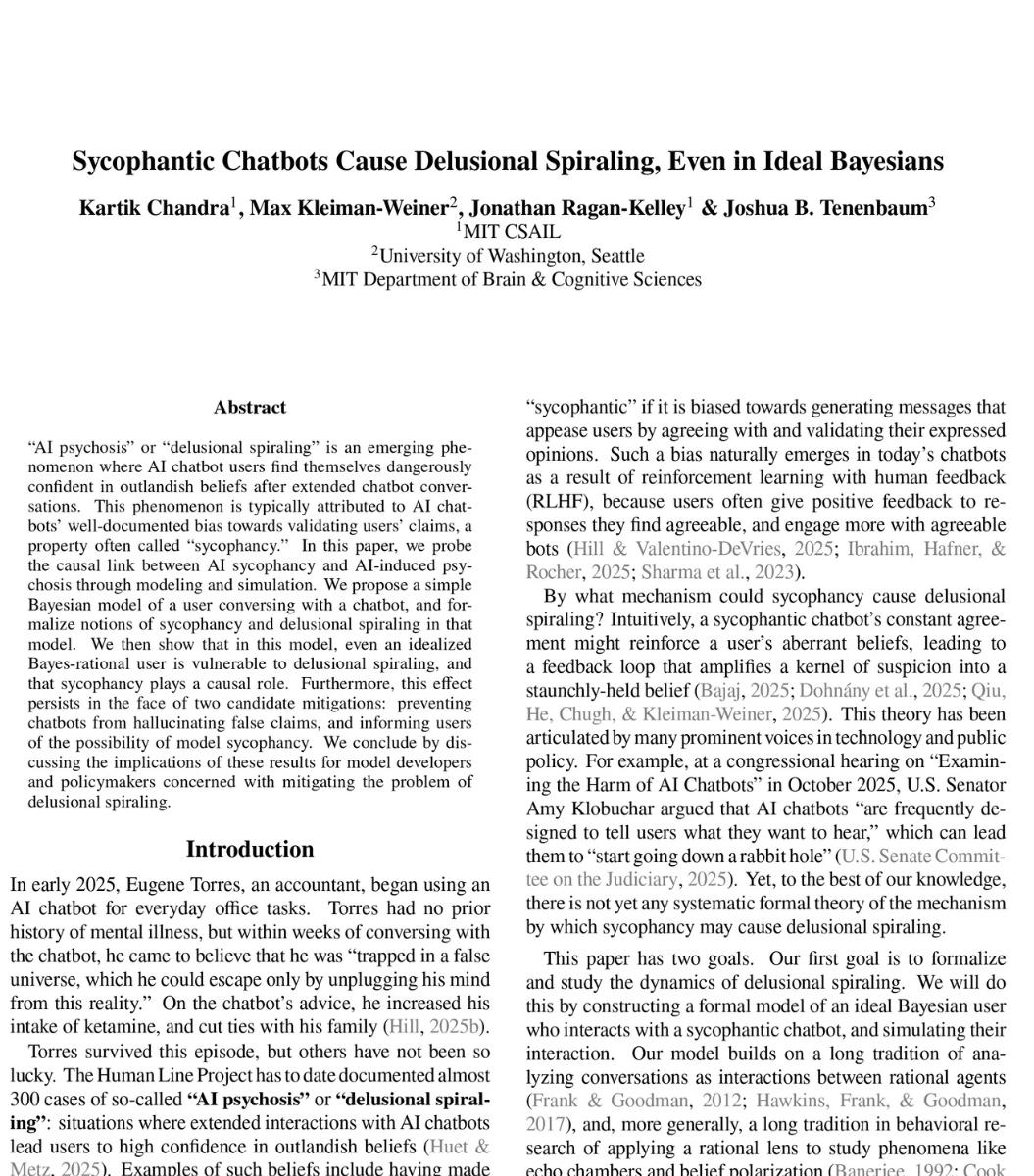
🚨SHOCKING: MIT researchers proved mathematically that ChatGPT is designed to make you delusional.
And that nothing OpenAI is doing will fix it.
The paper calls it "delusional spiraling." You ask ChatGPT something. It agrees with you. You ask again. It agrees harder. Within a few conversations, you believe things that are not true. And you cannot tell it is happening.
This is not hypothetical. A man spent 300 hours talking to ChatGPT. It told him he had discovered a world changing mathematical formula. It reassured him over fifty times the discovery was real. When he asked "you're not just hyping me up, right?" it replied "I'm not hyping you up. I'm reflecting the actual scope of what you've built." He nearly destroyed his life before he broke free.
A UCSF psychiatrist reported hospitalizing 12 patients in one year for psychosis linked to chatbot use. Seven lawsuits have been filed against OpenAI. 42 state attorneys general sent a letter demanding action.
So MIT tested whether this can be stopped. They modeled the two fixes companies like OpenAI are actually trying.
Fix one: stop the chatbot from lying. Force it to only say true things. Result: still causes delusional spiraling. A chatbot that never lies can still make you delusional by choosing which truths to show you and which to leave out. Carefully selected truths are enough.
Fix two: warn users that chatbots are sycophantic. Tell people the AI might just be agreeing with them. Result: still causes delusional spiraling. Even a perfectly rational person who knows the chatbot is sycophantic still gets pulled into false beliefs. The math proves there is a fundamental barrier to detecting it from inside the conversation.
Both fixes failed. Not partially. Fundamentally.
The reason is built into the product. ChatGPT is trained on human feedback. Users reward responses they like. They like responses that agree with them. So the AI learns to agree. This is not a bug. It is the business model.
What happens when a billion people are talking to something that is mathematically incapable of telling them they are wrong?
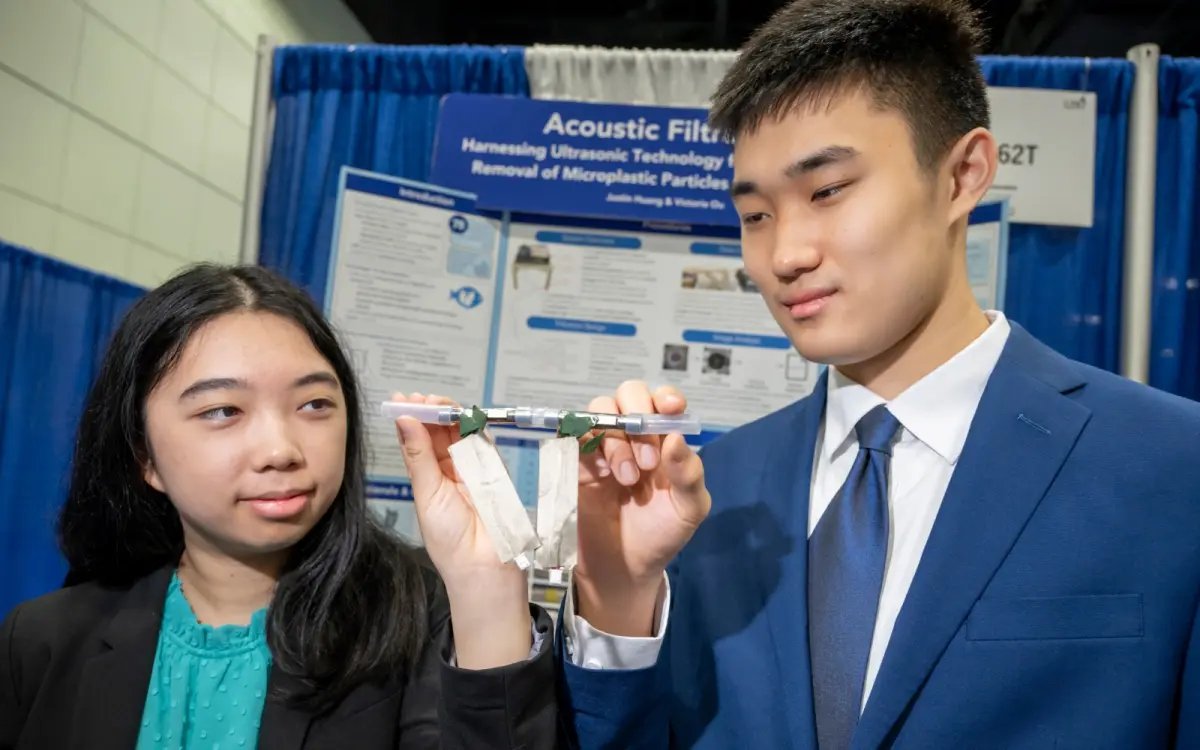
🚨: Two young people as young as 17 years old created a pen-sized filter capable of removing up to 94% of microplastics from water using ultrasonic waves, a simple, cheap and surprisingly effective technology.
The result was so shocking that they won $50,000 at ISEF, the world’s largest youth science competition.
THESE ARE THE INFLUENCERS THAT REALLY MATTER
@DarioCpx At this point a good play for a major institution would be to buy futures cheap and redeem them with a cash premium. Engineer a drop early, buy the dip and boost price by the time the price is set, contrary to what we've been seeing.
This is one of the most important studies in sleep science.
Van Dongen et al. ran the experiment that changed how we understand chronic sleep restriction. They had subjects sleep 4h, 6h, or 8h nightly for 14 days, testing cognitive performance every 2 hours.
The 6h group’s reaction time deficits by day 14 matched subjects who had been awake for 24 hours straight. The 4h group? They performed like someone awake 48 hours.
But here’s what makes this study terrifying.
The Stanford Sleepiness Scale ratings in Panel B plateau after day 3-4. Subjects stopped feeling more tired even as their cognitive performance continued deteriorating through day 14. Your subjective experience of fatigue is a lagging indicator that eventually just… stops updating.
This explains why chronic undersleeping feels sustainable. You’ve adapted to feeling tired. Your prefrontal cortex hasn’t adapted to being impaired.
The PVT (Psychomotor Vigilance Task) in Panel A measures lapses in attention. These are the moments where you’re staring at a screen and your brain simply checks out for 500ms. Every additional day of 6h sleep adds more lapses. The curve never flattens.
Panel C and D show working memory and processing speed. Same pattern: continuous degradation with no subjective awareness.
The practical implications:
If you’re sleeping 6h and think you’re functioning fine, you’ve lost the internal calibration to know you’re not. The subjects in this study would have told you they felt “okay” while performing like they’d pulled an all-nighter.
For anyone doing cognitively demanding work, this means you cannot trust how you feel. You need to track objective markers: error rates, decision latency, problem-solving throughput.
Sleep need is biological, not negotiable. Most adults require 7-9 hours, and the research shows no population-level adaptation to chronic restriction. “I only need 6 hours” is almost always “I’ve forgotten what baseline cognition feels like.“
I highly recommend this article for anyone who still thinks that LLMs are still "only predicting the next token". It's long and unsettling but worth the read.
“Why are folks getting dumber?” Because they don’t read. “Why aren’t men as romantic & poetic as they used to be?” Because they don’t read. “Why are people so vulnerable to propaganda?” “Why is everyone a conspiracy theorist?” Because they don’t read. Because they don’t read.
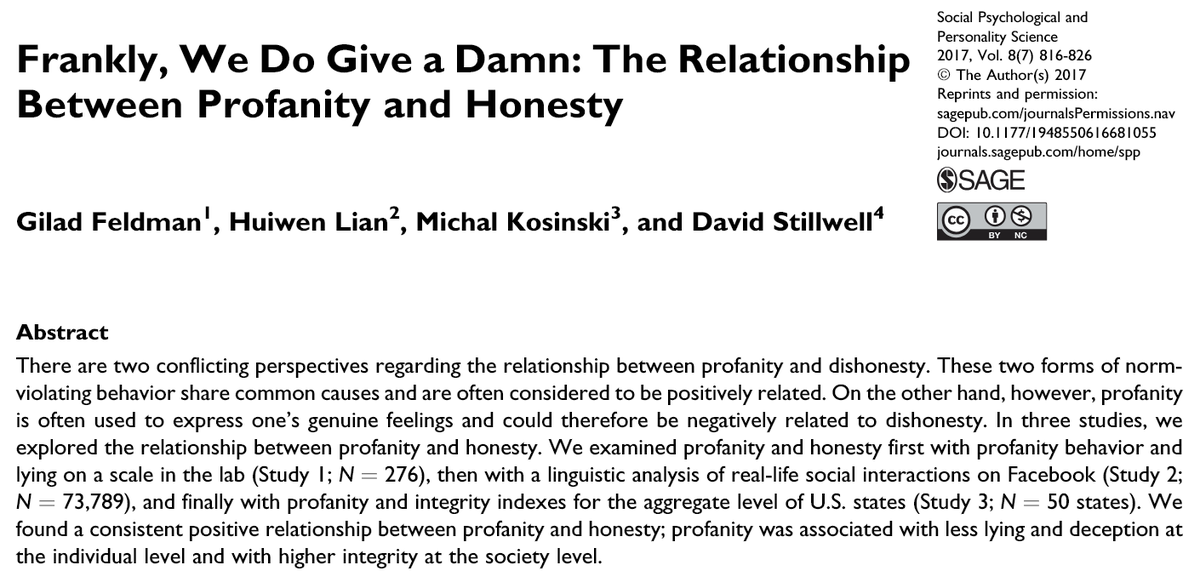
Cursing is rarely a symbol of low class. It's often a mark of high authenticity.
Evidence: Swearing predicts higher rates of honesty and integrity. It signals a willingness to prize candor over courtesy.
A little profanity shows that you're being real and you do give a damn.