Empower genomics education this #GivingTuesday by supporting @GEP_CURE’s mission to inspire and equip the next generation of scientists. Every donation helps! Donate now: https://t.co/HsiNYeoyUF
Learn more about your impact: https://t.co/As7vUMWudJ
🚨 New microPublication Alert
Gene model for the ortholog of Pten in Drosophila miranda
Student Authors: Megan E. Lawson (@UaDeptBSC), Marjorie Dela Cruz (@uwtacoma), & D'Andrew L. Harrington (@CSNCoyote)
https://t.co/wUzt5rf2GY
As of 3am, I am finished with my contributions to the @GEP_CURE's @NIGMS IPERT grant. Our team has given it all would could and if its rejected we must lay off our staff, including myself. Please send positive vibes toward the IPERT reviewers!
Hosting this @cshlbanbury meeting - Fulfilling the promise of @nanopore sequencing in education. My goal is a sequencer in every classroom, alongside the tools to achieve benefits and ethical practice. Biology education should prepare for the day when DNA sequencing is “free.”
To speed up dissemination and create publishing opportunities for undergraduate students, GEP is collaborating with @Micropub7n to establish an integrated workflow for citable peer-reviewed gene model reports.
https://t.co/dvCBK8jlEH
Don't delay! Get attendance support for #Dros25 🪰
📝 Request a letter of recommendation from your PI, professor, or research supervisor
📝 Check you're a GSA member or join now: https://t.co/KmJZGXdSh3
Apply now: https://t.co/0f94gwbBXB
Can't wait to see you in San Diego☀️
The 'Characteristics of Excellence in Undergraduate Research' summarizes best practices for highly effective #UndergraduateResearch environments. Download the updated COEUR 2.0 to understand how to provide a sustainable foundation for your #URSCI program.
https://t.co/aTHU6giKCd
Laura Reed (@GEP_CURE) will be speaking on a panel alongside Jonathan Pugh (@nanopore) et al., moderated by Jason Williams (@DNALC), on Inclusive Genomics Education: Empowering Everyone to Sequence Everything on 08/28/2024 at 11a-12:30p (CDT). It’s FREE to register!
📣 Sharing 📣
Equity & Justice for Diverse Women in the Sciences
Hosted by American Association for the Advancement of Science
Registration link - https://t.co/3y3xQJEu6w
New TTS! A Journal Club Project to Promote Interpreting and Presenting Information From the Primary Scientific Literature - Students work in teams to present primary scientific literature and incorporate peer and instructor feedback into their work. https://t.co/ZbMmMP8aPW
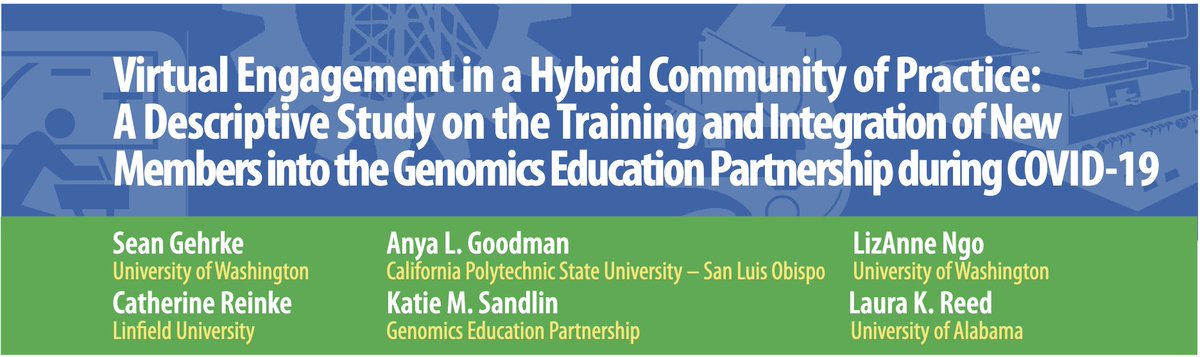
NEW GEP PUBLICATION ALERT! Virtual Engagement in a Hybrid Community of Practice: A Descriptive Study on the Training and Integration of New Members into the Genomics Education Partnership during COVID-19
https://t.co/bXTx586Tkx
GEP staff member @KatieMSandlin created her team’s introduction covering the roles and interactions of insulin with the insulin receptor in humans. Disclaimer: She still needs to add citations to the document :-)
https://t.co/mdVJESQe1T
It was a privilege to have been selected to attend the 1st BioEd Summit focused on Crafting Student-Centric Curricula with @NCBI Resources.
I learned a plethora of new skills & resources to aid in my work as the Director of Curriculum for the @GEP_CURE!
https://t.co/VAO4gxWRGx
I put together a 50ish minute lecture on long-read sequencing technology covering:
1. Review of RNA-Seq Short-read Sequencing
2. Overview and benefits of Long-read Sequencing
3. @nanopore Sequencing
4. @PacBio Sequencing
https://t.co/mlzmxXTPqm
I am incredibly honored to have been one of only 30 educators in the nation selected to attend the @genome_gov Short Course in Genomics, held on the @NIH campus in Bethesda, MD. I highly recommend the course to all genomics educators!
A great opportunity to connect with other biology and math educators and develop new teaching materials and strategies… check out BIOME 2024, offered by @BioQUESTed.
https://t.co/SYPlycQCgl
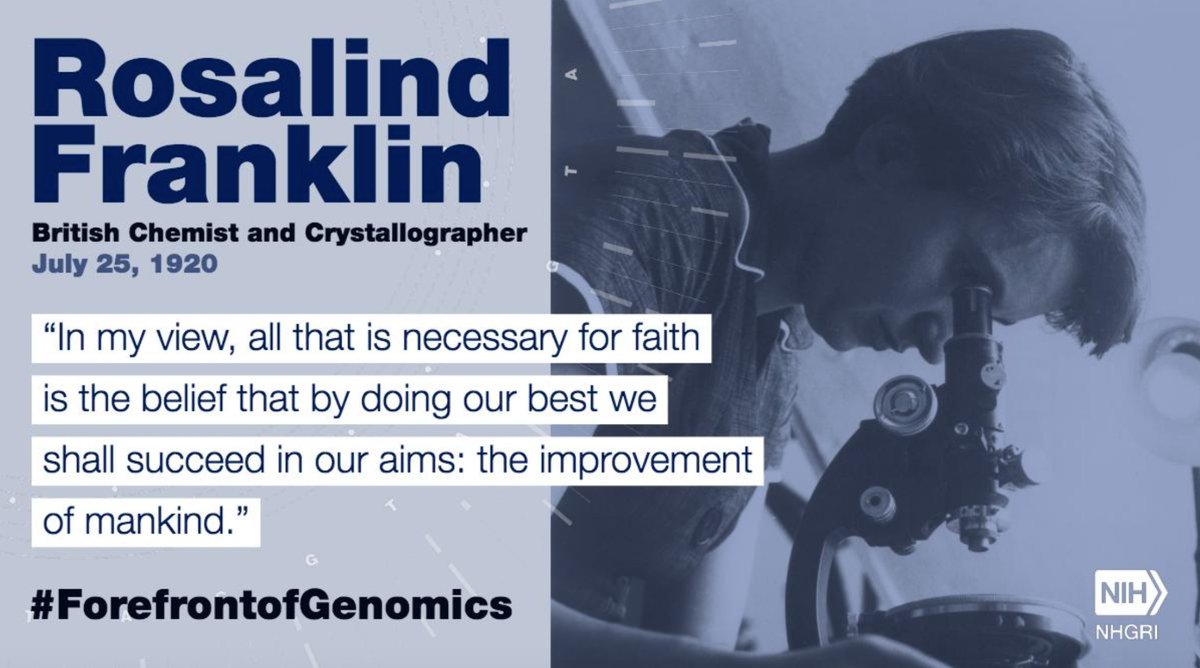
As part of #DNADay24, we celebrate Rosalind Franklin for her work and influence in science. Thanks to Franklin, we have the historic Photo 51, which revealed that DNA indeed has a double helix shape!
The lack of diversity in the genomics workforce reflects the long-term effects of a larger set of societal barriers, and it directly affects the work that we are doing in genomics – including using genomics to improve the practice of medicine.