We are living in interesting times.
A good MacBook now costs ₹3 lakh+.
Premium AI and Claude Pro Max subscriptions can easily cost ₹3 lakh a year.
Many fresher salaries in Indian IT services still start at around ₹3 lakh/year
Yet, we expect them to be AI-ready, fluent with the latest tech stack, and continuously upskill.
The question is: How are they supposed to afford the very tools they’re expected to master?
That’s a structural gap we don’t talk about enough.
I am sure you have heard that India was fragmented at the time of independence.
But do you have any idea about how fragmented it was?
Well, here is your answer.
What you see in Orange was the India that got liberated on 15th Aug 1947.
All the gaps in the middle, were also, technically, independent countries.
Had someone not stepped up like Sardar Patel did, India could have become a vastly different, fragmented country. It was because of him that led to the India that we know in 1949.
You all know he is called the Iron Man of India. Now you know why.
For the last 15 years, I've always had one dream and desire which was to make Indian history interesting for everyone.
In that time period, I have tried writing blogs, long-form posts, stories and threads, to do exactly that.
Some worked, most didn't. But with every post, I always had this nagging question.
Why is Indian history always taught with a tunnel vision. Why is it so fragmented?
Why do we always learn things from the perspective of one empire, kingdom, king or invader.
Why do we never see an all India view of history?
I mean most of us struggle if we are ever are asked this question
1. What was the true extent of the Mughal Empire at its peak?
2. Who were the Cholas' contemporaries in North India?
3. While Muhammad Ghori was fighting the Second Battle of Tarain, who ruled Thanjavur?
4. While Harsha ruled Kannauj, who ruled Assam?
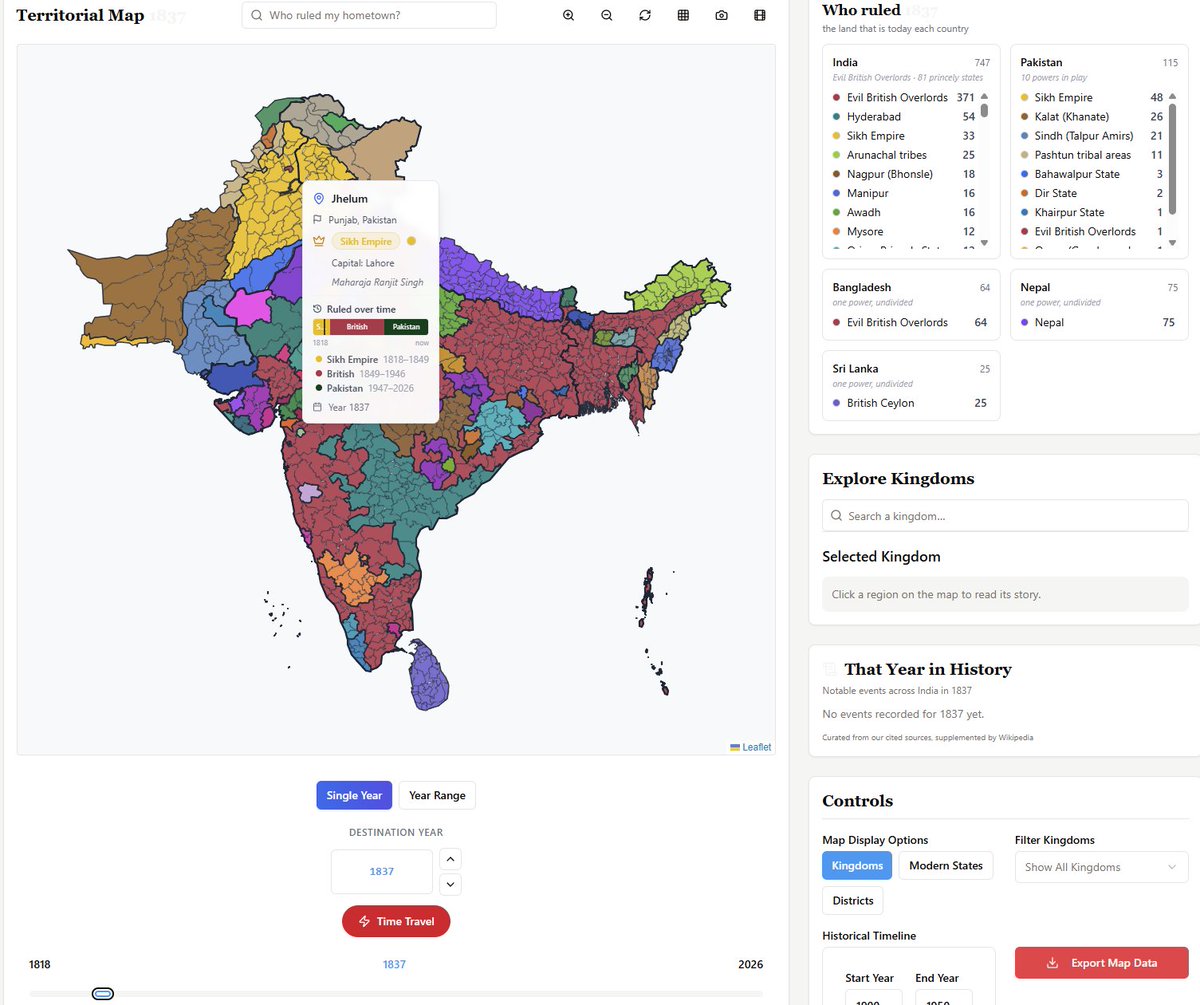
I have always wished there was a simple way to see the political map of India for any year in Indian history.
I have always wished there be a place where
1. One Could Select any year and instantly see who ruled every part of the Indian subcontinent.
2. One could Discover the important events that happened in that year
3. One could select a time period, say 1700 - 1947, and see how the Indian subcontinent evolved in that period.
4. How did one tiny red dot in West Bengal, from a tiny red dot in Europe, somehow came to rule an entire subcontinent of 400 million people,
For years, that idea remained just an idea and a dream because
1. I didn't know how to build a website.
2. I couldn't afford to hire someone who could.
Then Claude Came along.
Thanks to generous support and heavy lifting by Claude, over the last few months, that 15-year-old idea is slowly transforming into a reality.
And today, it has reached a position, where I'm excited to share with all of you, the first sneak peek of https://t.co/6ph2s9Zzl9
It is my attempt to create an interactive historical atlas of India that lets you travel through time and explore the political history of the subcontinent, one year at a time.
This is my attempt to make history interactive and fun.
I'd love to hear what you think.
Bro became a Road Engineer
Now owns 20 acres of land + 5 kg gold. Assets worth over ₹25 crore
All achieved on a salary of ₹85,000 per month. Power of compounding
Take refuge in silence. World can never perturb you if you are well within that tranquility. Watch the events in the world as a witness ~Sri Ramana Maharishi
I'm surprised to see news reports that money has been siphoned off for projects that never happened.
I saw the details about roads that were never laid but exist only on paper.
I had never imagined such things happening in Tamil Nadu.
All our politicians are already wealthy. What more will they achieve by siphoning off even more public money?
More than anger, I feel a deep sense of disappointment.
Since we in Tamil Nadu relate well through movies, this is similar to Vadivelu complaining to the police that a well has disappeared, or the Citizen movie where an entire village is made to disappear from government records.
In the cult classic Indian, a corrupt official smugly asks Kamal Haasan: "Don’t they take bribes in other countries?"
Kamal’s legendary reply hits like a thunderbolt:
"In other countries, they demand money to break the rules.
In India, they demand money to do the job they’re already paid for."
(Dialogues by Tamil Nadu’s legendary writer, the late Sujatha.)
At what point of time do govt officers go from "I take bribe becsuse I want money for for my family" to "I take a bribe because I can and I know I will never be punished for it"
Passport processing in India has become largely free of corruption at most stages.
However, during police verification, personnel visiting homes often still expect Rs. 500–1000.
The amount may not be big, but what matters is driving a deeper societal change - that everyone must live only within their legitimate income. Even asking for a single rupee should become unacceptable.
I’m confident that if the state and the public work together, we can eliminate corruption in the coming years.
The Upanishads were prophetic. They introduced us to Neti Neti (नेति नेति) meaning "not this, not that" or "neither this, nor that". Little did we realise that they were referring to proof of Indian citizenship.
Serious note on Makkal Saatchi.
Makkal Saatchi was built as an anonymous bribe-reporting portal for citizens to safely report everyday corruption.
It is not a court. It is not a final judgment portal. A submitted report is not treated as proof or accusation. It is only a citizen-submitted signal that needs verification.
Clear disclaimer, privacy policy, and terms are already added. The main purpose is to expose corruption patterns, repeated departments, locations, methods, and amounts not to shame anyone unfairly.
Because the platform is anonymous, anyone can submit anything. That risk exists. That is exactly why fake, repeated, personal, political, or unverifiable complaints are filtered/removed whenever identified.
The goal is not social media drama. The goal is responsible public-interest reporting.
I have tried my best to take this to the government and push for official integration, verification, routing, and action tracking. Sadly, a lot of my time has gone in waiting, follow-ups, and missed chances. Still, I am open to working with the right official system.
If someone feels a report is fake, don’t treat it as truth. Leave it, question it, or ask for verification. That is fair.
But please don’t ignore the bigger issue: everyday bribery is real, and citizens need a safe way to report it.
Makkal Saatchi will remain focused on one thing exposing corruption patterns responsibly.
https://t.co/y4OVP0jB50
This is a complaint today in anonymous bribe reporting portal.
https://t.co/XEHKukZcLx
Until yesterday, the discussion was about party funds. Today, the public has raised concerns about the Mayor Fund.
Corruption is deeply entrenched.
All these complaints warrant a detailed and impartial investigation.
As mentioned earlier, automatic approvals, minimal or no personal discretion, full process transparency, and citizen vigilance are the key steps required for the future. We should make it difficult for anyone in government to even ask for money.
This is a golden opportunity to eliminate corruption from Tamil Nadu. Both the government and the public need to work together towards this goal.