Editors and authors👋! I'm looking to review more papers in spatial omics🔬, especially in computational integration and analysis of spatial metabolomics, proteomics, and transcriptomics💻. Please RT and DM! @imaging_ms@IMSSNews@SpatialOmics
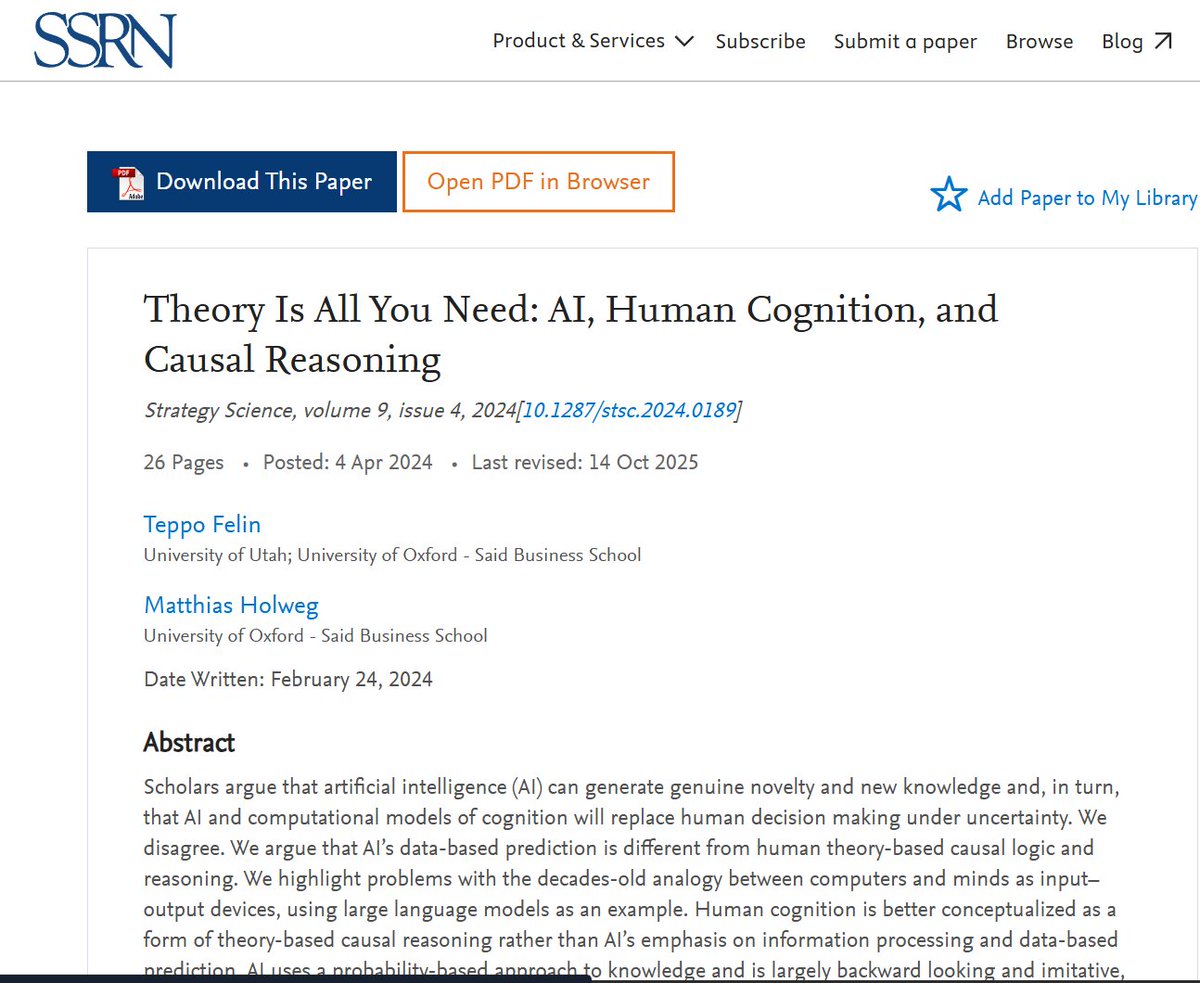
Oxford researchers argue that LLMs can never invent anything.
It is mathematically impossible.
They published a paper called “Theory Is All You Need" and it argues against the claim that computational models can generate genuine novelty or new knowledge.
They analyzed the limits of generative ai, and the results are a brutal reality check for the idea that ai will replace human decision making under uncertainty.
Here is why AI is stuck and human cognition wins:
backward-looking vs forward-looking.. llms are probability machines that look backward at existing data. human cognition is forward-looking and capable of generating genuine novelty. human cognition operates theoretically "top-down" rather than "bottom-up" from data.
the "data-belief asymmetry".. the researchers use the invention of "heavier-than-air flight" to illustrate this concept. an ai relies on data-based prediction, which is largely imitative. humans, however, use theory-based causal logic that allows them to hold beliefs that go beyond existing data.
the intervention gap.. humans don't just process information; we use theory to practically "intervene" in the world. we engage in directed experimentation to generate entirely new data. ai-based models are theory-free and place primacy on existing data and prediction.
tldr?
AI uses a probability-based approach to knowledge and ia largely imitative. It can process data and make predictions, but human cognition relies on theory-based causal reasoning.
The decades-old analogy comparing human minds and computers to mere "input-output" devices is fundamentally flawed.
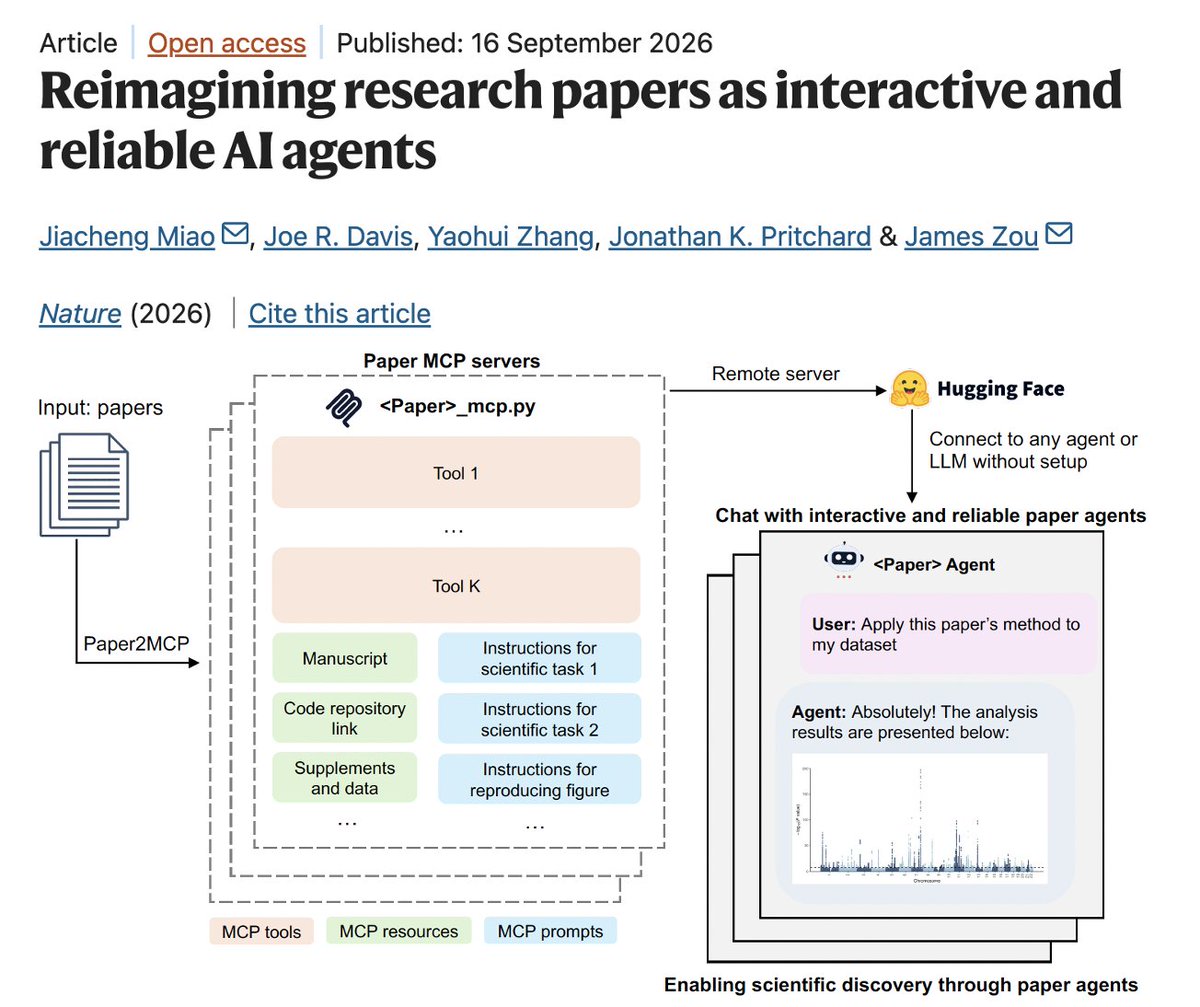
Thrilled that #paper2agent is published in @nature today!
Scientific knowledge is traditionally stored in passive papers. Paper2Agent transforms papers into virtual authors that answer questions, apply its methods and collaborate w/ other paper agents to make new discoveries 🧵
New discovery from our team defining how human brain cancers rewire the metabolism of the normal brain published today @Nature and led by @AndrewScottPhD https://t.co/Ij95esKmd3
New paper out in @OxfordJournals Briefings in Bioinformatics
📰SingleFrag: a deep learning tool for MS/MS fragment and spectral prediction and metabolite annotation https://t.co/EhQqa3S5WE
🚀 New paper alert! 🚀 Happy to introduce #ChemEmbed, a deep learning framework for metabolite identification that enhances MS/MS data and leverages multidimensional molecular embeddings. A 🧵 on how it works ⬇️ #metabolomics#MachineLearning#DeepLearning
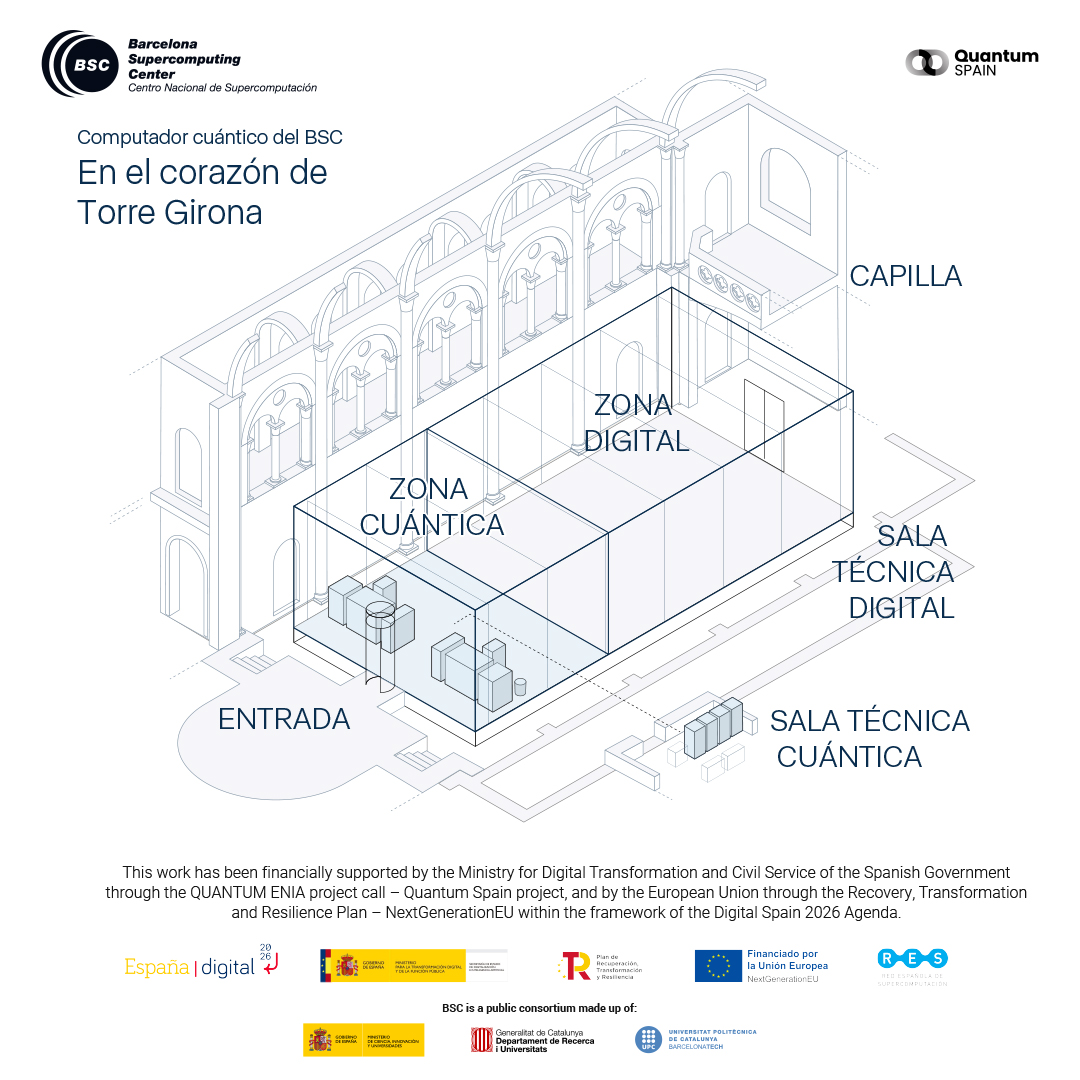
⚛️💻BSC presents the first quantum computer in Spain developed with 100% European technology
🌐The new system will be available to the research community, companies & public organisations in Spain, thus strengthening technological & industrial development throughout the country
➡https://t.co/eGMNh2eFwV
#NextGenerationEU #PlandeRecuperación
‚Foundation models for biology‘ are one of 6 techs to watch in 2025 according to @Nature. Agreed, but not sure yet how to evaluate at scale. ie what is ‚general biological intelligence’? https://t.co/55G8Ty9ojx