Africa's competitiveness in the global economy lies on the future of work across the continent.
The biggest leaps in economic prosperity has been at the centre of people.
We need. .
A self-taught Irish schoolteacher wrote a book in 1854 that almost nobody read for 80 years, until a 21-year-old MIT student picked it up and realized it could be used to design every computer in human history.
His name was George Boole. The book is called An Investigation of the Laws of Thought.
Boole was born in 1815 in Lincoln, England. His family was poor. He left school at 16 to support them. He taught himself Latin, Greek, French, German, and Italian.
Then he taught himself mathematics. By 19 he had opened his own school. By 24 he was publishing original papers in the Cambridge Mathematical Journal, competing with men who had spent decades inside the best universities in Britain.
He never had a degree. He never had a mentor. In 1849, Queen's College in Cork hired him as a professor anyway.
In 1854, he published his masterwork. What he built inside it was something nobody had attempted before at this scale. He turned logic into algebra.
Before Boole, logic was philosophy. You argued in sentences. You reasoned in paragraphs. It was powerful and completely impossible to automate, because there was no formal system underneath it, just language.
Boole stripped it down to arithmetic. He showed that every act of human reasoning could be reduced to operations on two values. True or false. One or zero. AND, OR, NOT. If both conditions are true, the result is true. If neither is, the result is false. Every judgment a human mind makes, every decision, every deduction, could be written as an equation following those rules.
Logicians read it. They found it interesting. Engineers building machines had never heard of it.
For 83 years, the book sat there.
Then in 1937, a 21-year-old MIT master's student named Claude Shannon was working on a thesis about electrical relay circuits. Switches that could be open or closed. Current that either flowed or didn't.
He read Boole and understood something nobody had connected before.
An open switch is a zero. A closed switch is a one. A circuit with two switches in series only carries current when both are closed. That is AND. A circuit with two switches in parallel carries current when either is closed. That is OR. Shannon proved that every possible logical relationship Boole had described could be physically built using wire and switches.
That single insight is the foundation of every computer ever made.
After Shannon, chip designers stopped thinking about electricity and started thinking about logic. Every transistor on every processor running right now is implementing a Boolean operation. Every if-statement in every codebase is Boolean logic. Every database query using AND or OR. Every neural network threshold that fires or doesn't fire. All of it is running the algebra of a self-taught schoolteacher from Lincoln who died 160 years ago.
The strangest part is what happened to Boole at the end.
He was walking to class in November 1864 when he got caught in a rainstorm. He lectured for hours in wet clothes. He went home sick. His wife, Mary, believed in homeopathic medicine and thought the cure should mirror the cause. She wrapped him in wet sheets and poured cold water over him repeatedly.
He died a few days later. He was 49.
He never saw a transistor. He never saw a circuit. He never saw a single physical machine run a single one of his rules.
His book is in the public domain. Free to download. Most engineers use the word Boolean dozens of times a week. Almost none of them know who they are saying.
The man whose logic runs inside every phone, every server, and every AI model on Earth died soaking wet in a small Irish town, 83 years before anyone figured out what he had actually built.
Happy Mother's Day to every mom and mother figure, your love, care, and strength make the world brighter.
Thank you for everything ❤️
#MothersDay #2026
Here are 3 key facts employers need to know about the Nigerian subject to regularization visa in 2026.
Get in touch with us to learn how we can assist your team get prompt and reliable immigration service.
#nigeria#str#visa
A neural network can begin as a flat sheet and learn the shape of hidden data
A self-organizing map turns learning into geometry. Each data point pulls one winning neuron toward it, but nearby neurons move too, and so the whole lattice bends without losing its neighborhood structure.
The strange part is that the network is not given the roll shape. It discovers the shape through competition and local cooperation.
Paper: Self-Organized Formation of Topologically Correct Feature Maps
Authors: Teuvo Kohonen
Year: 1982
Happy Workers Day! We salute everyone who keeps the world moving, your effort matters!
Grateful for the craft, grit, and teamwork behind every success 🙌🏼
#WorkersDay#Nigeria
Happy Birthday to Claude Shannon, known by many as the “father of Information Theory.” Shannon was an American mathematician and electrical engineer. In 1948, he published A Mathematical Theory of Communication, which effectively created the field.
Key facts about Nigeria’s expatriate quota - get in touch to learn how we can fast-track approvals for your team ⚡️
Quick, reliable support when you need it.
#Immigration#Nigeria#Facts
@MissedFlush@mathemetica The DPW starts with small predictable variances and rounding errors, over time this grows exponentially into an unpredictability with a magnitude of errors, hence the chaos.
Weather predictability is capped at 2 weeks. Variances and rounding errors make it impossible beyond.
If you're an investor, founder, operator or ecosystem builder this is for you.
Turns of events are happening in Nigeria and we want to make it easier for you to attend.
We're offering visa support for individuals and teams of all sizes from all regions.
#events#immigration
Worrying about late immigration applications in Nigeria? 🫠
Caught in between whatsapp groups, email threads and spreadsheets tracking and managing immigration processes?
Try Odyssey, the end to end immigration compliance solution for teams working across Africa 🪄
In August 2013, I emailed the @PayPal team. Nigeria’s fintech ecosystem was still young. @Paga was just a few years old. And the “Africa opportunity” wasn’t yet part of most global boardroom conversations. But even then, the opportunity was clear to us. In that email, I shared a simple belief: that Nigeria would become one of the most important economies in the world, and that there was strong alignment between PayPal and Paga to make payments, financial services, and global commerce work for Nigerians. I attached a presentation outlining how our two companies might collaborate: Paga could power on-ramps and off-ramps to and from PayPal in Nigeria. The partnership would enable Nigerians to use PayPal anywhere PayPal is accepted globally. It would also enable Nigerian merchants to accept PayPal for payments.
It would take more than a decade for that belief to fully materialize.
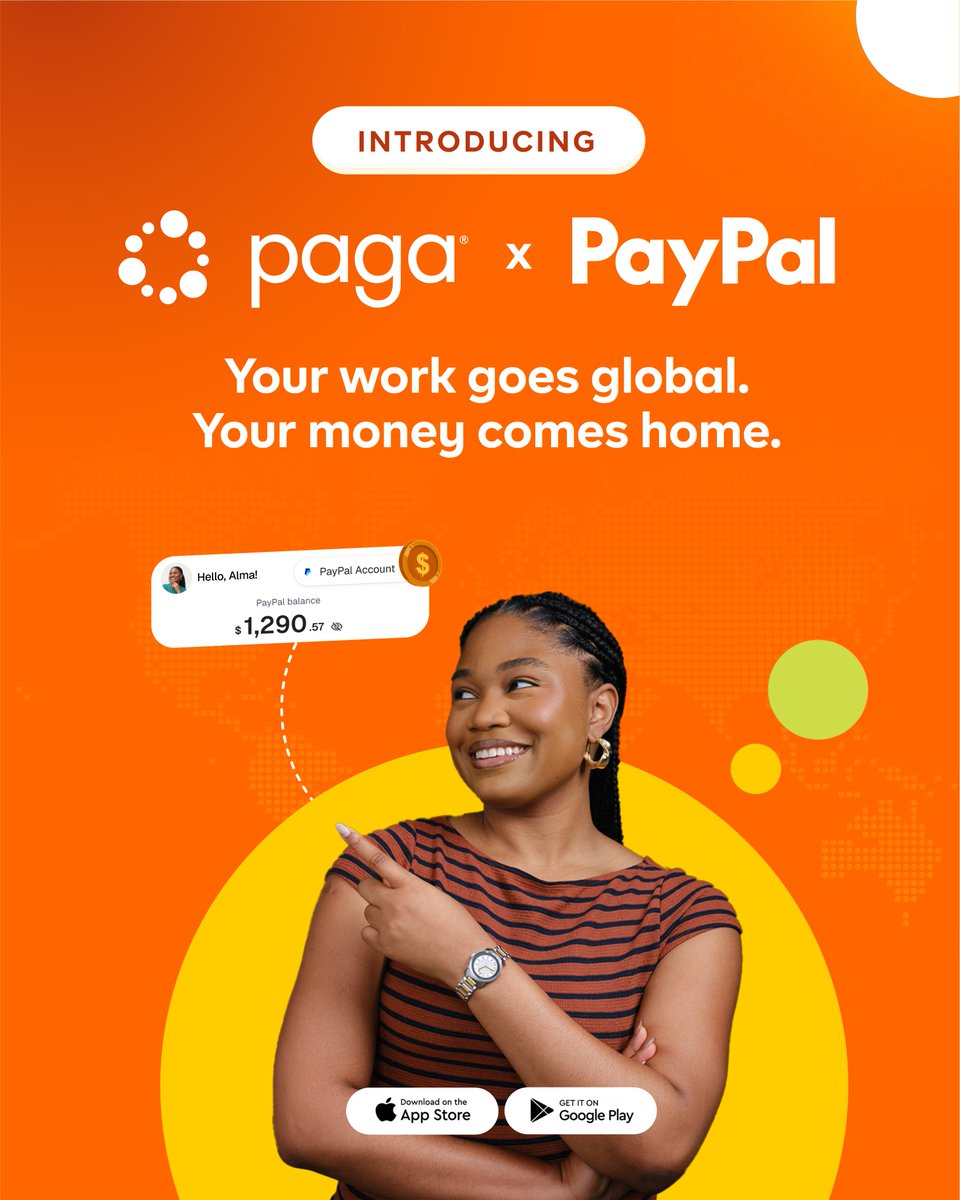
Today, I’m proud to share that PayPal is now live in Nigeria through Paga.
Until now, Nigerians could not receive money via PayPal. Our partnership unlocks that. Nigerian PayPal users who link their PayPal accounts to Paga can now receive money via PayPal. Only PayPal Nigeria accounts linked to Paga are enabled for receiving money.
Gig workers can now get paid through PayPal, and family members can now send you money on PayPal. Nigerian merchants can now receive payments on PayPal. The linkage is done within the Paga app, and users can view their PayPal balance and withdraw to Naira when they want. Nigerians can now use PayPal at over 30 million merchants worldwide!
This moment isn’t about a single announcement. It’s about patience. It’s about building robust, trusted local infrastructure. It’s about believing that global platforms scale better when they work with local systems, not around them. Partnerships like this don’t happen overnight. They are the result of years of conversations, trust-building, regulatory work, and showing up consistently. I’m proud of the Paga team for staying the course. I’m grateful to the PayPal team for believing in the long-term vision. And I’m excited about what this unlocks for Nigerians participating in the global digital economy.
Download the Paga app, link your PayPal to Paga, and connect with global commerce today!