It is clear now that @MKBHD is part of a bigger problem of not valuing innovation.
America is being held back by many trying to protect the status quo.
Shame.
Exclusive $TSLA Interview!
Keith Fitz-Gerald has a track record like no other predicting the dot com bubble, the global financial crisis, and calling the rise of Palantir. @fitz_keith
Last July, he was on national TV saying Tesla was set to double or triple.
Today, he's back with another bold prediction - $TSLA hitting a 20 TRILLION DOLLAR valuation!
Keith is Principal at the Fitz-Gerald Group and has had over 3,000 prime time TV appearances.
Don't miss this! Keith is very well spoken with some great points about Tesla
after my stress test through the Berkeley hills today, I am convinced Tesla employees are remote driving FSD 13
I mean it did release right after we saw the Optimus teleoperation demo… COINCIDENCE???
FSD 13 leaves parking lot (+ awkward interaction with other driver)
the smoothness is absolutely INSANE
it also saw the Model 3 backing up before I did, I was wondering why it wasn’t moving lol
엄마표영어 대표 인플루언서중에 한분인 유로맘님도 책을 집필하셨네요! 우리 아이들 영어로 고생안했으면 좋겠다는 마음만으로 여러가지 힘든길을 선택하는 분들을 위한 책일듯요.
🎉리트윗이나 인용트윗🎉 해주신 분들 중 3분 뽑아서 선물로 드릴게요. 롱테일북스에서 협찬해주셨습니다😘
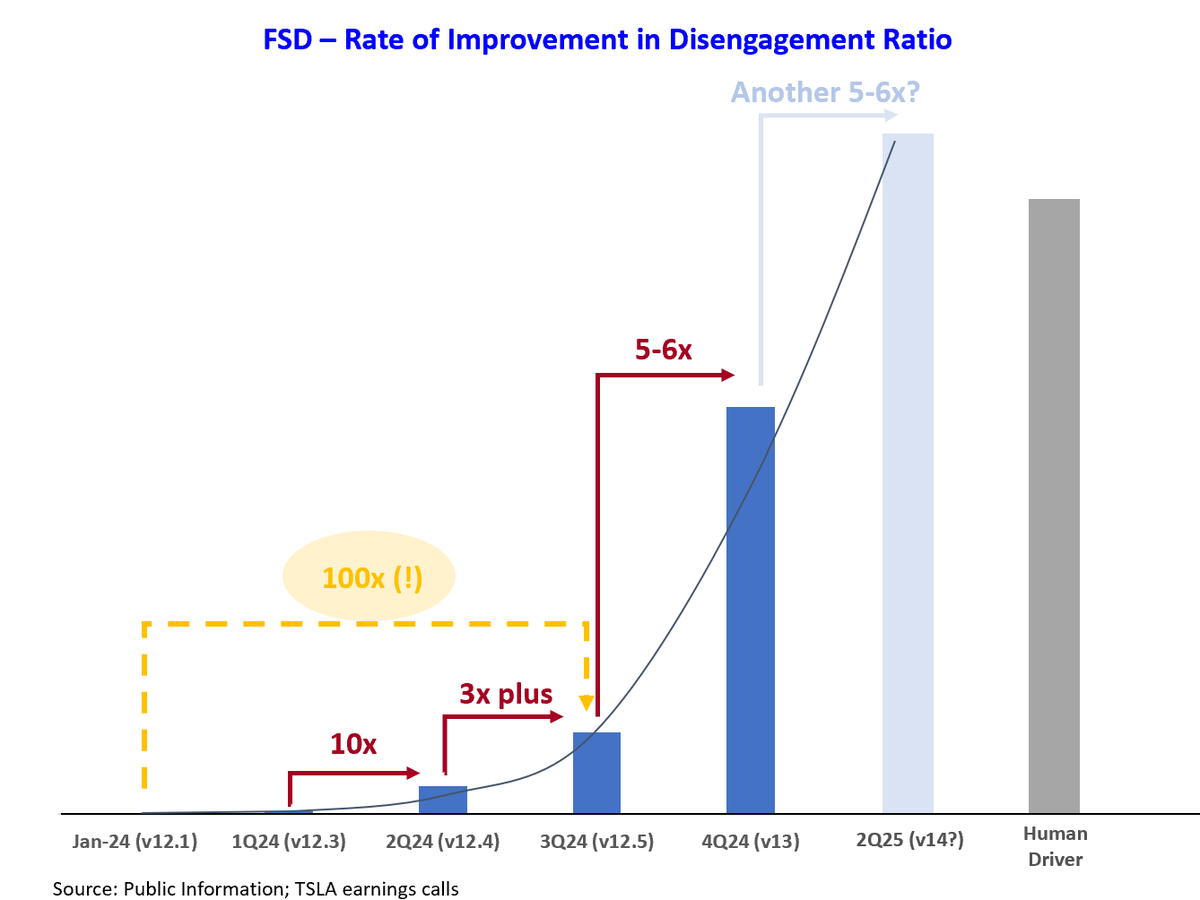
The rate of improvement in $TSLA's FSD disengagement ratio is stunning—it's proof that scaling laws apply to self-driving and real-world AI. Piecing together the progress:
v13: 5-6x improved Miles per Critical Intervention ("mpci") (Source: Tesla 3Q Earnings Call)
v12.5: 3x improved mpci (Source: https://t.co/4oCw49Tmsm)
v12.4: 5-10x improvement over v12.3 (Source: https://t.co/qRW5BW9oUu)
Compared to Jan 2024 (v12.1): v12.5 shows 100x improvement; v13 will show a 1,000x improvement (Source: Tesla 3Q Earnings Call)
By 2Q25, expect FSD to be safer than a human driver (Source: Tesla 3Q Earnings Call)
▶️Comparison 1 – Human Driver:
Miles per reported accident = 550k (Total miles driven in the U.S. per year = 3.3 trillion; Total reported accidents in the U.S. annually = 6 million)
This means around 60k miles per minor incident, which lines up with the average American driving 13.5k miles/year, having an accident every 3 years.
▶️Comparison 2 – Waymo:
Waymo's miles per disengagement = 17k (Source: California DMV, 2023)
It’s likely higher now, but the exact number isn’t public.
▶️If the math is right, FSD would hit ~100k mpci by 2Q25, meaning v13 is above 10k (20k?) mpci, and v12.5 ~5k. In Jan 2024 (v12.1), this was likely just ~50 miles per disengagement. driver's
I can only imagine the scaling here to continue, with more data, better inferencing hardware (HW5 or AI5 next summer?), and more training capacity over time.
⏳A few thoughts I’ve been having about FSD/robotaxi, would love to hear pushbacks:
1/ Why does $TSLA need a new Cybercab model when they can use the Model 3/Y for autonomous driving?
It’s about cost + adoption. Autonomous driving is a futuristic concept that requires a ton of public education. A sleek, futuristic car with *no steering wheel* running autonomously is the best ad for self-driving. Makes total sense to me that $TSLA saw a significant jump in FSD adoption post 10/10 (Source: 3Q earnings call). Also, Cybercab will cost around $25k, with 5x better cycle times and reduced parts, making it an efficient choice for scaling.
2/ What’s causing the discrepancy between my math and engagement ratios from trackers (~200 miles)? Why does it feel different in a $TSLA vs. a Waymo in terms of the urge to disengage?
I think most tracker data comes from user-reported disengagements, and when sitting in the driver's seat, you naturally feel more responsible, leading to a stronger urge to intervene. But this doesn’t mean every disengagement was necessary to avoid an accident. The experience sitting in the passenger seat (like in $Waymo) feels entirely different—"out of sight, out of mind."
3/ Why start the robotaxi fleet with the Model 3/Y?
Apart from fast production, it likely has to do with regulation. As Elon mentioned, each state has its own requirements for whether a safety driver is needed to get approval, and using existing models like the Model 3/Y allows $TSLA to adapt more quickly to these differences.
⏳Other thoughts:
How will robotaxis impact car ownership?
On one hand, robotaxis lower the cost of ownership, making it more accessible and driving adoption. Plus, your car could generate income for you (+ve for ownership). But, on the other hand, with autonomous fleets available, the need to actually own a car could diminish.
Autonomous trucking & the disruptions?
It’s not just passenger cars getting autonomous—Elon mentioned Semi trucks will also become autonomous! This could disrupt industries like logistics, freight, and transportation, with major implications for shipping costs, delivery times, and employment in those sectors.
Regulation? Why does it have to be state-by-state?
We really need national-level approval for autonomous driving instead of the current state-by-state process, which is inefficient and unclear.
🚗🤖 $TSLA has been criticized for overpromising FSD for years, but now they’re at a tipping point. The value of autonomy is about to be fully realized. Truly a “many companies in one”.
When 2M-4M Cybercabs 🚗are on the road, it’ll feel like living in a sci-fi movie—armies of robots 🤖around us reshaping the future. Can't wait to see how the world will be reshaped by an autonomous future!