Future proofing India’s strategic communication networks with quantum technology, DRDO has successfully completed military field trails of a scalable and practically secure, fiber based Quantum Key Distribution (QKD) system.
Leveraging their lab level proof of concept and experience of previous trials, the DRDO team with their industry partner, Taqbit Labs, Bengaluru has successfully architected and productized this advanced system to secure critical networks.
This milestone successfully lays the foundation for a large-scale, multi-hop quantum networks that is indigenously designed and can seamlessly safeguard national communication infrastructure against emerging cyber threats in the quantum era. #AatmanirbharBharat #QuantumTechnology #DefenseInnovation #MakeInIndia #CyberSecurity #QuantumSafe #DeepTechIndia
An Indian scientist at Harvard discovered ATP (Adenosine Triphosphate). Then he helped create the first chemotherapy drug and the first tetracycline antibiotic. Harvard still refused him tenure. A bowling alley would not let him bowl. He died at 53, without an obituary.
His medicines save tens of millions of lives every year. Most American doctors who prescribe them have no idea what his name was. His name was Yellapragada Subbarow (Subba Rao).
He was born in 1895 in Bhimavaram, India. His father was a Sanskrit scholar who died from tropical sprue. Tropical sprue is an acquired malabsorptive disorder found in tropical regions, characterized by chronic diarrhea, weight loss, and severe nutritional deficiencies. It is most commonly associated with deficiencies in vitamin B12 and folic acid, resulting in anemia, fatigue, and glossitis. The same disease killed two of his brothers. As a child, Subbarow watched them fade away and decided he would spend his life fighting disease.
He failed his school exams twice. Passed on the third attempt. His future father-in-law paid for his medical school books. Subbarow married his daughter and repaid the debt. In October 1922, he arrived in Boston with borrowed money and broken English. He was 27. He entered Harvard Medical School and joined the biochemistry PhD program.
He began working under a senior researcher named Cyrus Fiske. Long hours. Little pay. But he was at Harvard, and he did not care. In 1925, they developed the Fiske-SubbaRow assay, a method for measuring phosphorus in body fluids. It is still used today in kidney failure testing, vitamin D testing, and prostate cancer work. It became one of the most cited methods in biochemistry history.
Then they found something even bigger in 1926 - ATP - Adenosine triphosphate. The energy molecule that powers every cell in every living thing on Earth. That discovery changed biochemistry. It also proved that the 1922 Nobel laureate had been wrong about how muscles worked. Muscles did not run on glycogen. They ran on ATP.
Subbarow earned his PhD in 1930. He stayed at Harvard for another decade. Paper after paper. Discovery after discovery. And every year, Harvard refused to promote him. The biochemistry department had never given tenure to a foreigner. They were not going to begin with an Indian.
His colleagues took him fishing. Played tennis with him. Came to dinner at his home. Then voted against him year after year. Outside the laboratory, he met the same wall. He bought an airplane and learned to fly because he loved flying. Once, he tried to go bowling. The local alley refused him entry. The sign said it was “open only to the Caucasian race.”
Then Fiske turned against him. The senior researcher began blocking Subbarow’s discoveries out of jealousy. Some of Subbarow’s work had to be rediscovered years later by other scientists because Fiske kept his findings hidden.
May 1940. Harvard denied him tenure for the last time. After 17 years of groundbreaking work, he walked away. Lederle Laboratories in New York hired him as Associate Director of Research. By the end of the year, he was Director. In the next eight years, he changed medicine. He developed diethylcarbamazine, an oral medicine that killed the tropical worms crippling American soldiers in the Pacific. The World Health Organization still uses it.
He isolated folic acid from liver and worked out how to produce it on a large scale. Today, folic acid in pregnancy prevents birth defects in tens of millions of pregnancies every year. The same family of diseases that killed his father and brothers became preventable because of him.
Then Dr. Sidney Farber called from Boston with an idea: maybe a drug that blocked folic acid in cancer cells could kill childhood leukemia. Subbarow’s team created the drug. They called it Aminopterin. In December 1947, Farber gave it to an eight-year-old boy dying from leukemia. Within weeks, the cancer cells began to disappear.
It was the first chemotherapy drug in history. The first time anyone had put cancer into remission using a pill. Subbarow’s team later refined it into Amethopterin, now known as methotrexate. It became a gold standard treatment for leukemia, lymphoma, breast cancer, and lung cancer. Then rheumatoid arthritis, psoriasis, and Crohn’s disease. The World Health Organization lists it as an essential medicine. Tens of millions of people use it every year.
In 1948, his lab produced Aureomycin. The first tetracycline antibiotic - a broad-spectrum one that killed typhus, cholera, pneumonia, and many bacteria that penicillin could not touch. It opened the door to the whole tetracycline family: doxycycline, minocycline, and drugs still used today against plague, malaria, anthrax, and drug-resistant infections.
He was 53 years old. He had created medicines that would save tens of millions of lives. August 8, 1948. Yellapragada Subbarow suffered a heart attack at his home in New York and died. No American newspaper gave him a front-page obituary. No university held a memorial. The Nobel Committee never honoured him. His own colleague George Hitchings later won a 1988 Nobel Prize for work built directly on Subbarow’s foundation. Subbarow was not even nominated.
In 1950, Argosy magazine published a feature about him titled “Miracle Man of the Miracle Drugs.” It began with a line that still hits hard. “You’ve probably never heard of Dr. Yellapragada Subbarow. Yet because he lived, you may be alive and are well today. Because he lived, you may live longer.”
Most Americans had not heard of him in 1950. Most still have not. Harvard has never officially honoured him. American medical schools mostly do not teach his name. The Nobel Committee that honoured Hitchings for work built on his foundation never corrected the record. Every methotrexate prescription written today remains silent about the man behind it.
India remembers. The government issued a postage stamp for his 100th birthday. His childhood home became a museum. Indian medical schools teach his name. But the country that denied him tenure, refused to let him bowl, and allowed him to die unknown - the same country that uses his drugs every day - still mostly does not know him.
Here is the truth. If someone you know has ever taken methotrexate for cancer or an autoimmune disease. If someone you love has taken folic acid during pregnancy. If you have ever been prescribed doxycycline for an infection. That was him. Yellapragada Subbarow. Born 1895. Died 1948. Saved tens of millions of lives, while a country he loved barely knows what it owes him.
Please remember his name and let your near and dear know about this little-known scientific legend born on this soil but never got the true recognition that he deserved. A story you need to know. A story all of us need to know. #Medicine #Unknownlegends @centerofright@KiranKS
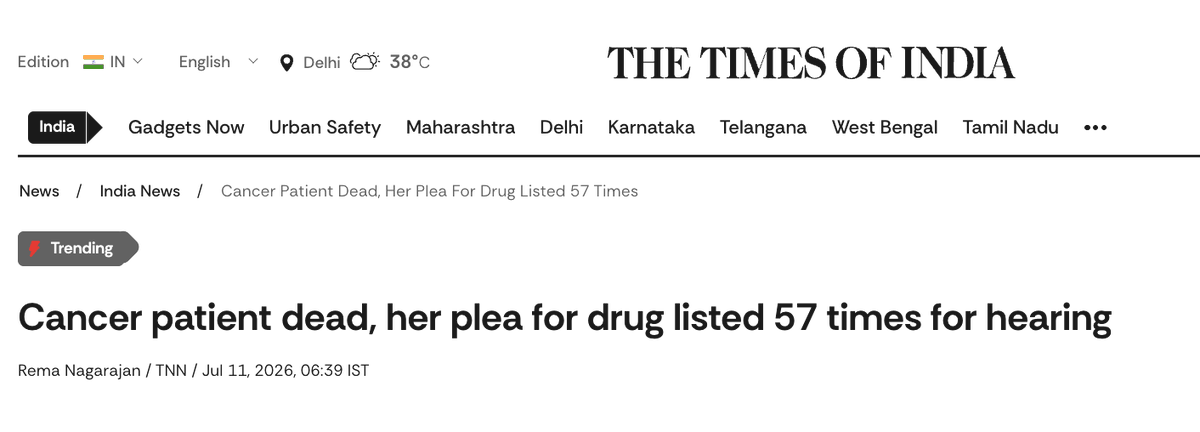
Cancer patient was about to die. She pleaded. Her plea has been listed 57 times. The court has still not heard it. Teesta Setalvad was about to be jailed. She pleaded. Her plea was listed out of turn. The court heard it at midnight.
Cancer patient is dead. Teesta is alive.
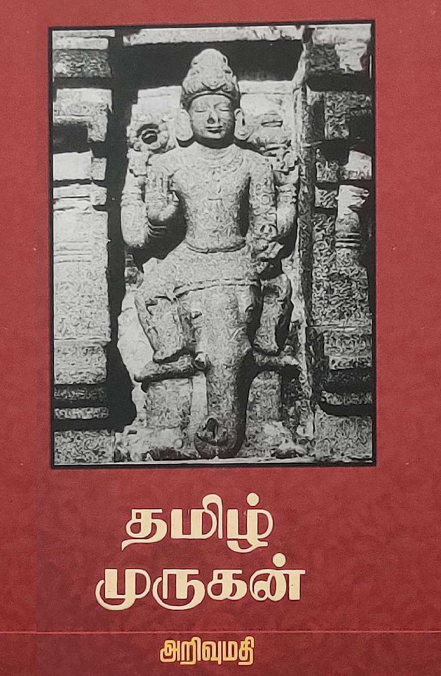
What exactly is the argument of Poet Arivumathi in his book "Thamizh Murugan" which is the inspiration for Dhanush x Vetrimaaran's next project?
A thread rebutting his book using his own sources. Do read this important thread, RT it and think for yourself (1/n)
Request people to see this
Thank you Shekhar Gupta for sharing the horror of Khalistani terrorism in old days
Terrorists had banned girls from wearing skirts in school
A school headmistress begged for some time for the poor kids to buy salwar kameez
They shot her in the belly
Anyone in India today who tries to create sympathy for Khalistani terrorists is a monster
Not many would remember that 22 innocent students who had gone to Thapar Institute of Technology, Patiala for a cultural festival in November of 1989 were brutally shot dead past midnight in their rooms and 11 of them were my college mates and friends at REC Kurukshetra (now NIT) and the rest from Nagpur.
3 decades of illegal encroachment, cleared 3 years ago & Nature has reclaimed what was rightfully Hers.
The majestic elephants are back at the southern periphery of Sonai Rupai Wildlife Sanctuary.
Eviction DOES result in restoration and its continuation will be OUR policy.
The economic and demographic effects of corruption.
Cost of land in our urban areas is far higher than what our GDP per capita would dictate. The ratio of land value to per capita GDP is probably higher in India than anywhere else. As an example, land prices in Chennai or Bengaluru rival that of cities like New York which has a vastly higher per capita GDP.
The key reason?
First, vast sums of political corruption money is parked in real estate. This raises real estate prices and high real estate prices affect everything downstream.
Second, corruption in building approvals and the like - the famous DTCP - raises construction costs, on top of already higher real estate costs.
Third, corruption in private school regulatory compliance enforcement raises school fees.
Fourth, corruption in private hospital regulatory compliance enforcement raises health care costs.
Fifth, household goods need sales outlets and those pay higher rents due to high real estate prices and construction costs.
So housing, education, healthcare and household goods - all of these now cost higher.
As a direct consequence, the economic burden on the average person gets worse. Young people, facing all these costs, postpone marriage, and postpone children or have fewer children.
That directly affects our demographics.
While this issue exists in many parts of India, Tamil Nadu, being the most urbanized of the bigger states, is particularly hit hard.
So corruption is becoming an existential threat to our society.
If you worry about the super-low birth rate in Tamil Nadu, way below replacement, understand that corruption raising our cost of living is one of the major causes, not the only cause, but a big one in our context.
The DMK ecosystem is attacking me that the school issue I reported was a lie I concocted to help the TVK government. Let me state the facts.
We run two rural schools, both free NIOS schools under the Kalaivani Kalvi Maiyam umbrella, one in rural Tenkasi and the other in rural Theni.
The Theni school was originally started and run by a retired IPS officer, a honest and upright man. He built very nice facilities but had to shut down his CBSE school because the state government demanded too much money to issue the NOC. He told me that as a honest retired officer he did not have the money to pay and they would not issue the NOC otherwise.
He urged us to take over his trust so we could run our free NIOS school in the premises. That is how we started our NIOS school in Theni.
Unlike in Tenkasi, where I live, the Theni school faced occasional harassment from the DMK government because we did not have a state government registration, so we tried getting state government approval again (this time for the state board) and that of course would also cost money. So it was in a limbo.
Meanwhile in Tenkasi we wanted to build new school facilities (we were operating in make-shift facilities, the ones that came in frequent photos) and we applied for DTCP approval to construct the new buildings. Everyone who knows DTCP in our state knows what kind of corruption happened there under the DMK.
We waited patiently for DTCP approval for the new school buildings but the approval never came as long as the DMK was in power. The approval came automatically once the government changed.
It is this DTCP approval that I posted about in X. I want to once again appreciate the refreshing change.
Not only did the approvals come, government people told us not to pay money to anyone for any approvals. I have to appreciate this in public, having endured what we had endured before.
This is the "lie" that DMK wants to attack me on.
I do not need their certificate on my character.
They can examine their conscience and ask why a technology nerd like me who is mostly immersed in code would post these.
If they think I would back down by their vile personal attacks because I am a Brahmin or TVK Stooge or Sanghi or whatever, I will tell them this: unlike you dynasts I grew up with nothing. I studied in Tamil medium schools. I know how to live on nothing. I have dedicated the remainder of my life to make Bharat self reliant in technology while reviving our rural areas, the soul of our eternal sanatana civilization.
I will not be intimidated by their attacks. I am unafraid of death, why would I be afraid of the mere DMK?
And if they had any conscience they can return the money they looted (they know there they keep it) and then they can attack my character.
I will now go back to optimizing the code of our compiler!
Abhijit Sarkar’s murder cannot be buried.
Abhijit Sarkar was not just killed. He was hunted. He was chased. He was murdered in front of his mother. And they even killed his dogs and puppies. And sexually assaulted his old mother.
Swapan Samaddar, the TMC councillor and one of the prime accused in the 2021 killing of Abhijit, has finally been arrested in West Bengal.
And yet, for years, his brother Biswajit fought relentlessly while an entire political ecosystem tried to bury the truth under power, fear and silence.
We petitioned the Supreme Court where we have names every accoused.
This arrest is not closure.
It is the beginning.
Bengal does not need selective memory.
There must be justice for:
Every murder.
Every rape allegation.
Every displaced family.
Every burnt home.
Every silenced witness.
Every cadre-protected accused.
Abhijit Sarkar’s last words in this video must haunt Bengal’s conscience.
Because his case was not an exception.
It is a window into what political terror looked like under the Trinamool Congress when the state government of Mamata Banerjee looked away.
அண்ணாமலை அவர்களுடன் சென்ற அனைவரும் சுயநலவாதிகள் - தமிழிசை
யக்கோ!
அவங்க எல்லாரும் தேசியவாதிகள்
நீதான் சுயநலவாதி
👇
1. 2006 சட்டமன்றத் தேர்தல்: ராதாபுரம் தொகுதி
2. 2009 மக்களவைத் தேர்தல்: வட சென்னை தொகுதி
3. 2011 சட்டமன்றத் தேர்தல்: வேளச்சேரி தொகுதி
4. 2016 சட்டமன்றத் தேர்தல்: விருகம்பாக்கம் தொகுதி
5. 2019 மக்கள��ை தேர்தல்: தூத்துக்குடி தொகுதி
6. 2024 மக்களவைத் தேர்தல்: தென் சென்னை தொகுதி
7. 2026 சட்டமன்றத் தேர்தல்: மயிலாப்பூர்
இதுல நீங்க எதுல ஜெயிச்சிங்க ? 😂😂
நீங்களெல்லாம் தொலைந்தால்தான் தமிழகத்தில் தாமரை மலரும்
இல்லேனா திமுககாரன் சொல்ற மாதிரி மயிர்லாதான் மலரும்
இதுல கவர்னர் பதவி வேற
உண்மையை சொன்னேன்...
Bravery like this keeps the Nation’s flag flying high! From Theni, Tamil Nādu to the blood-soaked battleground of Kulgam… Lance Naik Meenatchi Sundaram took bullets straight to his face & shoulder. But this proud Bharat`s son didn’t flinch. He charged in close combat, neutralised the terrorist and became KIRTI CHAKRA!
Man made of STEEL. A real hero. A son of India. Salute!
Jai Hind!
#KirtiChakra #IndianArmy #ProudTamilNadu #RealHero