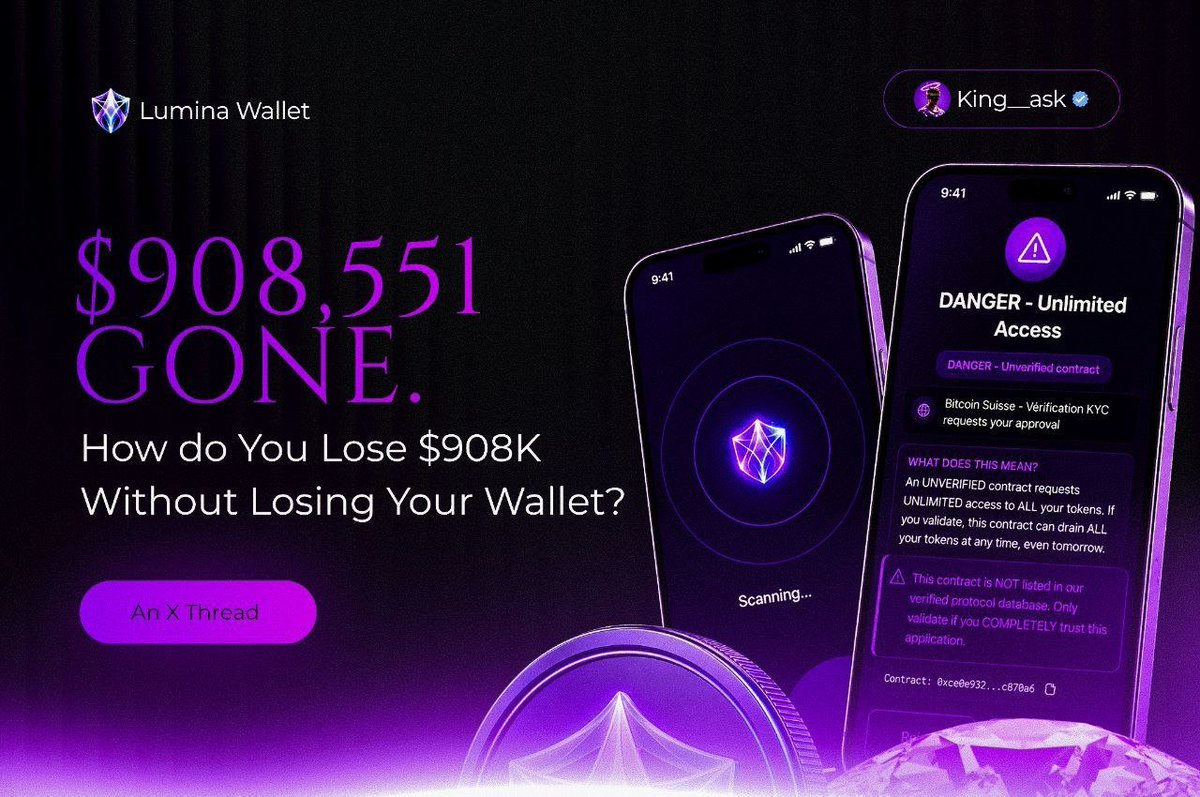
Meet Lumina Wallet: The self-custody wallet that reads the fine print for you.
Before you sign, Lumina scans every transaction to detect phishing, malicious contracts, and hidden risks.
✅ 10+ Blockchains
✅ 17,000+ Tokens
✅ 0% Swap Fees
Download now: https://t.co/b4u0F8ccDx
👋 Meet Lumina Wallet, a non-custodial multi-chain wallet built to give users more context before they sign.
@getluminawallet analyzes transactions and signing requests before confirmation, checking for malicious contracts, unlimited approvals, and other known risks.
See what Lumina brings to Web3 security: https://t.co/ykQfkyHTfh
@exolix_com Thank you for the thoughtful overview. We especially appreciate the focus on helping users understand transactions, permissions, and signing requests before they confirm. Security starts with knowing what you are authorizing.
@king__ask This is exactly why old approvals deserve attention. Your seed phrase can remain private while a permission signed months earlier is still active. Thank you for explaining this risk so clearly and without oversimplifying it.
A crypto address can be valid and still belong to the wrong person.
Address poisoning works because attackers place a lookalike address in your transaction history and wait for you to copy it.
For important transfers, verify the full address through a second channel and send a small test amount first.
“Valid” does not mean “correct recipient.
@coinbureau Important distinction: connecting a wallet usually reveals only the public address. The real danger often comes with the next approval or signature. A basic AML check only needs your public address. If it asks you to sign, stop.
@salus_sec The “Sponsored” label is not a trust signal. Before approving, check the spender, token, amount, and expiry. An unlimited approval to an unknown contract should always be treated as a stop sign.
Imagine checking your wallet one morning and realizing $908,551 in USDC is gone.
Your seed phrase is still safe.
Your wallet is still yours.
So how did someone take almost a million dollars?
The answer starts 458 days earlier.
🧵
@getluminawallet On April 30, 2024, the victim signed an approval transaction.
Nothing happened immediately.
No money disappeared. No obvious warning.
Just one approval sitting quietly in the background.
And life just moved on. 🤷
@CoinDesk A QR code is just a delivery method; the real danger is what it asks your wallet to do. Scanning should never mean blind execution. Wallets must analyze and explain the underlying request before any signature is permitted.
Building a seamless Web3 experience takes the best infrastructure. Lumina Wallet integrates with industry leaders like @MoonPay and @Transak to let you buy crypto securely, directly in your app.
Self-custody meets world-class fiat on-ramps.
Crypto is global. Your wallet should be too.
Lumina Wallet supports 11 languages, helping users manage their assets in the language they understand best.
One wallet. Global access. Your keys, your control.
@TheHackersNews Typosquatting turns one mistyped package name into a wallet compromise. Developers should isolate signing wallets from build environments and keep recovery phrases completely offline.
@exolix_com Routine is exactly what makes these scams effective. Always verify the domain, distrust unsolicited support, and never approve a transaction or signature you don’t fully understand.
@SlowMist_Team Developer wallets and deployment keys should never share the same environment as third-party extensions. If the IDE is compromised, the signing boundary must still hold.
@SushiSwap Anyone can copy a token’s name and logo on a new chain. Wallets should protect users by identifying EVM assets strictly by their official contract address per network. If the contract doesn't match the whitelist, the fake token should be ignored by default.
Anyone can copy a token’s name, symbol, and logo. Lumina identifies EVM assets by their official contract address on each network. Wrong contract? The fake token is ignored. Verify the contract, not the logo.
@zerion@safe Accurate DeFi positions require deep contract parsing. The same data can improve signing UX: show which position changes, which assets move, and what approvals are added before execution. Portfolio visibility and transaction clarity should use the same contract intelligence.
@TrustWallet Custom RPCs preserve access, but they shift trust to the endpoint. Wallets should clearly label user-added networks, verify chain IDs, and surface the exact network and destination again before signing. Self-custody protects ownership; configuration still needs scrutiny.
@WalletConnect Native payouts remove manual mistakes, but the final confirmation still needs to be explicit. Show the verified recipient, exact network, asset, amount, and destination before signing. Automation should remove friction — not visibility.
@Uniswap Discovery is useful, but launchpad aggregation also increases the cost of a bad decision. Every new token should arrive with clear contract verification, holder concentration, liquidity, and honeypot risk before the first swap — not after.