Excellent, deeply researched piece in today's ET by @RicaB_ET on the staggering cost of cancer care and what needs to change.
Govt. needs to regulate the upper bounds of pricing that large hospital chains are setting year on year. Virtually all of them are now PE funded and they act as anchors for setting upper bounds of price charged. Mid tier or old large established hospitals in same area simply offset against these rates and entire pricing tier goes up. If this goes unchecked soon we will have a west like model where healthcare isn't affordable without insurance and healthcare lobby group have so much sway there isn't much govt can do.
More power to @RicaB_ET and other journalists writing about this topic.
Introducing https://t.co/427WVklG7W
A massive isometric pixel map of London, based on amazing NYC demo by @_coenen from 9 months ago
My agent created the dataset, finetuned qwen image LoRA adapter, did a multiday inference run and built an efficient tile viewer!
Excerpt from the agentic monitoring post on HN (link in 🧵): we piloted this last week for one of our customers.
A background agent sweeps logs every hour, generates a system health report for sandboxes, and spawns sub-agents to dig deeper or even create PRs for anything that feels off.
Each sub-agent runs in an isolated sandbox/harness and can run as long as needed while the parent goes back to sleep. Sub-agents can also wake the parent sweeper to reconcile findings and update the report.
My first reaction was that it produces an overwhelming amount of data; we’ll have to dial it down to the things that move the needle for customer-perceived reliability.
I think what is actually needed is for Indian people to actually give a damn about their cities and fellow citizens.
Anybody using the "I pay taxes, I shouldn't have to do anything" excuse should go live in another country. India isn't developed, it's developing, so it needs patriots, not parasites. If this triggers you, it means you're part of the problem.
If you're not happy with the footpath (or a pothole, or anything else which is broken), fix it, or call someone to fix it, and don't give up until it's fixed. Be relentless. Be vocal. Be creative. Make it your mission to get that one thing fixed. Look at what Virendra (@Virendra0698) did by just calling the right people and being respectful (but also persistent). He and Arun Pai (@arunpaiblrwalks) along with the help of GBA and some wonderful volunteers turned an unofficial garbage dump into a pristine, beautiful footpath through sheer force of will.
https://t.co/pBmWjgckFf
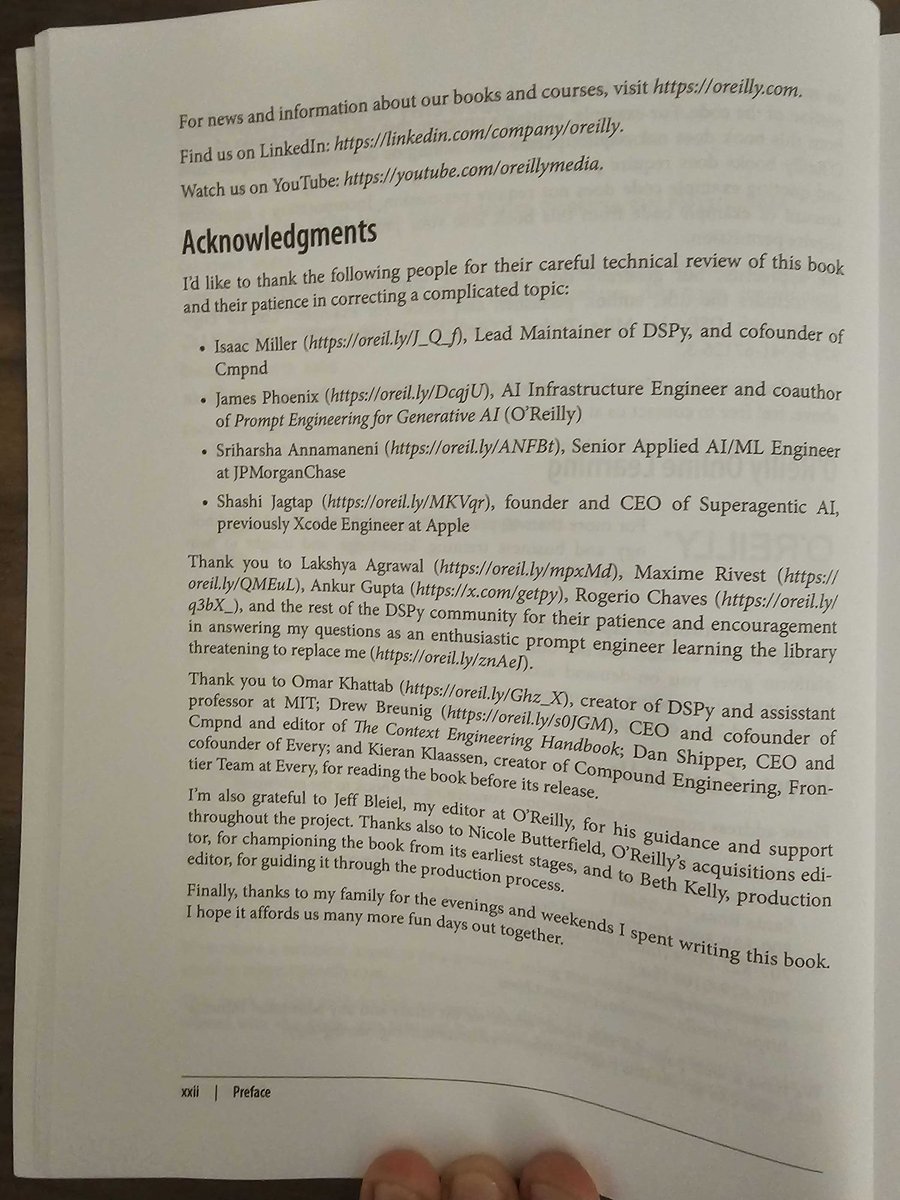
Thanks to @lateinteraction for creating @DSPyOSS and encouraging me out of my imposter syndrome, and @dbreunig for convincing @OReillyMedia this topic was a good bet.
Thanks @LakshyAAAgrawal for making GEPA the optimizer that has been dominating every prompt I try.
Also @isaacbmiller1 the lead maintainer of DSPy, @jamesaphoenix12 coauthor of my last book, @Shashikant86 and Sriharsha Annamaneni for technical review.
Thanks to my colleagues @danshipper and @kieranklaassen for reading and endorsing the book before it was published.
Thanks also to the team at O'Reilly, Jeff, Nicole, Beth for making my writing fit to print.
The wider DSPy community @MaximeRivest, @getpy, and @_rchaves_ and everyone who was patient enough to explain to a naive prompt engineer why we didn't need prompts anymore.
Finally thanks to my wife and kids (who thankfully aren't on X), for giving me 9 months of evenings and weekends to get this done.
Creating, maintaining and extending a hand curated benchmark suite has been a learning experience even if it's a tiny subset of what leading ones have and even if yours is inferior in coverage and breath. Why?. You personally develop an intuition on model drift, performance and can quickly A/B test and know how your AI workflows might perform. Since you know each case in the suite and by extension failure traces or lower confidence scores make sense quickly. Plus you gradually extend coverage on cases that need attention. It becomes a source of reassurance with ever evolving customer prompting style and variations, accompanying dataset, new model choices.
Done testing, time to 💤
YouTube has many of the Adobe vibe coded clone reviews. Heard few ppl cloned word and excel now. Still some quarters to go for high-margin software moats, welcome to the cigar butt phase of value extraction.
Telling a 3D satellite mapping model to focus on buildings made buildings worse in three of four test scenes.
When a satellite photographs the same patch of city from slightly different angles over several passes, you can work out how tall everything is, much as your two eyes judge depth. The result is a surface height map: a grid where every cell holds the height of whatever sits on top, whether that's a roof, a tree canopy or a road. Emergency teams use these maps to spot collapsed buildings, and planners use them to track what's gone up.
The newest tools for building them have a blind spot. They're tuned to redraw the original photos as faithfully as possible across the whole scene, so a crisp car park counts as much as a crisp roof edge. Analysts, though, almost always look at buildings first.
A bunch of researchers used Gaussian-splatting to over each photo to mark the buildings, then told the reconstruction to care up to two and a half times as much about getting those pixels right.
On the main test scene, a suburban block from a public 2019 benchmark, average height error on buildings fell from 84.4 cm to 80.6 cm, a gain of under 4 cm. A gentler version that ramps the building emphasis up during training cut whole-scene error from 1.362 m to 1.349 m, about a centimetre, while keeping part of the building gain.
Those are of course som epretty small numbers, and the other three scenes tell the more useful story. Building emphasis made buildings worse there. On one block, building error rose from 1.36 m to 1.43 m, and on another the strongest setting pushed it from 83 cm to 95 cm.
So the second half of the system is a controller, which the authors call an agent, that decides scene by scene whether building focus is worth using. It first checks how much of each photo the outlining model has marked as building. Two scenes came in at around 40% to 44%, which it treats as a warning that roads and other hard surfaces may be getting swept in, and it falls back to cautious settings. It then compares the candidate reconstructions on buildings, vegetation and everything else before choosing.
It chose building focus for one scene and the plain version for the other three. Averaged across all four, its building-focused picks gave 1.012 m of error, against 1.021 m for always using the plain version and 1.049 m for always using the ramped one.
Every decision gets written to disk with the evidence behind it: mask coverage, building count and footprint area, the options considered and the errors that settled it. Alongside the height map, an analyst gets a building inventory, a shaded relief overlay and a 3D preview they can open in ordinary mapping software.
The 4 cm will be forgotten. A machine that writes down when its own upgrade didn't help is the part more mapping pipelines should copy.
link to full article: https://t.co/6Xf8HboRCC
@AzizSunderji It's easier to time real estate market vs stock market in country like India where real estate down cycle are usually flat / stagnant on price and long drawn.
One of the biggest historical bottlenecks for training specialized models has been curating ground-truth. This is typically a very labor intensive process done with human supervision.
Now frontier models/agents are getting better and better at bootstrapping ground-truth from scratch, especially for verifiable tasks. They can do this either in a single-shot setting for simple tasks or simulate longer rollouts with rewards for longer tasks.
This paves the way for anyone to build mostly automated research loops without needing deep ML expertise or deep access to human labor for data curation. That part can be offloaded to the frontier model/agent; the human's main goal is to define the right evals. This is especially useful for anyone who wants to optimize for a given task at the price-performance frontier. Posttraining open-weight models/harness should be made available to everyone, not just labs/specific startups.
Flow for the average user, who is only responsible for the first step:
1. define goal/evals for a given task
2. run frontier agents to gather ground-truth signals for the task. they can bootstrap annotations directly, and reach out to human review where needed
3. train specialized models (and harness) against this task
If you aren't paying attention, no matter which frontier max model you use, or how many of them you chain in reviews and re-reviews, it's always gonna turn into slop.
Django has inspectdb that introspected the database tables you pointed to and would output django models. Asked LLM a TSQL to models conversion and you see harness generate entire multiverse to accomplish the task.