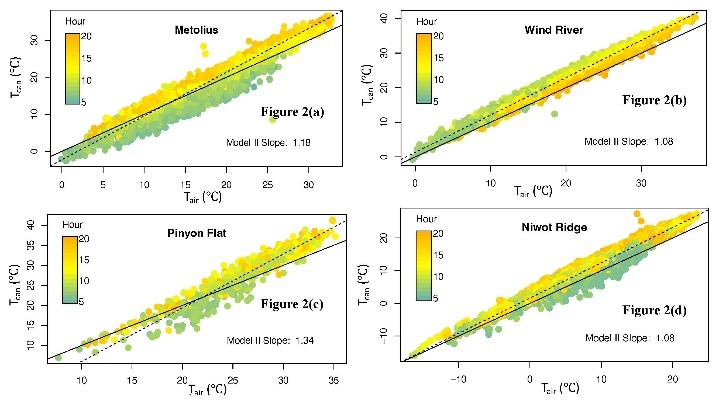
Our paper on forest canopy temperature is out in PNAS today! Forest canopies can get much warmer than air temperature, and as air temperatures increase it gets worse, with troubling implications for forest carbon uptake: https://t.co/uO3YAEHQVS
I'm very pleased to have been involved in this fun and novel approach to mapping vegetation structure using @GEDI_Knights data in sparse, tall woodlands in a remote corner of Western Australia. Good science with a solid application to biodiversity conservation.
A paper led by the twitter-less Chris Still where we had a good hard think about the timing and geographic distribution of heat-stress related foliage damage relative to the potential for hydraulically induced damage. Check it out!
My science Twitter has gone awfully quiet... now all I get is rage tweets from a billionaire and sports gambling ads :(
I'm trying out Mastodon (@[email protected]) but am not finding much #ecophys and #remotesensing ... help?
Are you using or will you use #GEDI data, either in academics, private sector, or whatever? Let me know - we're gathering use cases to try to keep it up on the space station. Please RT!
The limited homeothermy hypothesis, a longstanding theory that forest canopy leaves can cool themselves below potentially damaging high air temperature, is not supported by evidence, a study finds. In PNAS: https://t.co/taU2FrNW7w
Temperatures in forest canopies are higher than previous estimates, threatening their vital role in mitigating global warming, according to new research published by @PNASNews from @FSU_Geography @FSUCOSS Associate Professor @stephanie_pau and colleagues.
https://t.co/RXPalRNZdH
@vinhare Yeah I agree that the isotope data is really interesting. Different scales of measurement and different mechanisms, so reconciling the two is a big question.
Our paper on forest canopy temperature is out in PNAS today! Forest canopies can get much warmer than air temperature, and as air temperatures increase it gets worse, with troubling implications for forest carbon uptake: https://t.co/uO3YAEHQVS
@EkoLogIt@EcofunTeam@GlobalChangeBio Hi Jonathan, yes, it'll be cooler beneath the canopy for sure. Our study looks at the temperature of the upper canopy relative to the air above it. What's happening in the microclimate beneath the forest canopy is a different scenario.
@SeanMichaletz@vinhare@agformet @benjaminblonder Furthermore, the point data presented in Michaletz (2018) to validate the modeling, are the same problematic LI6400XT data presented in the 2016 paper.
@SeanMichaletz@vinhare@agformet @benjaminblonder Hi Sean, yes you're right. Under the right combination of biophysical conditions, homeothermy is possible, as you modeled in your paper. However, those conditions are very difficult to find in nature, or at the very least, in the forest systems we instrumented.
@doctorjackpine @mallory_barnes@vinhare Thanks Shawn. Temperate and tropical forests are one thing, the Arctic is something else! Really interesting stuff.
@vinhare As an aside, we've also previously demonstrated that homeothermy in the LI6400XT point data in Michaletz et al. (2016) were most likely the result of a measurement error. You can replicate limited leaf homeothermy in an empty cuvette with a LI6400XT (https://t.co/ZZsJQKBjyF)
@vinhare So a good question to ask now is what exactly is the δ18O data telling us, if we weren't able to see any sign of it in the paired flux-canopy temperature data?