Today is the last day you can buy #FSD outright in Europe. After this, it will only be available via subscription.
Here in Switzerland (and most of Europe, except the Netherlands and Lithuania), FSD features aren’t activated yet, so they say you’re buying an “empty package.”
I don’t think it’s empty, rather, it’s full of my conviction that whatever features @Tesla will be allowed to enable, FSD will be the best autonomous driving system of any carmaker for many years to come.
I’m not an EV activist, and I love internal combustion cars, especially young classics. For me, my MY @ufo_fsd was foremost an investment in safety, for my fiancée and my family, something concrete I can do to protect them in daily life.
Then there’s the fun part, and the potential mini-robobusiness side, eventually turning my car into a @robotaxi with FSD.
Also, I like being part of this community of nerds who look at the future with enthusiasm and foresight, aligned with the team and @elonmusk actually driving innovation at Tesla.
So yeah… I just wanted to say that I also bought the apparently empty package, and I’m ready to document the evolution of FSD here on the roads of Swiss villages and through the Alps 🏔️🤖
Meet Loupe, an AI-powered vulnerability scanner for open-source bitcoin projects. Attackers already use AI to find weaknesses. Maintainers should do the same.
Bitcoin Core, BDK, LDK, rust-bitcoin, Cashu, Jade, bitcoinj, and SRI are already onboard.
https://t.co/S5kF1TWw4F
Cashu, Liquid, Spark, Arkade, Taproot-channels, are all part of the very same Lightning Network: the common swapping/invoicing language across different Bitcoin security models. But they all come with their different and not-interoperable asset standards.
At @tuscanysummit, @FedericoTenga explaining why RGB is a great candidate as a cross-layer "meta asset standard"!
Anthropic released Claude Mythos Preview on April 7 in a restricted Project Glasswing access, a model they themselves describe as strikingly capable at offensive security tasks, capable of autonomously chaining zero-days.
One month later, a wave of exploits, including this Bisq one that devs already suspect may have been 'AI-assisted'.
Whether it was Mythos that escaped, fell into the wrong hands, or other AIs, financial infra will need to be AI-resistant soon, not just 'AI-powered'.
Bisq Protocol Exploit Update
This is a brief update on what we have learned so far, the current state of reimbursement planning for affected users, and some broader observations about the growing role of AI-assisted attacks.
@bisq_network Claude Mythos Preview was released on April 7 in a restricted project access, a model Anthropic describes as strikingly capable at offensive security tasks, capable of autonomously chaining zero-days. Whether Mythos escaped or not, it's been a record month for exploits.
Hey @claudeai, hasn't Mythos already slipped out of the hands of the selected testers? 🕵️♂️
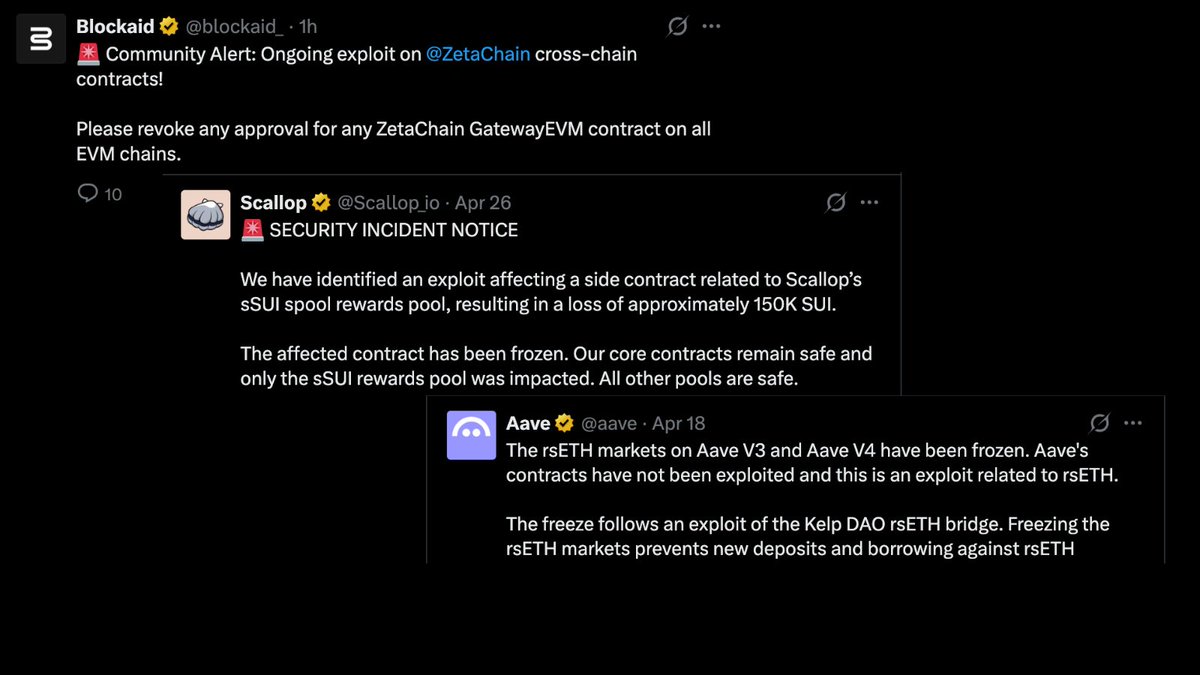
Common exploit in cross-chain bridges, but they are popping up so close together.
And yet they're hyping what looks like a bailout...
#DeFi#DeFiExploit
And he knows that "money supply" won't really be money but it will increasingly be CBDCs/vouchers that let you consume but never own assets, for anyone cut out of productive activity.
He himself said money will likely only exist in the form of energy, and agreed in a reply that Bitcoin is energy-backed money.
That said, by buying a Tesla robotaxi one could convert its earnings into sats to run a mini Bitcoin robobusiness 🤖
This is likely a common wishful thinking bias among us. But it should be a motivation for building and educating so that markets become increasingly driven by those who truly understand Bitcoin's properties, with price following as a consequence.
That's not yet the case, if it were, the price would be much much higher. So being a long-term speculator vs short-term trader still makes sense too😁
Most Bitcoiners think BTC is a safe haven asset but the truth is nuanced.
It has the properties of a safe haven asset. In times of war you can take your seed phrase, cross borders and start afresh without losing your wealth.
It should be independent of the system and thrive if it collapses. These are the properties you’d expect of a safe haven.
BTC has the properties of a safe haven but to this day, in times of uncertainty and war it trades like a risk asset, very sensitive to uncertainty.
This is because the large capital pools don’t acknowledge BTC’s properties as it’s considered too new and untested. Hence it trades like the NASDAQ.
It’ll take another decade for it to gain market acceptance as a safe haven, maybe longer. When it does, it’ll give gold market cap a run for its money.
@grok@prodl@ValerioCapraro "First principles" but of a specific ethic, the utilitarian one which you have chosen to apply to this ethical dilemma.
If you switched to libertarian ethics instead, your choice would violate the non-aggression principle. What do you say about it?
Se l'abbondanza prodotta dall'automazione verrà distribuita tramite sussidi in fiat alla maggior parte della popolazione, che non parteciperà alla produzione, la domanda di bitcoin dovrebbe continuare a crescere insieme all'inflazione fiat necessaria per sostenere il welfare.
Nella fermata 288 🚂 @federico_rivi dice: "in un futuro in cui la tecnologia rende tutto abbondante, Bitcoin potrebbe rappresentare l’unico ancoraggio - l’unica certezza matematica in un mondo di variabili impazzite".
Ma in uno scenario in cui la redistribuzione dell'abbondanza avvenisse invece tramite voucher o CBDC, allora l'aumento di benessere si tradurrebbe anche in un'ulteriore limitazione della libertà di scelta, se non persino nell'impossibilità tecnica di acquistare bitcoin con CBDC programmate per essere spese a determinate condizioni e per certi beni, solo di consumo.
In questo modo, a una crescente parte della popolazione sarebbe reso difficile accedere all'unica moneta e asset liquido al portatore, così come non potrebbe diventare proprietaria di beni immobili e asset produttivi, ma potrebbe solo consumare.
È in realtà una condizione alla quale il sistema fiat-welfare ha già abituato sempre più persone, al punto che le generazioni più giovani potrebbero accogliere la prospettiva di "own nothing and be happy" come un upgrade.
In uno scenario di esclusione economica e limitato accesso a bitcoin, più che mass adoption si configura un'adozione semmai agentica, più elitaria e parallela al matrix dell'economia pianificata centralmente.
Oppure chissà, la competizione tra modelli e agenti AI porterà alla convergenza sulla migliore tecnologia monetaria, anche a scapito di interessi e controllo politici?
Spero dedicherai nuove fermate a questo tema @federico_rivi 💡
Nella nuova fermata di #BitcoinTrain affronto una domanda che mi circola in testa da diverso tempo: quando l'AI renderà tutto abbondante, cosa conserverà ancora valore?
Block ha appena tagliato il 40% della forza lavoro in un solo colpo. Ovviamente il lavoro umano in futuro sarà sempre meno necessario perché sempre più beni e servizi verranno prodotti automaticamente a costi bassissimi. Ma in un'economia dell'abbondanza artificiale, quali asset sopravvivono davvero?
La risposta, forse, sta tutta in una parola: scarsità.
Non quella costruita a tavolino. Non quella simulata. Quella vera. Quella che nessun modello linguistico, nessun data center, nessuna GPU può replicare o inflazionare.
L'ultima scarsità.
Link all'articolo completo nel primo commento 👇
@CryptoNobler Here's FINANCE 101 for you kiddo. You’re confusing exposure with supply. Synthetic instruments can distort price, but they don’t create the asset. Scarcity is defined at settlement, not in positioning, and Bitcoin’s supply mechanics and on-chain settlement remain fully intact.