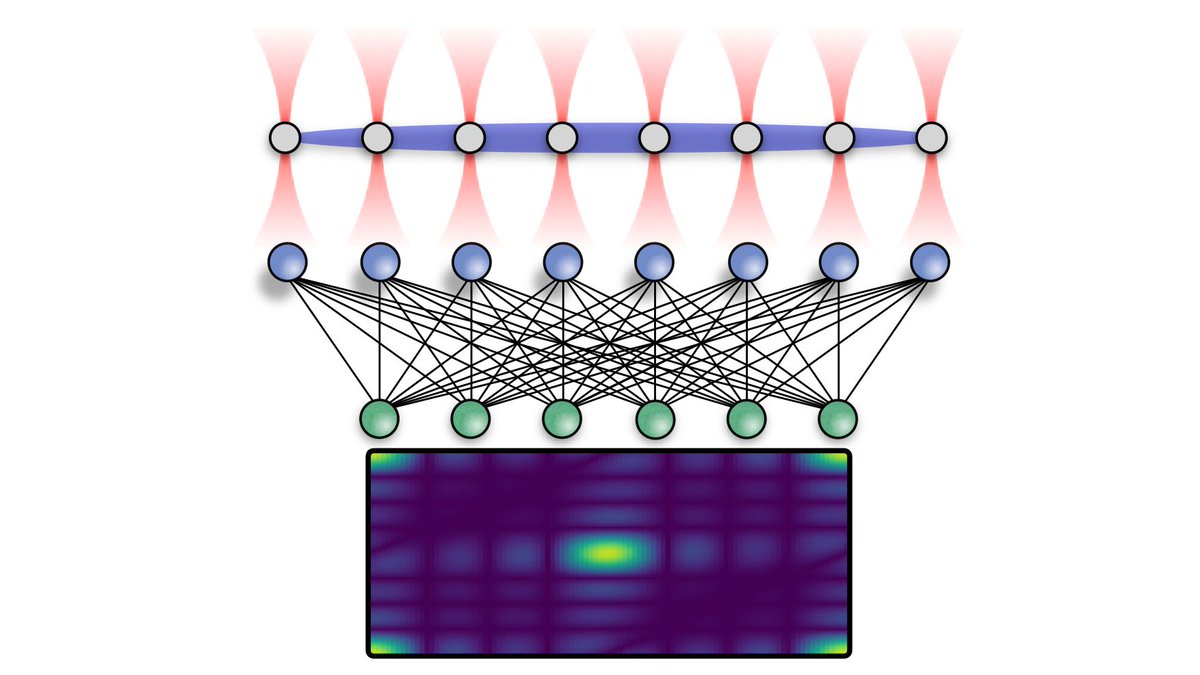
Happy to introduce PastaQ, a Julia package for simulating and benchmarking near-term #quantum computers, using a combination of tensor networks and #MachineLearning algorithms.
https://t.co/LEeoAOUjKQ
Really fun project with Matt Fishman @FlatironCCQ, supported by @SimonsFdn.
@AzizaS A good addition/alternative to Nielsen and Chuang is “Principles of Quantum Computation and Information”, by Benenti, Casati and Strini (there is a recent edition too)
In our latest work, we introduce an active learning 🤓 scheme to efficiently reconstruct a quantum state ⚛️ by choosing the measurement configurations adaptively — check out the details here: https://t.co/ftnXKJHs2E @QManyBody @MKebric@harvardphysics@MCQST_cluster
Roeland Wiersema's new preprint: if your quantum algorithm uses a small number of gates that can't be physically implemented, you can emulate their action classically through measurement and re-preparation on the qubits where the gates act https://t.co/MEILDUkBoH
Your RNN-based VMC needs long runtimes to converge? Speed it up with a data-driven initialization!
Check out our preprint to see how a small amount of measurement data can significantly improve the performance of VMC: https://t.co/lpeqJhXezz
@MossSchuyler@MRadzihovsky@rgmelko
Check out my new preprint: https://t.co/Rm0MNZAqCG
Stripe formation in systems of strongly interacting electrons can lead to a "fragmentation" of the superconducting condensate.
Running quantum-classical workloads in the @awscloud just became a lot easier and more performant. With today’s launch of Amazon Braket Hybrid Jobs, you just need to provide your algorithm, and Braket will take care of the rest. Try it out today https://t.co/BZzWBSfzyL
New preprint in collaboration Roeland Wiersema, Cunlu Zhou, and Yong-Baek Kim. We provide evidence that variational quantum circuits display measurement induced entanglement transitions. Also interspersed measurements could alleviate barren plateaus https://t.co/52iXqB59Jm
We are hiring! We have a 2-3 year postdoctoral equivalent position focused on scientific software development of the ITensor Library in the Julia language (1/3) https://t.co/adi4qmXeVC
We are pleased to offer this hands-on guide that elucidates key operational aspects of machine learning and how to apply it for tackling condensed-matter problems. Thanks to @giactorlai and @carrasqu for the exceptional work!
Tutorial: A newcomer guide on applying tools from #MachineLearning to solve problems in condensed-matter physics and quantum information: From key ingredients to the implementation. @giactorlai@carrasqu
https://t.co/GdNgBlRgUa
[Amazon] will benefit hugely from having access to the Caltech community, the physicists said. “This is really one of the best places on Earth for quantum computing,” [Fernando] Brandao said.
https://t.co/HOwR5nKHaZ
Anna Golubeva @_anna_go shows how pruning can be used to produce more efficient neural networks for the reconstruction of quantum states @UWaterloo@Perimeter@iaifi_news@MIT
https://t.co/NzHUy2Pvxm
From the @awscloud Quantum Computing Blog: Mario Berta on generating randomness with quantum processors, including an implementation on Amazon Braket you can try yourself.
https://t.co/ONXroYISRo
Are you interested in quantum circuit compilation and optimization? We are looking for applied scientists to join our team at Amazon Braket. https://t.co/X04H9SIBvB
Interested in neural quantum states? Check out this NetKet 3.0 @NetKetOrg tutorial I recently gave! You can learn how to build and use complex JAX models for wave functions, learn ground states, apply symmetries, train wave-function phases and more! https://t.co/NueYmjpSYk