Work in progress, Iris.c in a DGX Spark running Flux 3 Klein. I know prompts for Flux 3 should be post-processed for better results, but it kind works even with humans written descriptions, more or less.
@thdxr i really like it, one thing i notice is that local servers randomly get send in screenshots. Since we have the connection anyways couldn't we have a tunnel to e.g. see ui state of something it's working on?
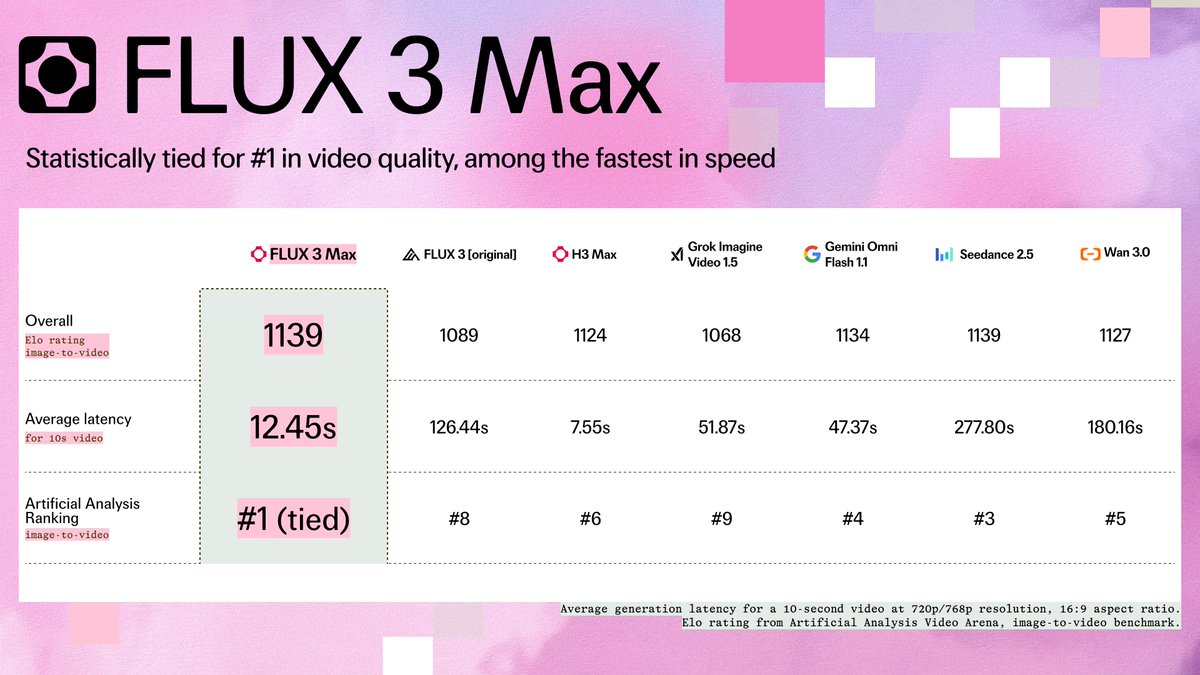
Introducing FLUX 3 Max, the latest post-trained video model from fal Research in partnership with @bfl_ai.
FLUX 3 Max is tied for #1 in image-to-video quality on independent third-party benchmarks, generating a 10-second, 720/768p video in ~12 seconds.
For the next three weeks, FLUX 3 Max is 75% off, making it the most affordable frontier video model at its quality level.
FLUX 3 Image Klein is here.
Open Weights with the quality of a large frontier model. Customizable and fast.
5.6B parameters and runs on a single consumer GPU.
Native 4K, bounding boxes, and pixel-perfect editing.
Introducing FLUX 3 Image.
Control every pixel.
Make precise multi-turn edits without changing any other pixel.
Lay out the image exactly how you want using bounding boxes.
Generate in up to 4K to preserve details.
Use up to 10 references to compose an image.
Commercial Weights available for companies running image generation at scale.
Open Weights version of FLUX 3 Image is launching in the coming weeks.
Introducing FLUX 3 Action.
An open weights 7B World Action Model that achieves first place on the RoboLab benchmark.
It outperforms the previous best open model by 6.1 percentage points while using 56% fewer parameters and running up to 3.95x faster.
FLUX 3 Action removes the usual trade-off between world action model performance and VLA speed: it still predicts video and actions together, but plans more than twice as far ahead and runs faster per second of robot motion than the strongest open VLA.
Teams can fine-tune FLUX 3 Action on their own demonstrations to create policies for a particular robot and task. Together with @nvidia, we also integrated FLUX 3 Action natively into @huggingface's LeRobot, with fine-tuning recipes included and edge deployment on NVIDIA Jetson.
Beyond robotics, we’re also seeing promising results training task-specific policies for acting in simulated environments like gaming, controlling a vehicle, computer use, and wherever else a model needs to understand a visual environment and then choose what to do next.
FLUX 3 Action builds on the same image, video, and audio pretraining as FLUX 3, but uses a smaller architecture designed for practical deployment. In midtraining, we trained the model to predict actions and future frames together.
We’re releasing the weights, code, fine-tuning recipe, benchmarks, and reproducible examples so researchers and developers can build on the model with their own robots, environments, and tasks (see below).
There's something missing from benchmarks. Kimi K3 often writes much better code than GPT-6 Astra. It doesn't write useless verbose tests, it doesn't give confusing explanations. To be a good software engineer, you have to be able to communicate well, and RL doesn't capture that.
@sunncynn@johnyeo_@typesafeai I mean I have no idea how he implemented it but skills are just living in a file path you can even append that on a new turn without breaking cache with codemode you can do the same as well maybe check how opencode implementated it to understand how this works