Earlier this month I volunteered at Stanford’s Future of Math symposium, and ever since, I've been puzzling through what it now means to pursue mathematics as a student in the age of AI. I wrote an essay to make sense of it all: https://t.co/cYyUDqSady
very thought provoking talk from @andy_matuschak . I found out about this the day after it happened. Thank you for putting it online! https://t.co/b0BqzIBqGw
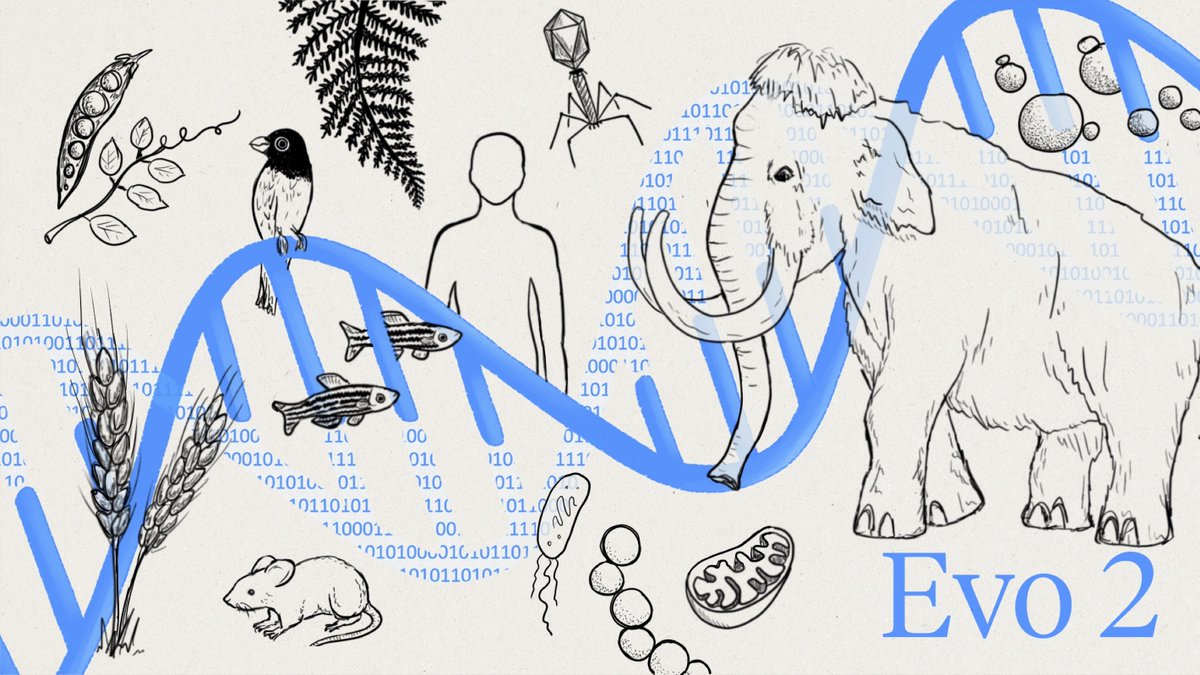
Evo 2 is out in Nature today, showing that genome language models can predict and design across the full complexity of life, from phages to eukaryotes.
A few surprises from the project, including how ignoring trillions of nucleotides was key to getting a good model. 🧵
Really good! love the idea that the cortex/cerebellum are the flexible "scaling" systems. What could the AI analog to the steering subsystem be? Interesting connections to computational efficiency here, too.
How do cell types relate to function? Prodded by @AdamMarblestone's recent appearance on @dwarkeshpodcast, I break down the logic of Steve Byrnes' theory of the steering vs. learning subsystem, and answer why many cell types are better than few for instincts and primary rewards.
@josephreisinger So good. The parts about different response curves were a beautiful link between behavior and things I could imagine networks of cells doing.
Have you read A Brief History of Intelligence? Recommend!
Also lmk if you have a Goodreads…
🚀 Fellowship applications are OPEN for Encode: AI for Science.
What if you could use AI to
- Design shape-shifting robots
- See through solid materials
- Decode language of the brain
- Create advanced materials
Announcing Encode: AI for Science
We're launching a fellowship powered by @ARIA_research to connect top AI talent with leading UK science labs to unlock the next wave of scientific breakthroughs.
How can we condense 50-100 years of biological progress into 5-10 years?
I wrote a response to @DarioAmodei's essay, "Machines of Loving Grace." Most bottlenecks slowing biology today, I argue, are biophysical rather than computational.
LEVERS FOR BIOLOGICAL PROGRESS🔻
An inspired choice! Hinton will certainly go down as one of the most important computer scientists of all time, and Hopfield has had a long and deeply inspiring career.
BREAKING NEWS
The Royal Swedish Academy of Sciences has decided to award the 2024 #NobelPrize in Physics to John J. Hopfield and Geoffrey E. Hinton “for foundational discoveries and inventions that enable machine learning with artificial neural networks.”
@rao2z Still with higher performance on zero than one shot, but a significant jump nonetheless. Makes me suspect that it will improve with scale in a way the llms won’t. Thanks for this work!
Today I’m so excited to launch The Biocreative Index, a directory of people working at the intersection of biology and creative disciplines. Want to join the index, be connected to our community, or contribute a resource? Head over to our website for more: https://t.co/zJT0fZIdku