@_JeanLannes Democracy makes generational projects impossible because voters don't understand tradeoffs. They want lower taxes and more services, growth without datacenters, etc. Whoever they elect can't deliver the magic they expect, so they vote them out and the cycle starts again.
@sporadica AI labs have no theory of mind for the working class. For most, work gives their life purpose, and redistributing AI wealth wouldn't fix that. Deep down they know that once they're no longer needed, redistribution isn't going to happen. “Luxury for all” is magical thinking.
@thetechbrother Liberal democracy requires exceptionally virtuous citizens who care about their country, have empathy for those they disagree with, and actually WANT to talk things through and find solutions. We’re starting to see what an anomaly it was to have that, and we took it for granted.
The idea that if you have more, someone else must have less makes no sense under capitalism. But it persists because our brains evolved in a world where that was much closer to true, and most still instinctively think of wealth as if we were subsistence farmers.
Leftists are fundamentally deluded about the world.
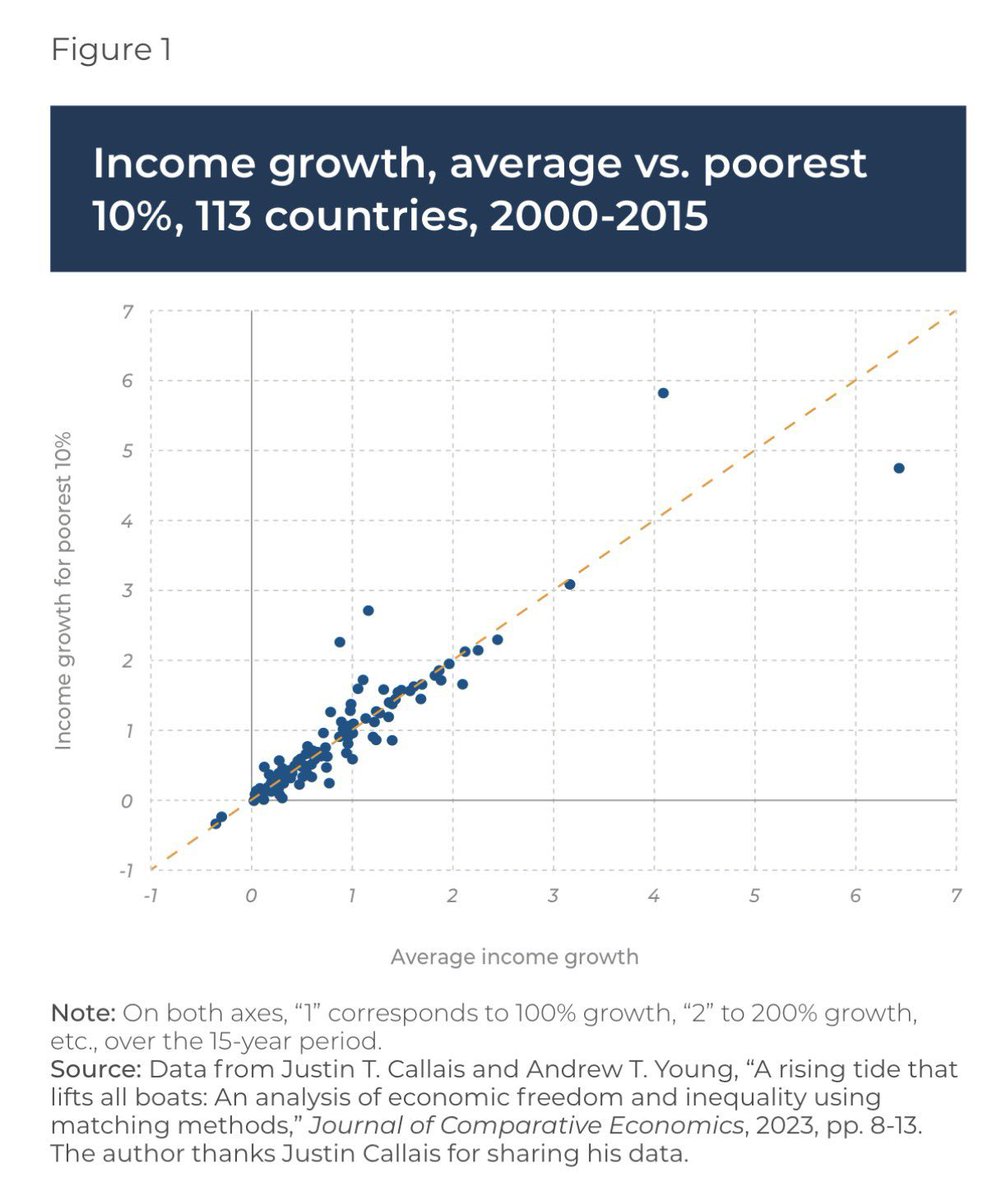
Wealth is not a fixed pie; it grows. In market economies, poor people are not poor simply because some billionaires exist. People usually become billionaires by creating enormous amounts of value for millions of people.
Likewise, poor countries are not poor because other countries are wealthy; in fact, trillions of dollars in foreign aid have been provided to poor countries over the decades. And indeed, many poor countries have actually become wealthier during the same period in which the number of billionaires worldwide has increased. Income inequality has declined, too.
And btw, Africa's share of global FDI is relatively small, especially given its size (contrary to what the image implies).
@thetechbrother Liberal democracy requires exceptionally virtuous citizens who care about their country, have empathy for those they disagree with, and actually WANT to talk things through and find solutions. We’re starting to see what an anomaly it was to have that, and we took it for granted.
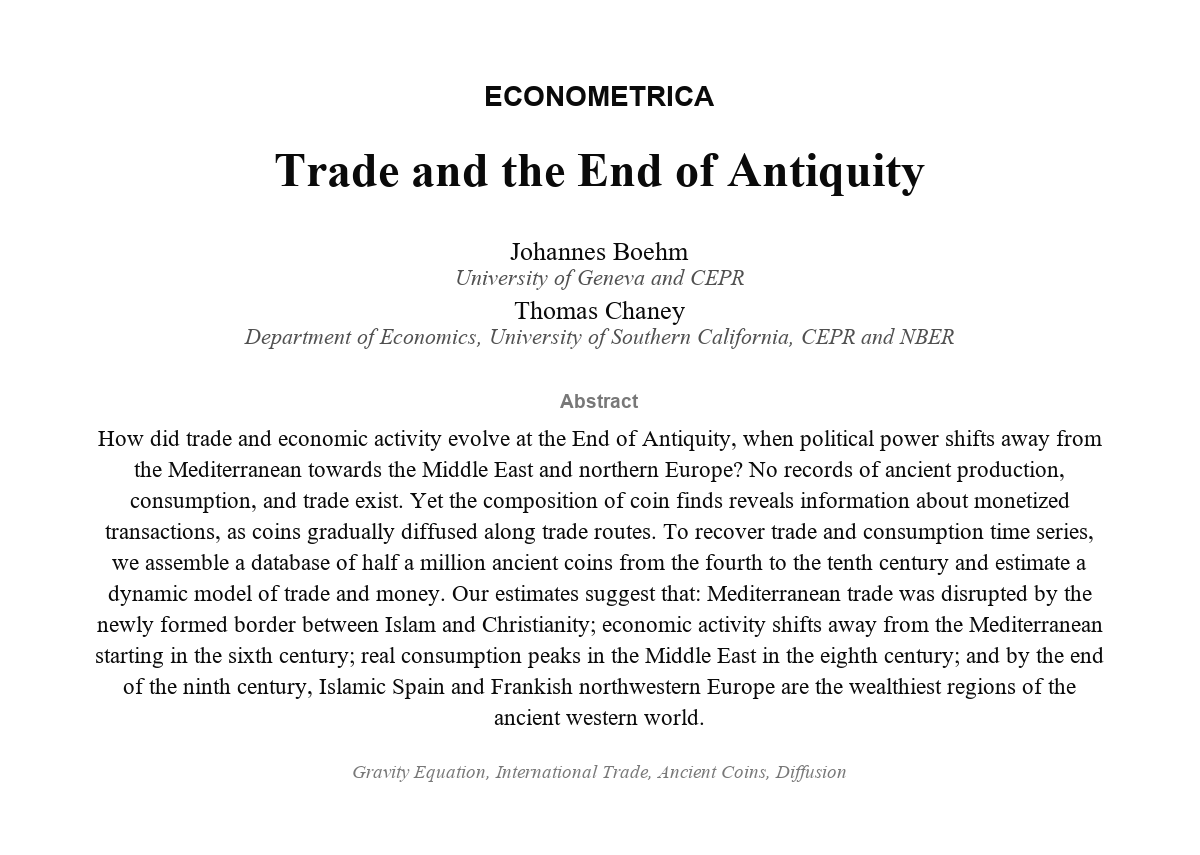
Our understanding of history could be much more objective than it currently is. Too bad that telling a story your audience likes gets you more praise than getting it right.
Hopefully we get more papers like this to ground our understanding of history in data instead of vibes.
@johannesmboehm and Chaney combine data on half a million ancient coins with a model of trade and money to reconstruct trade and consumption from AD 325 to 950. The estimates show economic activity shifting away from the Mediterranean from the 6th century.
https://t.co/LjwuEevS2e
@ctbeiser have you spoken to a 300,000 yo man? Our brains were still changing shape long after that. In the genetic record we can see DNA changes linked to better cognitive performance becoming more common even in the last 10k years. How is his high school performance “obvious”?
@MTSlive Every social app is unfortunately converging on the same vertical entertainment feed that you scroll in a near-catatonic state. I haven’t seen any convincing alternative that makes thoughtful back-and-forth as easy as scrolling.
@ATabarrok We got very attached to the idea that being smart means solving test problems, but good ideas often come from connecting things across fields. If you only know your own, whole lines of thought never occur to you.
@ArtemisConsort The West is exceptional in large part because its people, by and large, don't see every interaction as 0 sum. We tend to take that disposition for granted, but Western civilization would never have been possible without it.
The idea that you can skip knowing things and just get good at reasoning is incredibly naive. You need a map of the world in your head to even know what questions to ask, otherwise you're limited to solving problems someone else gives you.
Memorization has an unfairly negative reputation. I recently spent a few hours memorizing the names of all the countries in the world and it's such a clear improvement in how well I can understand and reason about other topics. Memorization is scaffolding for more complex ideas
@felixringe This is what happens when technical people meddle in the affairs of wordcels. Law is a wordcel domain, and as such is not bound to logical consistency. You can keep finding these bugs and it wouldn't really matter.
Universities will probably just be social clubs for smart people in a few decades. You'll go for the network and do the actual learning elsewhere. That's already most of their value, but eventually it will become the entire pitch.
@TrueSlazac Thinking that AI is a bubble became the consensus contrarian opinion for people that feel threatened by technology. Totally not a good indicator of anything.