Computer Science x Biology. I like to think about algorithms, graphs and statistical models. Free time spent running, volunteering, and learning about security.
This story makes me smile every time I get to tell it. Back when I was an undergrad, a bunch of my friends who were much smarter than me were getting into this thing called "research." So, I also cold-emailed a few professors and one got back to me, asking me to read some paper:
The culmination of several PhD years — today LAML is published! LAML infers max likelihood time-resolved cell lineage trees from dynamic lineage tracing data accurately and efficiently. Thanks to @benjraphael for his guidance! https://t.co/Juk74XuXcd
thrilled to receive the outstanding paper award for our work on shallow alignment!
i’ll be giving the talk at 10:42am tomorrow (Thursday) in oral session 1D. the poster will be Friday 3PM.
Sad news all … Satish Rao has informed me he discovered a bug in the O~(m sqrt(n)) preprint he had for negative weight SSSP and that he withdraws the claim. 😞
What I’ve been working on for the past year! A new mathematical framework + deep learning algorithm, GASTON, for modeling spatial gradients in ‘omics data
(I’m also open to input for the next climbing-themed algorithm name 🧗 😀)
New paper on phylogenetic placement pipelines to place into yet larger trees. Surprisingly, we find it’s important to use FastTree for numeric parameter estimation over RAxML https://t.co/wCvazGFxYv
Had a ton of fun this weekend building a demo project: PapersGPT. It enables you to feed any scientific papers into GPT to give it deep customized knowledge. Moreover, it’s a proof-of-concept UX of the end goal of connecting arbitrary data. Demo: https://t.co/aMm7Tn5oCo [1/4]
Today in @NatureComms, we explore how AI agents can better communicate and cooperate in Diplomacy - a 7-player board game of coordination and alliance formation. 🤝
Find out more: https://t.co/OOUlxZU1zK
Tournebize et al present ASCEND:
a method to infer timing & strength of founder events
▪️ suitable for sparse datasets
▪️ reliable across a wide range of demographic scenarios
@ArcimBoldique@gillianychu @moorjani_priya @berkeleyMCB@CCBBerkeley
🔎: https://t.co/gge4lsACUf
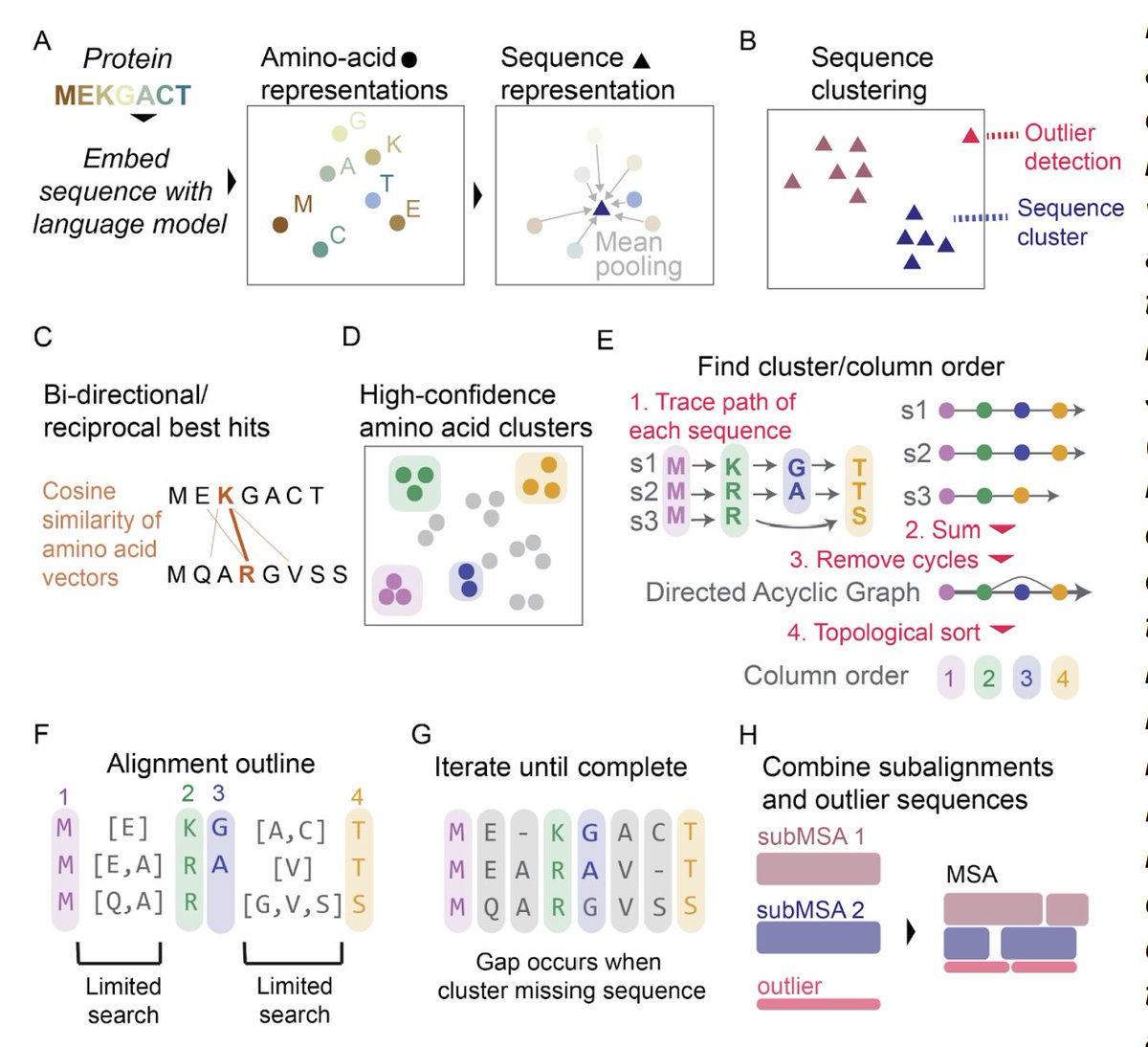
New preprint with @ProfMonaSingh. We present vcMSA, a totally new algorithm for multiple sequence alignment that's based on clustering protein language representations of amino acids. No gaps penalties, substitution matrices, or guide trees required. https://t.co/TR1Tz3zPCj
@gillianychu has prepared a comprehensive collection of screencasts and video demos to guide you in every step at: https://t.co/NzELKkEk34
For example, please check out this great CNAViz video demo from @gillianychu :
https://t.co/jH0jUzCPXj
@melkebir and I are glad to present CNAViz by Zubair @gillianychu et al., an easy-to-use webtool for aiding in copy-number analysis and manually correcting copy-number segmentations. Try now one-click demos directly in your browser at:
👉 https://t.co/wFY3XvkWPw
👇GIF examples
Want to improve segmentation & copy-number calling given a tumor's DNA sequencing data? Check out CNAViz, an intuitive, interactive web-based visual analytics tool.
@melkebir@zaccasimo@gillianychu
https://t.co/ZgprhNqY93