Hunter-Gatherer - The Latest Restructuring Structure You Must Understand
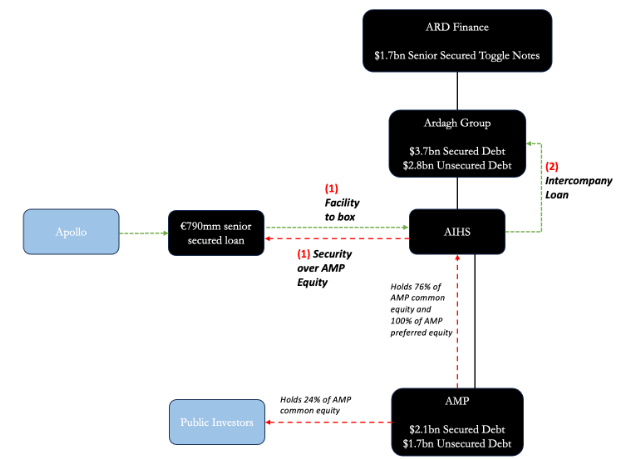
At its most basic, the structure is as follows: a third-party investor purchases a company’s existing unsecured or subordinated debt on the secondary market, and then the company exchanges it for newly issued senior secured debt under a pre-agreed structure.
So, how is this done? Let's see a simple example.
The full article explains this concept in greater detail (including all definitions required to follow), what brought us here, everything there is to know about the mechanics, analysis of the Apollo-Ardagh deal, and what are some of the considerations of this form of LMT vs. Uptiers / Dropdowns
Let’s consider company ABC, which has $500mm in unsecured notes maturing in 2027.
Due to financial stress, those notes are trading at 40 cents on the dollar in the secondary market.Rather than launching a traditional exchange offer (which would require reaching minimum participation thresholds or bondholder consents), the company establishes an agreement exclusively with a Third-Party distressed investor, XYZ.
Under this arrangement, investor XYZ commits to buying these bonds in the open market when company ABC decides to exercise its right to exchange the XYZ purchased bonds into newly issued senior secured debt.
This new debt will be issued at a face amount that is equal to the purchase price of the unsecured notes plus a premium.Suppose XYZ purchases $100mm face value of the 2027 notes at 40%, spending $40mm in cash.
Under the agreed-upon exchange terms, the investor is eligible to receive new senior secured notes equal to 110% of the purchase price—in this case, $44mm.
After company ABC conducts the swap, it achieves two things:
1) It eliminates $100 million of unsecured debt from the company’s balance sheet.
2) It adds $44 million of new senior secured debt backed by specific assets or structural protections.
As a result, company ABC has effectively retired $100mm of junior debt at a 56% discount while issuing only $44mm in new secured obligations.
Its gross debt falls by $56mm, and its capital structure improves.
This is also a win for the new investors, as they enjoy an immediate 10% mark-up from $40mm to $44mm
__
This is a must-read for everyone working in finance.
Find full piece below!
🚨Anthropic just showed a 24-minute workshop on how to actually do prompts for Claude.
Taught by the people who built it.
Free. No registration. No paywall.
I've seen $300 courses that don't cover what they teach in the first 8 minutes.
Watch it and bookmark it now.
The SpaceX IPO is the dumbest “smart” trade of the decade. You will get 4 shares at $440. The institutions will get 4 million at $400. You will buy at $620 on day one because that’s where the algos and the FOMO meet. You will sell at $480 in six months when the lockup expires and early employees dump billions of stock into the market in a single quarter. Your “I got SpaceX” story will cost you 22% and an evening explaining it to your spouse.
Meanwhile there is a $30 million company on the pink sheets that makes a component inside every commercial satellite that goes up. Trades 200 shares a week. P/E of 6. Pays a dividend. Nobody in your group chat has heard of it. CNBC will never say its name. There is no roadshow, no allocation game, no countdown clock — just a balance sheet you can read in 20 minutes and a price that hasn’t moved meaningfully since 2019. The edge in markets has never been buying what everyone is fighting for. The edge is buying what nobody is allowed to want — because it’s too small, too illiquid, too boring, too unfashionable to mention at a dinner party. SpaceX is a trade where you are the exit liquidity. The microcap nobody is following is a trade where there is no exit liquidity, which is precisely why the entry is cheap. Retail’s actual edge in 2026 is the same as it was in 1976: be willing to look at what the professionals can’t.
Google is raising $80 billion of equity a week before SpaceX is trying to raise $75 billion a few months before Anthropic and OpenAI are trying to raise $100 billion from investors and you’re laughing???
This is a cataclysmic exit liquidity avalanche
Intern season kicks off tomorrow for parts of Wall Street, so want to spend a moment refreshing my annual advice for Students.
1) Avoid AI brain drain and social media brainrot like your career depends on it. Because it really does. I wasn't saying this advice in 2022, but with the rise of AI, it is either a tool that propels you or a crutch that cripples your ability to do the basics. Overreliance and the inability to think critically & build models on ur own (just to make sure you can) will kneecap you. You need to know the ins & outs and know how to reach original opinions before letting AI boost you.
2) Speed, Acting with Urgency, and Responsiveness is how you differentiate: I've interviewed a lot of Interns and the key differentiation is the most successful ones are able to act with urgency vs. taking their sweet time. Overcommunicate by saying "Will do”, “sounds good” , or “On it” constantly so we know the message has been recognized. In our interview processes, we test for making sure interns can respond to an email in a normal amount of a time. A shocking amount of them fail at this and are removed from our processes.
3) Don't make the same mistake twice: Easier said than done, but the people evaluating you are keeping tabs on whether you’re smart/teachable. They’ve been trained by this philosophy and are judging you by the same standards. If you make the same mistake twice, then they may perceive that you may not have the ability to retain information, learn from experience, etc.
4) Don't ask questions when it's been answered in an email, a CIM, a powerpoint, etc: You will be given a lot of resources or have something explained to you in an email. You shouldn't ask a question that's already covered. Any question you have should be an expansion or clarification point NOT something already clearly stated. Frankly, if someone makes me have to repeat something that's already in an email or a recent message, then I'm going to get annoyed. As an Associate, the equivalent is asking a Banker or Sponsor a question that's already in the CIM.
5) Don't take a week long vacation during a ten-week internship. You can always vacation before or after your internship. You are trying out for a sports team – you haven’t made the team yet, but you’re getting the chance to make the big leagues. Would you leave the team in the middle of preseason before the roster is finalized? Of course not.
6) Dress the part and look professional: Don't overdress (wearing gucci as an intern), but also don't come in with wrinkled shirts. Make sure your haircut is professional and clean cut.
7) Save a Copy of a File so you don't destroy a Master Document
8) This isn't School - you need a 100% score: I stole this from a video Steve Schwarzman did where he welcomed Blackstone's 2019 Analyst Class in an 8 minute video. I would actually say you don't need "a 100" on the first round of a deck or model. But when we're talking about the finished product, or real world things like wiring money to people, you absolutely need a 100. I think the lesson more so is there are situations where the answer/output is either right or it's wrong - there's no "A-".
9) Don't worry about Work From Home quite yet - make sure you're learning and coming in the office if someone else important is. Also AI is a real danger so you probably have to accept the return to a 5-day in the office world.
10) Proofread constantly: Try different strategies to proofread - this can include reading from beginning to end, end to beginning, speaking out loud, and reading in different formats (like printing the materials out). If allowed, AI is obviously an amazing proofreading tool. I would argue typos shouldn't really exist in workplace setting given you can have AI check it.
11) Write everything important down and keep a notepad on you.
12) Predict demands: This is a good way to stay busy and show you can take initiative. Just don't overstep. Your perceived intelligence and ability to learn comes from your ability to predict demands.
13) Network with everyone, leave no stone unturned, respect everyone: Converse with others, be friendly, say hello, and be looking to learn from different types of people. Be nice to admins and the middle and back office. Don't get "front office" ego, there is no ego here, you are all part of the same team.
14) Show this is where you want to work (even if it's not true): If there's rumors you're using the internship as a stepping stone, you will be toast - give it your best efforts and have a positive attitude about the work!
15) Be careful about how much you drink during happy hours. Use your best judgment.
16) Don't beat yourself over mistakes or if you don't get an offer. It's just a job, not your life. You have a long career ahead of you. Learn from experience.
17) Follow my resources to learn more about finance: I'm dedicated to helping financial professionals, through my compensation and insights platform @Buyside_Hub and my newsletters @WallStRollup and @HYHNewsletter - I've got your back. Links for those below.
As two of the largest forces in equity markets -- growing index ownership and increasing amounts of capital controlled by extremely short-term-oriented, leveraged, volatility-intolerant investors -- converge, we have found occasional opportunities to acquire some of the most dominant long-term compounding franchises at attractive valuations.
For example, we acquired Alphabet $GOOG when the stock declined substantially on the release of ChatGPT in late 2022, Amazon $AMZN in the weeks following Liberation Day, and $META more recently on the market's response to the company's unexpectedly large cap ex guidance and expenditures.
In our 13F which we will file later today, we will disclose a new position in Microsoft, a company we have followed for many years now offered at a highly compelling valuation. While $PSUS will not be filing a 13F tomorrow, it has also recently made $MFST a core holding.
Microsoft operates two of the most valuable franchises in enterprise technology, which account for approximately 70% of the company's overall profits: M365 and Azure.
M365, the company's productivity suite, is the dominant operating platform for knowledge work, with over 450 million workers using Word, Excel, PowerPoint, Outlook, and Teams on a daily basis.
Azure is the world's second-largest hyperscaler cloud platform and, like AWS in our Amazon investment, is a direct beneficiary of the multi-decade migration of enterprise IT workloads to the cloud, which is now further accelerated by surging demand for AI inference workloads.
Both M365 and Azure are underpinned by Microsoft's unparalleled enterprise distribution and the security, compliance, and identity infrastructure it has built and refined over decades.
Beyond these core franchises, Microsoft also owns a portfolio of other leading businesses, including LinkedIn (the world's largest professional network with 1.3 billion members), its gaming platform (Xbox and Activision Blizzard), and search and news advertising (Bing and the Edge browser).
We began building our position in MSFT in February following a meaningful share price decline after the company reported its fiscal Q2 2026 results. We were able to establish our position at a valuation of 21 times forward earnings, broadly in line with the market multiple and well below Microsoft's trading average over the last few years.
Notably, MSFT's headline multiple does not reflect the value of Microsoft's approximately 27% economic interest in OpenAI, which would represent approximately $200 billion, or 7% of Microsoft's market capitalization, at OpenAI's most recent funding round valuation.
We believe Microsoft's recent share price decline has been principally driven by investor concerns around two key issues: i) the competitive positioning of M365 against increasingly capable AI lab offerings (notably Anthropic's Claude Cowork), and ii) the durability of Azure's growth, especially in light of Microsoft's evolving relationship with OpenAI.
In our view, investors underestimate the resilience of the M365 franchise given its deeply embedded role across enterprises and highly attractive price-value proposition. Unlike point software solutions, which may be vulnerable to disintermediation by better-performing AI alternatives, M365 is tightly integrated into the daily workflow of nearly every large enterprise and is supported by Microsoft's identity, security, compliance, and data governance infrastructure, which would be nearly impossible to replicate.
Attractive bundle economics further reinforce Microsoft's advantage, with monthly average revenue per user on the M365 suite at approximately $20, less than half of what customers would pay to purchase the underlying applications individually from different vendors.
Moreover, we are encouraged to see Microsoft prioritizing its R&D efforts and investment in Copilot, its own AI agent embedded across M365, with direct involvement from CEO Satya Nadella. We believe these efforts will translate into improved product velocity and greater customer adoption over time.
Alongside Copilot's rollout, the company has also begun shifting its pricing model from pure per-seat licensing to a hybrid model of seats plus metered consumption, which helps expand the company’s revenue opportunity as AI agents drive incremental usage that a seat-only structure would not capture. These initiatives should help sustain M365’s strong underlying growth momentum, which was already evident in the business unit’s 15% revenue growth (in constant currency) last quarter.
We believe concerns regarding Azure's growth trajectory are similarly misplaced, particularly in light of the franchise's exceptional recent performance. Azure revenue grew 39% in constant currency last quarter, with company guiding to modest acceleration through the second half of the year.
We view Microsoft's recent decision to restructure its OpenAI partnership not as a concession but as part of a deliberate pivot toward a more open, multi-model architecture that better serves enterprise customers, who increasingly seek optionality across model providers.
Microsoft recently disclosed that over 10,000 enterprise customers have used more than one model on Azure Foundry, the company’s modular AI model marketplace. This model-agnostic approach also strengthens Copilot, which can auto-route queries across multiple models to deliver the optimal output for a given task.
To support Azure's rapid growth amid persistent supply constraints, Microsoft has raised its calendar year 2026 capex budget to approximately $190 billion. Consistent with what we have observed at hyperscaler peers Amazon and Google, we view this spend as growth capex that should drive future revenue generation. This is particularly true for Microsoft, given that roughly two-thirds of its capex budget is allocated to server and networking equipment that correlates directly with near-term revenue.
Like our purchases of $GOOG, $AMZN, and $META, we believe that $MSFT offers analogous and compelling long-term value at today's valuation.
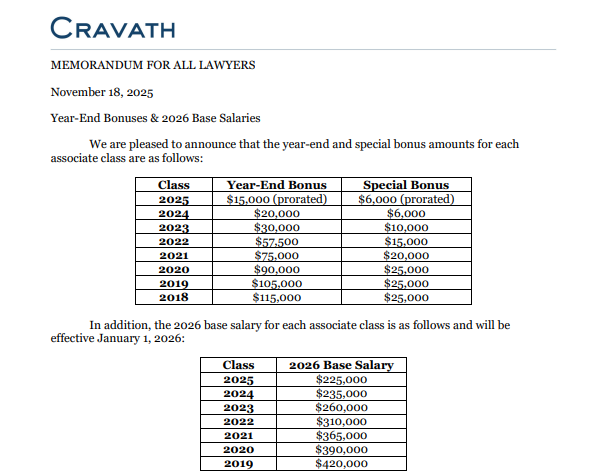
Imagine saying a law degree is a waste of money...
Yearly reminder about law school
- New big law class started out at $225k/yr. base
- 5th year associates making ~$500k/yr.
- No bonus variability
- All cash
BREAKING: Andrew Ross Sorkin challenges GameStop CEO Ryan Cohen on how the company plans to finance the $56B eBay acquisition, claiming the math doesn’t add up.
Cohen appears unamused by the questions and simply says 50/50 cash and stock.
A junior associate informed me she has a "hard stop" at 5 PM on Fridays.
She said she needs the weekend to protect her peace and maintain her energy.
I told her I completely respect her commitment to boundary setting.
I then removed her from the M&A deal she'd spent two months diligence-ing.
She came to my office on Monday confused as to why her access was revoked.
I explained that a closed deal requires momentum, not a pause button.
She asked how she was supposed to hit her billable requirement now.
I suggested she use all that extra weekend energy to find a new practice area.
Peace is a wonderful concept for people who don't practice corporate law.
The rest of us find our tranquility in a signed signature page.
Had a Jane Street interview in 2013 that still bothers me.
It was my 6th round. Final interview. The guy walks in carrying no laptop, no notebook, just a cold brew and what I later realized was a single IKEA tea candle.
He writes on the whiteboard:
food: $200
rent: $800
utilities: $150
candles: $3,600
family: dying
Then he turns around and says, “Optimize.”
I laughed because I thought it was a culture-fit bit. He did not laugh.
So I said, “Well, obviously you spend less on candles.”
He says, “Assume candles are non-discretionary.”
Okay.
I start building a model. Basic constraint satisfaction. Family survival as a soft penalty. Candles as a state variable. Maybe there’s an arbitrage where you buy wholesale paraffin and convert the $3,600 line item into inventory.
He stops me.
“You’re thinking like a consultant.”
That’s when I knew I was in trouble.
He says, “Give me a bid-ask on family dying.”
I say, “What?”
He says, “You’re long candles, short family. Where do you make markets?”
I try to recover. I say the real issue is liquidity: rent and utilities are fixed, food is elastic, candles are emotionally inelastic. Therefore the optimal strategy is to securitize future candle enjoyment and borrow against it.
He nods for the first time.
Then he asks, “What time do you sell the candles?”
I say, “Whenever the market is liquid?”
He says, “Be more specific.”
I say, “Uh… 10 a.m. Eastern?”
For the first time, he smiles.
He goes, “Every day?”
I say, “Every day.”
He says, “In size?”
I say, “In size.”
He says, “And what do we call that?”
I say, “Market manipulation?”
The room gets very quiet.
He looks disappointed and writes something down.
“No. We call it providing liquidity to candle ETFs during the U.S. cash open.”
I try to save it. “Right. Of course. The family isn’t dying because we underfunded them. They’re just experiencing temporary price discovery.”
He nods again.
Then he points back at the board.
I had missed it. The utility bill was $150, but candles provide light. You can zero out utilities.
I update the budget:
food: $200
rent: $800
utilities: $0
candles: $3,750
family: still dying, but now in a more capital-efficient way
He says, “How confident are you?”
I say, “0.95.”
He smiles and circles candles.
“0.95 huh?”
Then he asks me to estimate how many leveraged longs get liquidated if we dump $3,750 of candles at 10:00:01 every morning for 90 consecutive trading days.
Needless to say I did not get the offer.
They do not ring a bell at the top, but this is starting to get loud
Some things we have seen in the last few months:
- CEO of the largest company in the world signs autographs on women's boobs
- A failed consumer company added AI to its name and increased 700% in one day (dot-com bubble, anyone?)
- Space exploration company will go public at $2T valuation or 100x+ sales
- Multi-layer SPVs to get access to hot private deals
- S&P is trading at highest valuation in history
- Next 10 year expected returns are 0%
- Highest market concentration in history, ever
- Explosion in leveraged ETF adoption