1994….
This photo was taken during a VO₂max test when I was a young competitive cyclist and a physiology student at Colorado State University.
My VO₂max was 76.7 mL·kg⁻¹·min⁻¹ 🤘😊
Back then, VO₂max was the number. The holy grail of endurance performance.
But something didn’t add up. With such a high a VO₂max, I should have made it to the Tour de France... Clearly, there was another layer that VO₂max and physiology back then couldn’t explain.
That question changed my life. It led me to follow the work of Dr. George Brooks and into the fascinating world of lactate metabolism, muscle bioenergetics, mitochondrial function, pyruvate oxidation and metabolic flexibility…
32 years later, my questions are no longer about how much oxygen the body can consume, but about muscle bioenergetics and metabolic equilibrium. I’ve been incredibly fortunate to contribute to this field and to have worked alongside my longtime scientific idol, Dr. Brooks.
Ironically, VO₂max has recently re-emerged as one of the hottest topics in health and longevity.
But after spending 3 decades studying metabolism in sports performance and disease, I’ve come to see VO₂max not as the destination, but as the beginning of the story.
The real story starts inside the cell, inside mitochondria…
A through provoking article by @doctorinigo
Rethinking Exercise Metabolism: From "Aerobic vs. Anaerobic" to Metabolic Equilibrium https://t.co/pmlHd7anjK
Joel Jamieson did everything right and was still walking around with a 50% blockage in his widowmaker artery.
He’s a world-renowned cardiovascular expert who doesn't smoke, doesn't drink, sleeps well, manages stress, trains consistently, and has a VO2 max probably north of 55. He got screened at 40 and found it. He had zero symptoms the entire time.
This is the core problem with cardiovascular disease in well-trained individuals — it doesn't announce itself the way we expect it to. The markers we typically use to flag risk don't apply. No excess body weight, no poor lifestyle habits, no reason to think anything is wrong.
What actually predicted Joel's risk was his family history. His mom had a stroke at 60. His dad and uncle died early. His brother had a triple bypass before 50. Every signal was there, just not one he could feel.
If that kind of history exists in your family, get screened. The CT angiogram runs around $1,200 out of pocket — not cheap, and hopefully that comes down over time. But if you can justify it, it's worth it.
Introducing the @digg CLI with a Claude Code Skill, OpenClaw Skill and Hermes Skill made with @ppressdev. I am loving using the CLI to use the new Digg. Thanks @kevinrose@addison@JustinMezzell https://t.co/OsAOajkHSR
Introducing the Printing Press, a CLI-factory and a CLI-library. Built with @trevin. 🏭🖨📚
Most APIs suck for agents. Most MCPs suck for agents. Most official CLIs suck for agents. They waste tokens and time. @steipete started making his own because of this.
📚 A Library of agent-native CLIs you install today (Linear, ESPN, Flight GOAT (Google Flights + Kayak nonstop), Contact Goat (LinkedIn + Happenstance + Deepline more) +30+ more)
🏭 A factory that prints new ones for any service - just type /printing-press <product name>
CLIs are fast, local, SQLite-backed. Work in Claude Code, Codex, OpenClaw, Hermes.
🌐 https://t.co/GjnN9E9yTH
“The Senate needs to be less like Instagram. The Senate needs to be more deliberative. And that means less smack-down nonsense,” says former Republican Sen. Ben Sasse. https://t.co/kg2uyqkOzR
“We’ve never lived in a world where 22-year-olds couldn’t assume that the work they did they would be able to do until death or retirement, and we’re never going to have that world again,” says former Nebraska Sen. Ben Sasse.
Despite what you see online by so-called speed gurus who train kids like adults, young athletes do not need sprint technique training.
Early on, speed isn’t about mechanics—
it’s about building movement capacity.
Kids need variety, diversity, and novelty of movement, not repetition of ideal form.
This develops:
Coordination
Timing
Rhythm
Spatial awareness
Adaptability
Many sports and game-based activities require children to run using unorthodox, variable patterns.
Over-coaching technique narrows solutions.
Expanding the environment builds capability.
Skip the drills.
Use:
Games
Races
Hills
Resistance
Reactive work
Kids’ bodies are constantly changing, growing, and reorganizing.
There is no single “perfect” sprint pattern.
Expose them to more. Not less.
Technique isn’t forced—
it emerges.
Build the athlete first. Refine later. #LTAD
If you make Power BI reports, I think you might enjoy stepping outside of Power BI to experiment with coding agents and dataviz libraries like Vega, Altair, or d3.js. Here's an example of a dashboard I made with FitBit data.
While making the pbir-cli (testing starts this week, thanks to everyone who showed interest!), we learned a lot. Chiefly: we've found it's really, really hard to get an agent to work well with Power BI reports!!
Power BI reports are built around abstraction and different intersecting layers. Themes, metadata, extensions, the model... all of it built for a low-code SSBI experience (clicky-clicky-draggy-droppy). That's fine for you and me (mostly). For a coding agent, though, it's inflexible... maybe even hostile. Even with the right tools and context, you simply can't get a Power BI report to reliably do _exactly_ what you want; it's just not meant for that. If you experiment a bit with Vega, Altair, or d3.js... you'll see what I mean; the contrast is pretty clear.
This isn't necessarily a bad thing; unlimited flexibility may lead to inconsistency, and there's creativity in constraints. But still, I've been wanting to explore visualization without these constraints...
My experiments beyond Power BI reports have been interesting and given me a lot to think about. The most promising approach so far: viz-as-code with custom embedded visuals, pulling from local or remote data sources. This stepcount dashboard is one such example... made in just a few hours between other tasks. Materializing a dashboard like this from natural language wasn't really viable a year ago. Project out another 12–18 months and it's certainly difficult to imagine what the future looks like...
That said, reports and dashboards in an enterprise context aren't just visuals. Governance, distribution, integration, etc... years of individual and organizational investment. All of that makes change have a speed limit; we won't be plugging in custom embedded dashboards, overnight.
But if you're curious, I do think it's a good investment to step outside Power BI and experiment. Investments you may even be turned into custom visual designs, anyway :). As @HavensBI put it recently to me: it's time to multiclass...
Next Bay Area Coaches Network Meeting | Thursday · March 12
Free, open to anyone interested in better coaching - Join Us
📷 6:00 PM
📷 Crystal Springs Uplands School
Hillsborough, CA
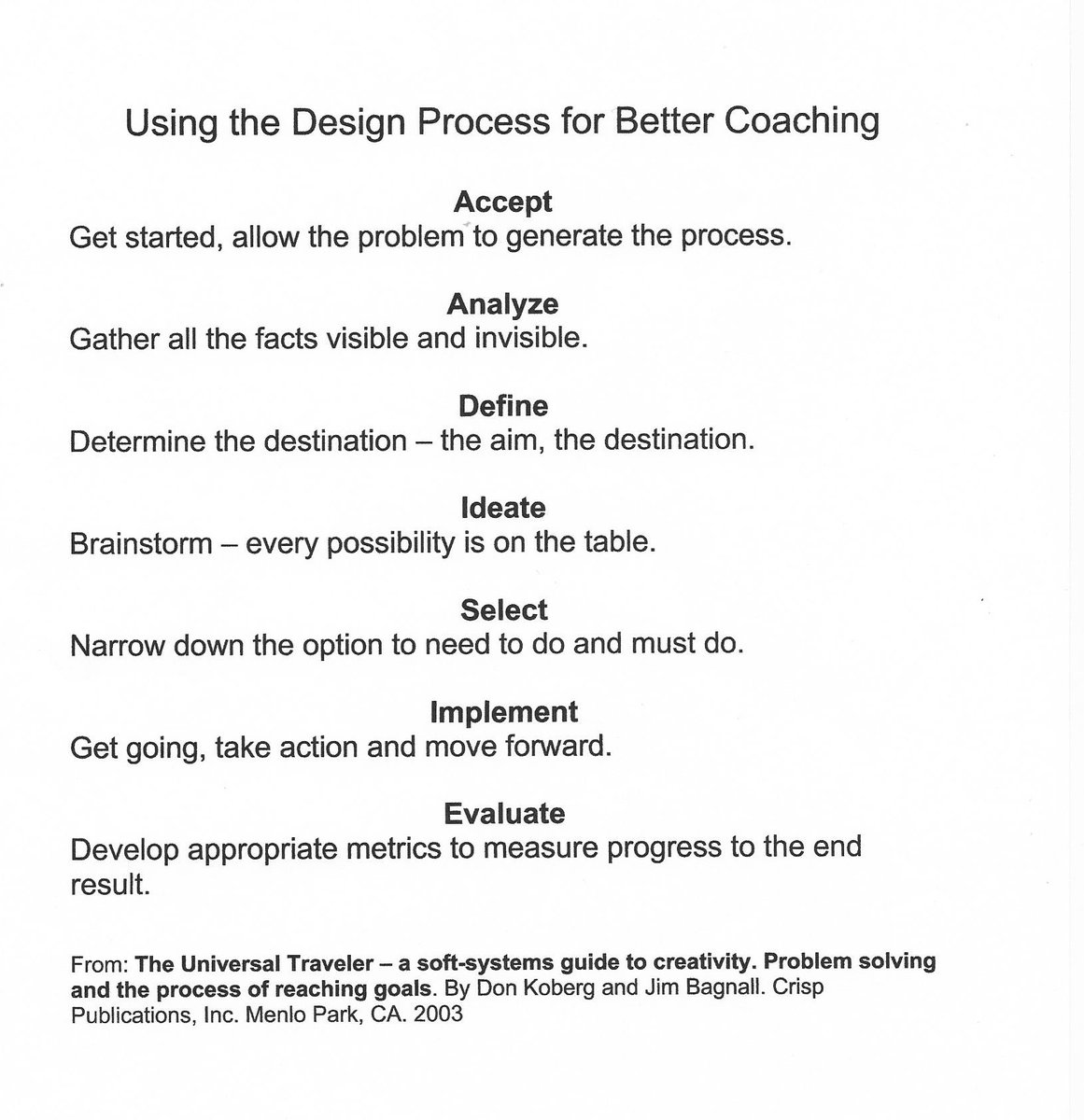
Vern Gambetta will present on Using the Design Process for better Coaching.
Going Founder Mode On Cancer
https://t.co/vAqXIV5zvE
Sid Sijbrandij is a generational founder. He founded and led GitLab, one of the largest remote companies in the world, from idea-stage startup to NASDAQ-listed software giant.
But in 2022, a six centimeter mass growing from his upper spine threatened to end all of that. He had cancer.
What happened next is nothing short of remarkable. Sid went founder mode on his care journey. In the years since, he's deployed cutting-edge genomics to profile his disease. Based on this data, he's developed a growing armamentarium of personalized therapies.
As a result, his disease is now undetectable.
A simplistic version of this story could be, “Wow! A brilliant billionaire seemingly cured his cancer. Good for him!”
But as I’ve gotten to know Sid, it’s become abundantly clear to me that there is more to the story than that.
In an in-depth profile for The Century of Biology, I explore Sid's journey and what this might mean for the future of cancer care.