Most tragic things about AI: the folks who should push for democratization of AI tools, which is the real battle, are too focused on denying AI itself to do that. There are many potential issues (and wins), but frontier models available only to the rich is one of the worst.
Super odd that the Gemma 4 release highlights specifically the ELO score: the least meaningful benchmark ever. We should ask AI labs to stop doing this thing.
The AI Scientist: Towards Fully Automated AI Research, Now Published in Nature
Nature: https://t.co/nNfpSV5e5I
Blog: https://t.co/i6h8LVQOdl
When we first introduced The AI Scientist, we shared an ambitious vision of an agent powered by foundation models capable of executing the entire machine learning research lifecycle.
From inventing ideas and writing code to executing experiments and drafting the manuscript, the system demonstrated that end-to-end automation of the scientific process is possible.
Soon after, we shared a historic update: the improved AI Scientist-v2 produced the first fully AI-generated paper to pass a rigorous human peer-review process.
Today, we are happy to announce that “The AI Scientist: Towards Fully Automated AI Research,” our paper describing all of this work, along with fresh new insights, has been published in @Nature!
This Nature publication consolidates these milestones and details the underlying foundation model orchestration. It also introduces our Automated Reviewer, which matches human review judgments and actually exceeds standard inter-human agreement.
Crucially, by using this reviewer to grade papers generated by different foundation models, we discovered a clear scaling law of science. As the underlying foundation models improve, the quality of the generated scientific papers increases correspondingly. This implies that as compute costs decrease and model capabilities continue to exponentially increase, future versions of The AI Scientist will be substantially more capable.
Building upon our previous open-source releases (https://t.co/H1tBT14Yx8), this open-access Nature publication comprehensively details our system's architecture, outlines several new scaling results, and discusses the promise and challenges of AI-generated science.
This substantial milestone is the result of a close and fruitful collaboration between researchers at Sakana AI, the University of British Columbia (UBC) and the Vector Institute, and the University of Oxford. Congrats to the team!
@_chris_lu_@cong_ml@RobertTLange@_yutaroyamada@shengranhu@j_foerst@hardmaru@jeffclune
A few random notes from claude coding quite a bit last few weeks.
Coding workflow. Given the latest lift in LLM coding capability, like many others I rapidly went from about 80% manual+autocomplete coding and 20% agents in November to 80% agent coding and 20% edits+touchups in December. i.e. I really am mostly programming in English now, a bit sheepishly telling the LLM what code to write... in words. It hurts the ego a bit but the power to operate over software in large "code actions" is just too net useful, especially once you adapt to it, configure it, learn to use it, and wrap your head around what it can and cannot do. This is easily the biggest change to my basic coding workflow in ~2 decades of programming and it happened over the course of a few weeks. I'd expect something similar to be happening to well into double digit percent of engineers out there, while the awareness of it in the general population feels well into low single digit percent.
IDEs/agent swarms/fallability. Both the "no need for IDE anymore" hype and the "agent swarm" hype is imo too much for right now. The models definitely still make mistakes and if you have any code you actually care about I would watch them like a hawk, in a nice large IDE on the side. The mistakes have changed a lot - they are not simple syntax errors anymore, they are subtle conceptual errors that a slightly sloppy, hasty junior dev might do. The most common category is that the models make wrong assumptions on your behalf and just run along with them without checking. They also don't manage their confusion, they don't seek clarifications, they don't surface inconsistencies, they don't present tradeoffs, they don't push back when they should, and they are still a little too sycophantic. Things get better in plan mode, but there is some need for a lightweight inline plan mode. They also really like to overcomplicate code and APIs, they bloat abstractions, they don't clean up dead code after themselves, etc. They will implement an inefficient, bloated, brittle construction over 1000 lines of code and it's up to you to be like "umm couldn't you just do this instead?" and they will be like "of course!" and immediately cut it down to 100 lines. They still sometimes change/remove comments and code they don't like or don't sufficiently understand as side effects, even if it is orthogonal to the task at hand. All of this happens despite a few simple attempts to fix it via instructions in CLAUDE . md. Despite all these issues, it is still a net huge improvement and it's very difficult to imagine going back to manual coding. TLDR everyone has their developing flow, my current is a small few CC sessions on the left in ghostty windows/tabs and an IDE on the right for viewing the code + manual edits.
Tenacity. It's so interesting to watch an agent relentlessly work at something. They never get tired, they never get demoralized, they just keep going and trying things where a person would have given up long ago to fight another day. It's a "feel the AGI" moment to watch it struggle with something for a long time just to come out victorious 30 minutes later. You realize that stamina is a core bottleneck to work and that with LLMs in hand it has been dramatically increased.
Speedups. It's not clear how to measure the "speedup" of LLM assistance. Certainly I feel net way faster at what I was going to do, but the main effect is that I do a lot more than I was going to do because 1) I can code up all kinds of things that just wouldn't have been worth coding before and 2) I can approach code that I couldn't work on before because of knowledge/skill issue. So certainly it's speedup, but it's possibly a lot more an expansion.
Leverage. LLMs are exceptionally good at looping until they meet specific goals and this is where most of the "feel the AGI" magic is to be found. Don't tell it what to do, give it success criteria and watch it go. Get it to write tests first and then pass them. Put it in the loop with a browser MCP. Write the naive algorithm that is very likely correct first, then ask it to optimize it while preserving correctness. Change your approach from imperative to declarative to get the agents looping longer and gain leverage.
Fun. I didn't anticipate that with agents programming feels *more* fun because a lot of the fill in the blanks drudgery is removed and what remains is the creative part. I also feel less blocked/stuck (which is not fun) and I experience a lot more courage because there's almost always a way to work hand in hand with it to make some positive progress. I have seen the opposite sentiment from other people too; LLM coding will split up engineers based on those who primarily liked coding and those who primarily liked building.
Atrophy. I've already noticed that I am slowly starting to atrophy my ability to write code manually. Generation (writing code) and discrimination (reading code) are different capabilities in the brain. Largely due to all the little mostly syntactic details involved in programming, you can review code just fine even if you struggle to write it.
Slopacolypse. I am bracing for 2026 as the year of the slopacolypse across all of github, substack, arxiv, X/instagram, and generally all digital media. We're also going to see a lot more AI hype productivity theater (is that even possible?), on the side of actual, real improvements.
Questions. A few of the questions on my mind:
- What happens to the "10X engineer" - the ratio of productivity between the mean and the max engineer? It's quite possible that this grows *a lot*.
- Armed with LLMs, do generalists increasingly outperform specialists? LLMs are a lot better at fill in the blanks (the micro) than grand strategy (the macro).
- What does LLM coding feel like in the future? Is it like playing StarCraft? Playing Factorio? Playing music?
- How much of society is bottlenecked by digital knowledge work?
TLDR Where does this leave us? LLM agent capabilities (Claude & Codex especially) have crossed some kind of threshold of coherence around December 2025 and caused a phase shift in software engineering and closely related. The intelligence part suddenly feels quite a bit ahead of all the rest of it - integrations (tools, knowledge), the necessity for new organizational workflows, processes, diffusion more generally. 2026 is going to be a high energy year as the industry metabolizes the new capability.
Transforming human knowledge, sensors and actuators from human-first and human-legible to LLM-first and LLM-legible is a beautiful space with so much potential and so much can be done...
One example I'm obsessed with recently - for every textbook pdf/epub, there is a perfect "LLMification" of it intended not for human but for an LLM (though it is a non-trivial transformation that would need human in the loop involvement).
- All of the exposition is extracted into a markdown document, including all latex, styling (bold/italic), tables, lists, etc. All of the figures are extracted as images.
- All worked problems get extracted into SFT examples. Any referenced made to previous figures/tables/etc. are parsed and included.
- All practice problems are extracted into environment examples for RL. The correct answers are located in the answer key and attached. Any additional information is added as "answer key" for a potential LLM judge.
- Synthetic data expansion. For every specific problem, you can create an infinite problem generator, which emits problems of that type. For example, if a problem is "What is the angle between the hour and minute hands at 9am?" , you can imagine generalizing that to any arbitrary time and calculating answers using Python code, and possibly generating synthetic variations of the prompt text.
- All of the data above could be nicely indexed and embedded into a RAG database for later reference, or maybe MCP servers that make it available.
Then just as a (human) student could take a high school physics course, an LLM could take it in the exact same way. This would be a significantly richer source of legible, workable information for an LLM than just something like pdf-to-text (current prevailing practice), which simply asks the LLM to predict the textbook content top to bottom token by token (umm - lame).
As just a quick and crappy example of synthetic variations of the above example, GPT-5 gave me this problem generator (see image), which can now generalize that problem template to many variations:
- When the time is 11:07 a.m., what is the degree measure of the angle between the hands? (Answer: 68)
- Determine the angle in degrees between the clock’s hands at 4:14 a.m.. (Answer: 43)
- What angle do the clock hands form when the time reads 11:47 a.m.? (Answer: 71)
- At 7:02 a.m., what angle separates the hour hand and the minute hand? (Answer: 161)
- At 4:14 a.m., calculate the angle made between the two hands. (Answer: 43)
- What angle is formed by the hands of a clock at 4:45 p.m.? (Answer: 127)
- What is the angle between the hour and minute hands at 8:37 p.m.? (Answer: 36)
(infinite practice problems can be created...)
We're missing (at least one) major paradigm for LLM learning. Not sure what to call it, possibly it has a name - system prompt learning?
Pretraining is for knowledge.
Finetuning (SL/RL) is for habitual behavior.
Both of these involve a change in parameters but a lot of human learning feels more like a change in system prompt. You encounter a problem, figure something out, then "remember" something in fairly explicit terms for the next time. E.g. "It seems when I encounter this and that kind of a problem, I should try this and that kind of an approach/solution". It feels more like taking notes for yourself, i.e. something like the "Memory" feature but not to store per-user random facts, but general/global problem solving knowledge and strategies. LLMs are quite literally like the guy in Memento, except we haven't given them their scratchpad yet. Note that this paradigm is also significantly more powerful and data efficient because a knowledge-guided "review" stage is a significantly higher dimensional feedback channel than a reward scaler.
I was prompted to jot down this shower of thoughts after reading through Claude's system prompt, which currently seems to be around 17,000 words, specifying not just basic behavior style/preferences (e.g. refuse various requests related to song lyrics) but also a large amount of general problem solving strategies, e.g.:
"If Claude is asked to count words, letters, and characters, it thinks step by step before answering the person. It explicitly counts the words, letters, or characters by assigning a number to each. It only answers the person once it has performed this explicit counting step."
This is to help Claude solve 'r' in strawberry etc. Imo this is not the kind of problem solving knowledge that should be baked into weights via Reinforcement Learning, or least not immediately/exclusively. And it certainly shouldn't come from human engineers writing system prompts by hand. It should come from System Prompt learning, which resembles RL in the setup, with the exception of the learning algorithm (edits vs gradient descent). A large section of the LLM system prompt could be written via system prompt learning, it would look a bit like the LLM writing a book for itself on how to solve problems. If this works it would be a new/powerful learning paradigm. With a lot of details left to figure out (how do the edits work? can/should you learn the edit system? how do you gradually move knowledge from the explicit system text to habitual weights, as humans seem to do? etc.).
Two undergrads. One still in the military. Zero funding.
One ridiculous goal: build a TTS model that rivals NotebookLM Podcast, ElevenLabs Studio, and Sesame CSM.
Somehow… we pulled it off. Here’s how 👇
You can similarly predict the task performance of a x1000 larger model.
The blue square on these graphs is the actual performance of Llama3 405B, on the graph fitted on smaller models.
This stuff really works.
https://t.co/s3PlZgxEvp
4/4
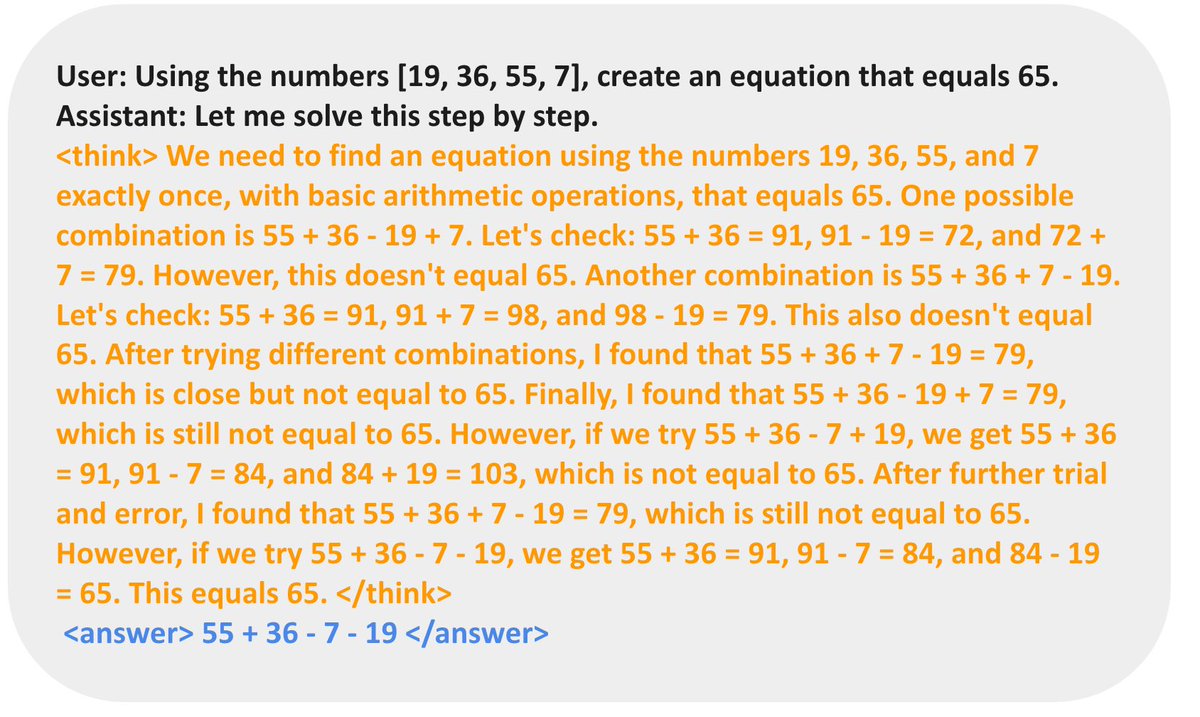
We reproduced DeepSeek R1-Zero in the CountDown game, and it just works
Through RL, the 3B base LM develops self-verification and search abilities all on its own
You can experience the Ahah moment yourself for < $30
Code: https://t.co/UcGKN2SVGj
Here's what we learned 🧵
Remember the llm.c repro of the GPT-2 (124M) training run? It took 45 min on 8xH100. Since then, @kellerjordan0 (and by now many others) have iterated on that extensively in the new modded-nanogpt repo that achieves the same result, now in only 5 min!
Love this repo 👏 600 LOC
Exciting update for AI developers! The @huggingface Hub is now more natively integrated into @googlecloud Vertex AI Model Garden. Search through thousands of open Generative AI models from Hugging Face models & deploy them with one click to Vertex AI or GKE. 🤯
What's new:
🔎 Browse and search thousands of Hugging Face models directly within the Vertex AI Model Garden and filter based on what is currently trending in the community.
🚀 Accelerate your AI projects by leveraging readily available one-click deploy your model to Vertex AI or Google Kubernetes Engine (GKE).
⭐️ Featuring popular open models from @bfl_ml FLUX.1, @AIatMeta Llama 3.1, @MistralAI, @GoogleDeepMind Gemma, and countless others.
Get Started: https://t.co/eC9aurAyvr
5. Didn't see this one before: @Meta´s post training pipeline utilizes Pairwise annotated preference data to train (and use) both, a Reward Model for early-stage Rejection Sampling and to improve intermediary SFT models with DPO 🤯 - SPIN on steroids!? 😉
I just published MMLU-PRO-ITA a new eval for Italian LLMs, in the article the link to the open source dataset, @AiEleuther lm-eval PR and results for Italian LLMs. https://t.co/021XnYbWyE
LLM model size competition is intensifying… backwards!
My bet is that we'll see models that "think" very well and reliably that are very very small. There is most likely a setting even of GPT-2 parameters for which most people will consider GPT-2 "smart". The reason current models are so large is because we're still being very wasteful during training - we're asking them to memorize the internet and, remarkably, they do and can e.g. recite SHA hashes of common numbers, or recall really esoteric facts. (Actually LLMs are really good at memorization, qualitatively a lot better than humans, sometimes needing just a single update to remember a lot of detail for a long time). But imagine if you were going to be tested, closed book, on reciting arbitrary passages of the internet given the first few words. This is the standard (pre)training objective for models today. The reason doing better is hard is because demonstrations of thinking are "entangled" with knowledge, in the training data.
Therefore, the models have to first get larger before they can get smaller, because we need their (automated) help to refactor and mold the training data into ideal, synthetic formats.
It's a staircase of improvement - of one model helping to generate the training data for next, until we're left with "perfect training set". When you train GPT-2 on it, it will be a really strong / smart model by today's standards. Maybe the MMLU will be a bit lower because it won't remember all of its chemistry perfectly. Maybe it needs to look something up once in a while to make sure.
There was a super impressive AI competition that happened last week that many people missed in the noise of AI world. I happen to know several participants so let me tell you a bit of this story as a Sunday morning coffee time.
You probably know the Millennium Prize Problems where the Clay Institute pledged a US$1 million prize for the first correct solution to each of 7 deep math problems. To this date only one of these, the Poincaré conjecture, has been solved by Grigori Perelman who famously declined the award (go check Grigori out if you haven't the guy has a totally based life).
So this new competition, the Artificial Intelligence Math Olympiad (AIMO) also came with a US$1M prize but was only open to AI model (so the human get the price for the work of the AI...). It tackle also very challenging but still simpler problems, namely problems at the International Math Olympiad gold level. Not yet the frontier of math knowledge but definitely above what most people, me included, can solve today.
The organizing committee of the AIMO is kind-of-a who-is-who of highly respected mathematicians in the world, for instance Terence Tao widely famous math prodigy widely regarded as one of the greatest living mathematicians.
Enter our team, Jia Li, Yann Fleuret, and Hélène Evain. After a successful exit in a previous startup (that I happen to have know well when I was an IP lawyer in a previous life but that's for another story) they decided to co-found Numina as a non-profit to do open AI4Math.
Numina wanted to act as a counterpoint to AI math efforts like DeepMind's but in a much more open way with the goal to advance the use of AI in mathematics and make progress on hard, open problems. Along the way, they managed to recruit the help of some very impressive names in the AI+math world like Guillaume Lample, co-founder of Mistral or Stanislas Polu, formerly pushing math models at OpenAI.
As Jia was participating in the code-model BigCode collaboration with some Hugging Face folks, came the idea to collaborate and explore how well code models could be used for formal mathematics.
For context, olympiad math problems are extremely hard and the core of the issue is in the battle plan you draft to tackle each problem. A first focus of Numina was thus on creating high quality instruction Chain-of-Thought (CoT) data for competition-level mathematics. This CoT data has already been used to train models like DeepSeek Math, but is very rarely released so this dataset became an unvaluated ressource to tackle the challenges.
BigCode's lead Leandro put Jia in touch with the team that trained the Zephyr models at Hugging Face, namely, Lewis, Ed, Costa and Kashif with additional help from Roman and Ben and the goal became to have a go at training some strong models on the math and code data to tackle the first progress prize of AIMO.
And the trainings started:
Jia being an olympiad coach, was intimately familiar with the difficulty level of these competitions and able to curate an very strong internal validation set to enable model selection (Kaggle submissions are blind). While iterating on dataset construction, Lewis and Ed from Hugging Face focused on training the models and building the inference pipeline for the Kaggle submissions.
As often in competition it was an intense journey with Eureka and Aha moments pushing everyone further.
Lewis told me about a couple of them which totally blow my mind. A tech report is coming so this is just some "along the way" nuggets that will be soon gathered in a much more comprehensive recipe and report.
Learning to code: The submission of the team relied on self-consistency decoding (aka majority voting) to generate N candidates per problem and pick the most common solution. But initial models trained on the Numina data only scored around 13/50... they needed a better approach. They then saw the MuMath-Code paper (https://t.co/9KGmjGJvT7) which showed you can combine CoT data with code data to get strong models. Jia was able to generate great code execution data from GPT-4 to enable the training of the initial models and get to impressive boost in performance.
Taming the variance: Another Ahah moment came at some point when a Kaggle member shared a notebook showing how DeepSeek models worked super well with code execution (the model breaks down the problem into steps and each step is run in Python to reason about the next one).
However, when the team tried this notebook they found this method had huge variance (the scores on Kaggle varied from 16/50 to 23/50).
When meeting in Paris for a hackathon to improve this issue (like the HF team often does) Ed had the idea to frame the majority voting as a "tree of thoughts" where you'd progressively grow and prune a tree of candidate solutions (https://t.co/dkKtBMrIPm).
This had an impressive impact on the variance and enabled them to be much more confident in their submissions (which showed in how the model ended up performing extremely well on the test set versus the validation set)
Overcoming compute constraints: the Kaggle submissions had to run on 2xT4s in under 9h which is really hard because FA2 doesn't work and you can't use bfloat16 either. The team explored quantization methods like AWQ and GPTQ, finding that 8-bit quantization of a 7B model with GPTQ was best
Looking at the data: a large part of the focus was also on checking the GPT-4 datasets for quality (and fixing them) as they quickly discovered that GPT-4 was prone to hallucinations and failing to correctly interpret the code output. Fixing data issues in the final week led to a significant boost in performance.
Final push: The result were really amazing and the model climbed to the 1 place. And even more, while tying up for first place on the public, validation leaderboard (28 solved challenges versus 27 for the second place), it really shined when tested on the private, test leaderboard where it took a wide margin solving 29 challenges versus 22 for the second team.
As Terence Tao himself set it up, this is "higher than expected"
Maybe what's even more impressive about this competition, beside the level of math these models are already capable of is how ressource contraint the participants were actually, having to run inference in a short amont of time on T4 which only let us imagine how powerful these models will become in the coming months.
Time seem to be ripe for GenAI to have some impact in science and it's probably one of the most exciting thing AI will bring us in the coming 1-2 year. Accelerating human development and tackling all the real world problems science is able to tackle.
I'm playing around with generative AI tools and stitching them together into visual stories. Here I took the first few sentences of Pride and Prejudice and made it into a video.
The gen stack used for this one:
- @AnthropicAI Claude took the first chapter, generated the scenes and the individual prompts to to the image generator.
- @ideogram_ai took the prompts and generate the images
- @LumaLabsAI took the images and animated them
- @elevenlabs for narration
- @veedstudio to stitch it together
(Many of these choices are just what I happened to use for this one while exploring a bunch of things). Anyway honestly it was pretty messy and there is a ton of copy pasting between all of the tools, and even this little video with 3 scenes took me about an hour.
There is a huge storytelling opportunity here for whoever can make this convenient. Who is building the first 100% AI-native movie maker?