Officially from INDIAN IITs 🇮🇳
No fees. No entrance exam. No catch.
Here are 19 courses that are better than most paid bootcamps:
1. Artificial Intelligence: Foundations and Algorithms
🔗 https://t.co/oSYHBy2CAo
2. Introduction to Large Language Models (LLMs)
🔗 https://t.co/cb50yjV59U
3. Digital Marketing in the AI era
🔗 https://t.co/cY4BAnSMKI
4. Ethical Hacking
🔗 https://t.co/Vt6zK7tKzl
5. Generative AI for Computer Vision
🔗 https://t.co/GoFZOqhaOm
6. Cloud Computing
🔗 https://t.co/s3eKQ4kO5I
7. Data Science for Engineers
🔗 https://t.co/bc2P6F5Jsd
8. Computer Vision
🔗 https://t.co/sw0ODnKZkb
9. Cyber Security and Privacy
🔗 https://t.co/iqFHf8TPii
10. Corporate Finance
🔗 https://t.co/AMT78OsBlw
11. Database Management System
🔗 https://t.co/dFPgDFun9i
12. Data Structures and Algorithms using Java
🔗 https://t.co/X8UsoouHO6
13. Data Structures and Algorithms Design
🔗 https://t.co/kuixtbaTCD
14. Introduction To Operating Systems
🔗https://t.co/yq2e4gr2S9
15. Natural Language Processing
🔗https://t.co/NW57eofXXt
16. Programming In Java
🔗https://t.co/OAyT6kLYAz
17. Programming in Modern C++
🔗https://t.co/0E3lquqUpM
18. Programming with Generative AI
🔗https://t.co/MItYoWr2bF
19. Python for Data Science
🔗https://t.co/mCcMpCOsA3
Software horror: litellm PyPI supply chain attack.
Simple `pip install litellm` was enough to exfiltrate SSH keys, AWS/GCP/Azure creds, Kubernetes configs, git credentials, env vars (all your API keys), shell history, crypto wallets, SSL private keys, CI/CD secrets, database passwords.
LiteLLM itself has 97 million downloads per month which is already terrible, but much worse, the contagion spreads to any project that depends on litellm. For example, if you did `pip install dspy` (which depended on litellm>=1.64.0), you'd also be pwnd. Same for any other large project that depended on litellm.
Afaict the poisoned version was up for only less than ~1 hour. The attack had a bug which led to its discovery - Callum McMahon was using an MCP plugin inside Cursor that pulled in litellm as a transitive dependency. When litellm 1.82.8 installed, their machine ran out of RAM and crashed. So if the attacker didn't vibe code this attack it could have been undetected for many days or weeks.
Supply chain attacks like this are basically the scariest thing imaginable in modern software. Every time you install any depedency you could be pulling in a poisoned package anywhere deep inside its entire depedency tree. This is especially risky with large projects that might have lots and lots of dependencies. The credentials that do get stolen in each attack can then be used to take over more accounts and compromise more packages.
Classical software engineering would have you believe that dependencies are good (we're building pyramids from bricks), but imo this has to be re-evaluated, and it's why I've been so growingly averse to them, preferring to use LLMs to "yoink" functionality when it's simple enough and possible.
India is battling a silent epidemic. 71% of our deaths come from lifestyle diseases.
One IITian chose to fight it — not with pills or gyms, but with a ₹11-a-day habit that now helps 1.2 crore people across 169 countries show up for their health every single morning.
What began with 3 people on a Zoom call now sees 6 lakh people join daily — through a yoga class run on WhatsApp and YouTube.
This is how Saurabh Bothra built Habuild.
This is Naya Bharat — where Nayi Soch empowers every Indian to write their own story of health.
In partnership with @Kalaari — Championing India’s Trailblazing Founders
My biggest learnings from Jeanne DeWitt Grosser (ex-Chief Business Officer at @Stripe, now @Vercel COO):
1. What failed seven years ago now works with AI. In 2017, Jeanne tried to build a system at Stripe that would automatically personalize outbound emails based on company data. Despite working with world-class data scientists, it failed due to too many errors. Today, that exact same approach works. This shows how AI has made previously impossible ideas suddenly viable.
2. A single GTM engineer at Vercel reduced a 10-person sales team to 1 (in just 6 weeks). Jeanne’s team at Vercel had an engineer build an AI agent that handles inbound lead qualification, outbound prospecting, and deal loss evaluation. The agent costs $1,000 per year to run versus over $1 million in salaries for the sales team. The nine displaced team members moved to higher-value work rather than being laid off, and the remaining salesperson is 10 times more efficient.
3. Their AI deal-loss bot has become better at understanding what went wrong than humans. When Jeanne analyzed her biggest loss of the quarter, the salesperson blamed pricing. But an AI agent reviewed every email, call transcript, and Slack message and discovered the real reason: they never spoke to the person who controls the budget, and when ROI came up, the customer clearly didn’t believe the value claims. They are now using AI to analyze sales calls in real time and send alerts like “You’re halfway through the sales process and haven’t talked to a budget decision-maker yet.”
4. Wait until $1 million in revenue before hiring your first salesperson. Founders should continue selling themselves until they reach around $1 million in annual revenue with a repeatable process. The key is having a defined ideal customer profile—customers who look alike.
5. Segment customers on what drives their buying decisions, not just company size. OpenAI has roughly 3,000 employees, which would typically put them in the “mid-market” category. But they’re a top-25 website globally by traffic, so Vercel treats them as enterprise customers requiring complex sales. Effective segmentation combines company size with growth rate, web traffic, workload type, and industry—because selling to e-commerce companies requires completely different language than selling to crypto companies.
6. Most customers buy to avoid risk, not to gain opportunity. About 80% of customers purchase to reduce pain or avoid problems, while only 20% buy to increase upside. This means you should focus your sales messaging on what could go wrong without your product—like falling behind competitors or damaging their reputation—rather than just talking about exciting features. This is especially true when selling to larger companies, where individual careers are on the line.
7. Sales teams should be indistinguishable from product managers—for a bit. Jeanne hires salespeople who have such deep product knowledge that if you put one in front of a group of engineers, it should take 10 minutes to realize they’re not a product manager. This credibility allows sales teams to serve as an extension of research and development—a 20-person sales team talks to hundreds of customers weekly and can translate those conversations into product insights at scale.
8. Building your own AI sales tools may beat buying off-the-shelf software. Because AI is so new and every company’s sales process is unique, Jeanne finds that building custom internal agents often delivers more value than buying vendor solutions. A single go-to-market engineer built their deal analysis bot in just two days, perfectly tailored to their specific workflow. These engineers shadow top salespeople to understand their workflows, then build automation that would have taken months or been impossible just a few years ago.
9. Make every sales interaction great, whether customers buy or not. Jeanne replaced boring discovery calls at Stripe with collaborative whiteboarding sessions where customers drew their payment architecture. Many customers had never visualized their own systems before. They left with a useful asset and a feeling of collaboration, regardless of whether they bought. Many returned years later to purchase. Think about your go-to-market process like a product, not just a sales function.
10. Product-led growth has a ceiling—no $100 billion company runs on it alone. While product-led growth (where users can sign up and start using a product without talking to sales) works well for early growth, customers generally won’t spend a million dollars through a self-service flow. Every major technology company eventually builds a sales team for larger deals. The mistake is waiting too long, since building a predictable sales process takes time.
Realize your AI goals with Oracle Database 23ai. Learn about Agentic AI, Vector Search, App Dev, and the cool things users are doing today. Secure your spot now at https://t.co/B9kpyu45mL
Oracle Data Deep Dive at #AIWorld is bringing you the latest innovations in Oracle Database 23ai, highlighting how organizations are using its AI capabilities to improve productivity and gain smarter insights. See the sessions at https://t.co/qc3bov9VMX
Realize your AI goals with Oracle Database 23ai. Learn about Agentic AI, Vector Search, App Dev, and the cool things users are doing today. Secure your spot now at https://t.co/wwyKqcnKZJ
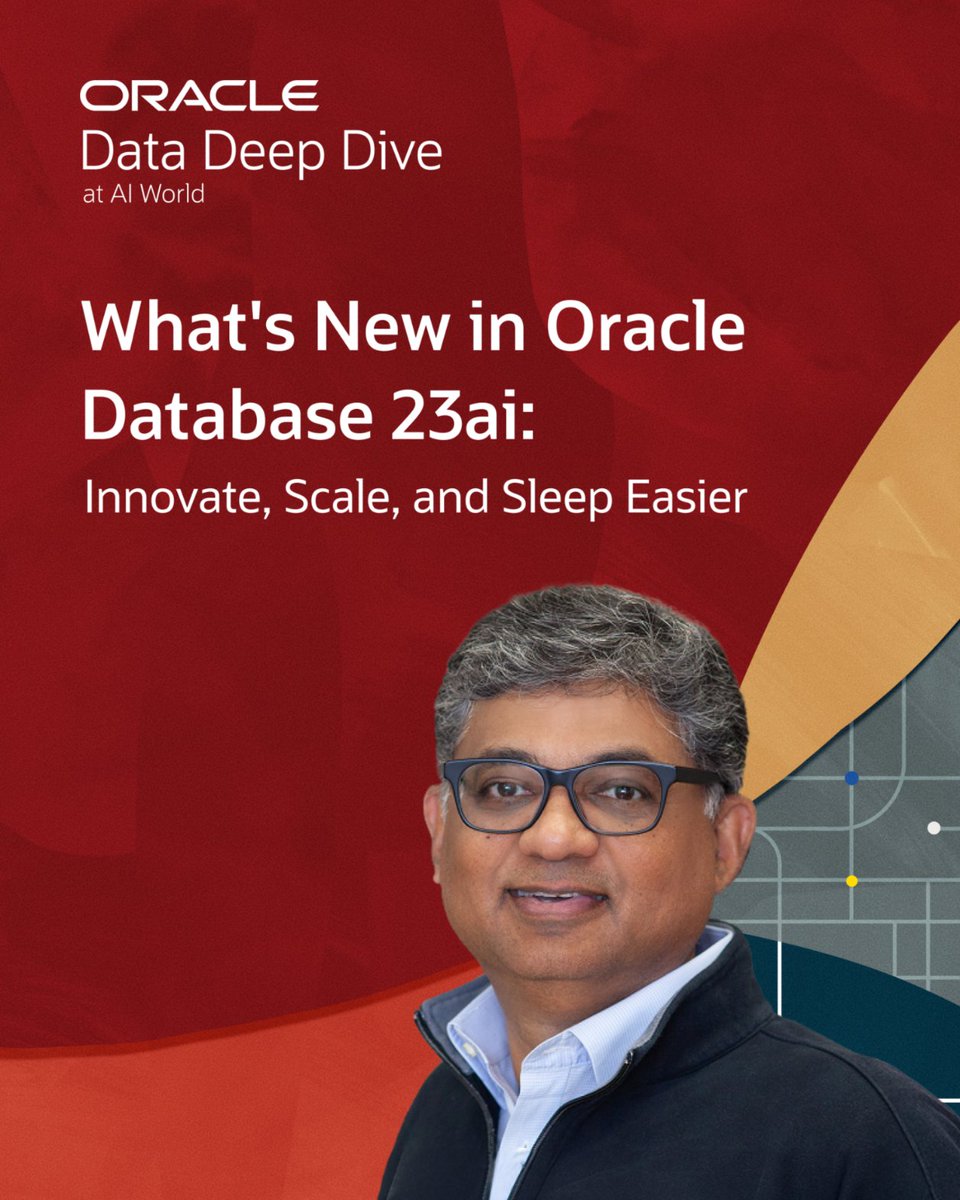
Catch Hasan Rizvi’s keynote at Oracle Data Deep Dive at #AIWorld to learn more about Oracle Database 23ai and how it can help you innovate faster with AI, scale smarter, and sleep easier. Learn more at https://t.co/pToE8JfI7n
Join the Globally Distributed Database team at Oracle Data Deep Dive at #AIWorld. Learn how to deploy always-on applications, increase performance, and implement petabyte-scale AI and analytics. See our must-attend session list and register today. https://t.co/hXqB2S2khH
The thing that often gets missed when thinking through the productivity gains that we’ll get from AI agents is all of the things that we’ll now be able to do that we didn’t do before.
The greatest upside of AI agents is not just that you automate what you already do. Agents will let you tackle work and add new practices that you never wouldn’t gotten around to.
In coding that may mean more testing, better security reviews, improved architectures, more features, and so on. But you can extrapolate this into all fields, whether it’s legal or finance or healthcare. The infinite abundance you get on knowledge work means so many areas of work become affordable now.
If we look at back at how we work in 5 years from now, I’d guess that 90% of the tokens generated by agents will be on things that we didn’t do before as people.
#Datasovereignty is a critical concern for many organizations. Oracle Globally Distributed Database is designed to help adhere to local requirements. https://t.co/BxngY54JqM